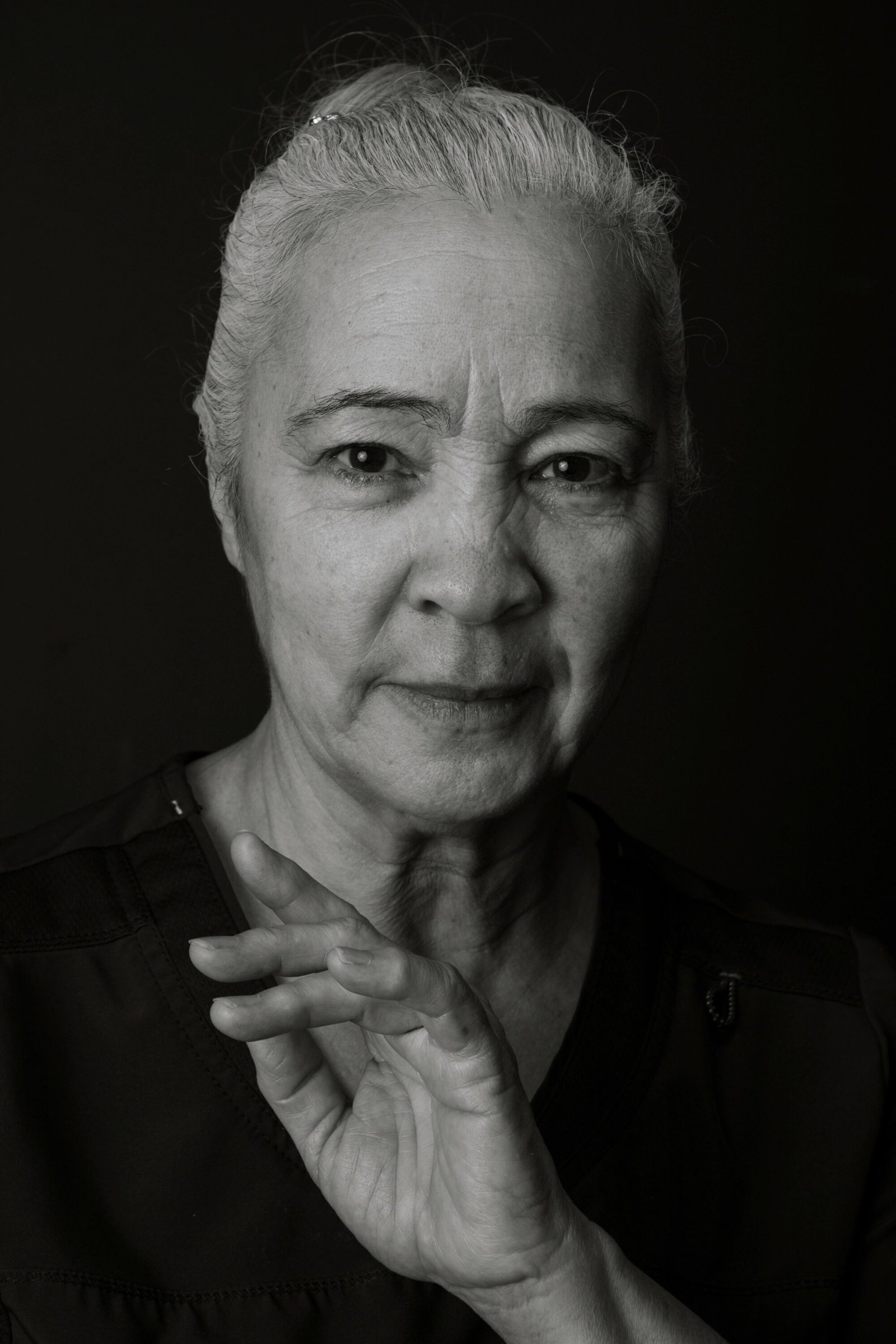
I founded NicheBlogLab to help entrepreneurs discover profitable opportunities through gap intelligence - systematic research that finds business potential in data gaps and market assumptions. When I’m not analyzing untapped niches, I’m a communications designer, editor and founder who’s also built and flipped digital properties.
Fayrooz
Culinary Nutrition Expert
Thinking about starting a blog in 2027 but don't have a particular hobby, specialist skill or exciting lifestyle to write about?
Here's an idea: what about cleaning?
Yes, cleaning. The everyday business of washing dishes, scrubbing bathrooms, organising cupboards, removing stains, doing laundry and keeping a home reasonably comfortable.
You might not even enjoy doing it. But if you maintain a household, chances are you've picked up a few tricks along the way.
What if that everyday knowledge could become the foundation of a niche blog?
You don't need to be a professional cleaner, a home organisation expert or someone with a passion for beautiful interiors. You simply need to have something useful to share and an interest in developing it.
And here's the interesting part: a cleaning blog can potentially become more than an online collection of household tips. It can develop into a publishing property with opportunities for advertising, affiliate marketing, sponsored content and digital products.
If you're considering starting a blog in 2027, let's explore why this is still a niche worth investigating.
Cleaning is an everyday activity with an everyday audience
Some blogging niches require you to have a specialist interest or spend considerable time developing knowledge before you can write confidently.
Cleaning is different.
Almost everyone who maintains a home has something to contribute to the subject.
You might know how to get stubborn grease off a kitchen surface, how to keep your bathroom smelling fresh or how to organise your laundry routine so that it doesn't take over your weekend.
These aren't necessarily extraordinary skills. They're practical solutions to everyday problems.
And that's precisely why people look for them.
Someone might search Google for how to clean a microwave, remove a coffee stain, organise a small kitchen or get rid of dust quickly.
They're not necessarily looking for an expert. They want someone to explain what works.
A cleaning blog gives you somewhere to collect and share that knowledge.
You can start with the things you already do and gradually expand into subjects you discover along the way.
Is there still room for new cleaning blogs in 2027?
You might wonder whether cleaning is too saturated a niche to enter.
There are certainly established cleaning websites, professional cleaning companies, lifestyle publications and thousands of individual bloggers covering household chores.
But competition doesn't automatically mean there is no room for another website.
Cleaning is a broad subject with numerous smaller areas that can become the focus of an individual blog.
Examples of people looking for cleaning content:
Cleaning for people living in small apartments.
Cleaning when you have young children.
Cleaning routines for busy working households.
Budget-friendly household cleaning.
Cleaning for people who dislike housework.
Laundry and clothing care.
Kitchen cleaning and food preparation hygiene.
Decluttering and household organisation.
Seasonal cleaning and household maintenance.
You don't have to compete with every cleaning website on the internet.
You can start by concentrating on a particular type of reader, household or cleaning challenge.
A blog about keeping a small apartment clean, for example, has a different perspective from one about managing a large family home.
The opportunity is in finding your particular angle and developing it.
Search engines continue to provide opportunities for websites that answer specific questions with genuinely useful content. Google's guidance emphasises helpful, original, people-first content rather than publishing articles simply to attract search traffic.
That means you should concentrate on sharing actual experience, useful explanations and information that helps someone complete a task.
You don't need to publish hundreds of generic cleaning tips. You need to give readers a reason to find your particular website useful.
And as we head into 2027, there's another consideration worth exploring: your local market.
If you're a South African blogger, for example, you can create content around products available in South Africa, local household challenges, pricing in rand and services that your readers can actually access.
You don't necessarily need to build an international audience to create a useful niche publication.
You don't need a special hobby to become a cleaning blogger
This is perhaps the most interesting part of the idea.
A lot of people believe they need an exciting lifestyle to become bloggers. They imagine travel bloggers, food enthusiasts, fashion lovers or people with interesting hobbies.
But what if your everyday life is your subject?
Consider someone who spends a considerable amount of time looking after a household. They might not have a particular hobby, but they know how to clean, organise, maintain and manage a home because they do it every day.
Why not turn that knowledge into something productive?
You could be:
A mom of twins: You understand the challenges of keeping a home reasonably clean while looking after two young children. You could write about laundry routines, toy organisation, cleaning around nap times and managing household chores with limited time.
A bored stay-at-home spouse: Perhaps your days revolve around household responsibilities, but you would like something intellectually stimulating to work on. A cleaning blog could give you a small publishing project of your own, with the possibility of earning money from it.
A busy working professional: You know what it's like to come home after a long day and still have a kitchen to clean, laundry to do and a household to maintain. Your blog could focus on realistic cleaning routines for people who don't have hours to spare.
Someone living alone: You might have developed practical ways of keeping a small living space clean without spending too much money or time. That's useful knowledge for other people in the same situation.
A naturally organised person: You enjoy figuring out where things belong, how to arrange cupboards and how to make household tasks more manageable. Your blog could explore the organisational side of cleaning.
Notice that none of these people needs to be a professional cleaner.
They simply have a perspective that someone else might find useful.
And that's what makes a niche interesting. It's not just the subject you choose, but the particular way you approach it.
What can you realistically write about?
You might be surprised by how many articles you can develop from ordinary household activities.
Start by looking at your own cleaning routine.
What do you clean every day? What do you clean once a week? Which tasks do you dislike? What have you discovered that makes a particular job easier?
Some examples of potential cleaning articles:
How to Clean Your Kitchen Properly After Cooking.
A Simple Weekly Bathroom Cleaning Routine.
How to Keep Your Home Clean When You're Always Busy.
How to Organise Cleaning Supplies in a Small Home.
How Often Should You Wash Your Bedding?
Cleaning Your Refrigerator: A Simple Step-by-Step Guide.
How to Remove Everyday Dust From Household Surfaces.
A Beginner's Guide to Organising Your Laundry.
How to Keep a Small Apartment Looking Tidy.
Five Household Cleaning Tasks You Shouldn't Keep Postponing.
Other things to consider
You could also develop printable cleaning schedules, household chore charts and seasonal cleaning checklists.
The important thing is to write from experience, research information you don't know and avoid presenting yourself as an expert where specialist knowledge is required.
For example, cleaning product safety is important. Always follow manufacturer instructions and never experiment with mixing household cleaning products.
Your credibility will come from being useful and honest, not from pretending to know everything.
TIP: These article ideas are also perfect for Pinterest
Here's another reason I like cleaning as a blogging niche: it's naturally suited to Pinterest promotion.
Look at the article ideas above. Almost every one of them can be turned into an attractive, useful Pin without requiring complicated graphic design skills.
Think about it.
A Pin titled "A Simple Weekly Bathroom Cleaning Routine" could feature a photograph of a clean bathroom, a short checklist and the article title.
"How to Organise Cleaning Supplies in a Small Home" could become a visual storage inspiration Pin.
"Five Household Cleaning Tasks You Shouldn't Keep Postponing" could become a numbered list graphic.
You could even create several different Pins for the same article, each highlighting a different tip or question addressed in the post.
The beauty of this is that you don't have to invent new content for every social media platform. Your blog article becomes the source material for your Pinterest promotion.
And cleaning topics have a particularly useful quality: people often save practical household ideas to return to later.
Think cleaning schedules, laundry tips, kitchen organisation and seasonal checklists.
These are the sorts of subjects people can discover, save and revisit when they need them.
You don't need to create elaborate graphics. A consistent template, a relevant photograph, a clear headline and a link to your article are a perfectly reasonable starting point.
Ways to monetise a cleaning blog
A cleaning blog has several potential income streams. You don't have to rely on just one.
Display advertising
Once your website attracts sufficient traffic and meets an advertising network's requirements, you can apply to display advertisements.
You earn money when visitors view or interact with advertisements, depending on the network's payment model.
This is a particularly interesting option for a blog because useful cleaning articles can continue attracting visitors long after publication.
However, advertising income depends on traffic, audience location, advertiser demand and other factors. It isn't something to expect immediately.
Affiliate marketing
Cleaning products provide plenty of opportunities for relevant affiliate recommendations.
You could recommend vacuum cleaners, mops, storage containers, laundry products, cleaning cloths, brushes and household appliances.
When readers purchase through your qualifying affiliate links, you may receive a commission.
If you're a South African blogger, don't overlook local opportunities. Here are some businesses and programmes worth investigating:
South African affiliate and referral opportunities
360 Cleaning Supplies – has a dedicated website affiliate programme. Its published standard commission rate is 5% on qualifying sales through your links.
DNA Cleaning Products – offers a connector programme for referring customers to its natural household cleaning products. The published commission is 5%, paid monthly by EFT once earnings reach R50.
Erthhaus – offers an ambassador programme for its more sustainable laundry and cleaning products, advertising 10% lifetime commission on customers you refer. It also provides a personal discount code.
Melso Cleaning – a South African cleaning detergent business with an affiliate/partner application page. You can enquire about its current terms and opportunities directly.
NovaCare Solutions – has a partner referral programme for people with an engaged local audience who can recommend cleaning and home services.
Affiliate Income for South Africans – The Laidback Employee’s Guide to a Lucrative Side-Hustle
These are useful starting points for research rather than guaranteed approvals. Check eligibility, commission structures, payment conditions and whether the programmes accept website publishers before applying.
Also investigate larger retail affiliate networks and programmes that carry household appliances and cleaning equipment.
The key is to recommend products that genuinely relate to your content rather than turning every article into a shopping list.
Sponsored articles and brand partnerships
As your readership grows, cleaning product manufacturers and household brands may become potential advertising partners.
You could publish sponsored reviews, product comparisons or articles featuring products supplied by a brand.
You would need to disclose paid partnerships clearly and maintain editorial honesty.
Digital products
This is another opportunity worth exploring.
You could create and sell downloadable products such as:
Weekly and monthly cleaning planners.
Printable household chore charts.
Deep-cleaning checklists.
Seasonal cleaning schedules.
Household inventory templates.
Moving-home cleaning checklists.
These products don't necessarily require a complicated business model.
A useful downloadable document can be a perfectly reasonable first product.
Your Own Physical Products
Eventually, you could explore household planners, cleaning journals, labels, storage accessories or other practical products that complement your content.
You don't need to start here. Build an understanding of what your readers actually need first.
Disclosure: While this publication uses AI tools for data collection and analysis support, the research questions, hypotheses, and core insights are the human author’s original work.NBL may receive a commission from some referral links mentioned in this article.
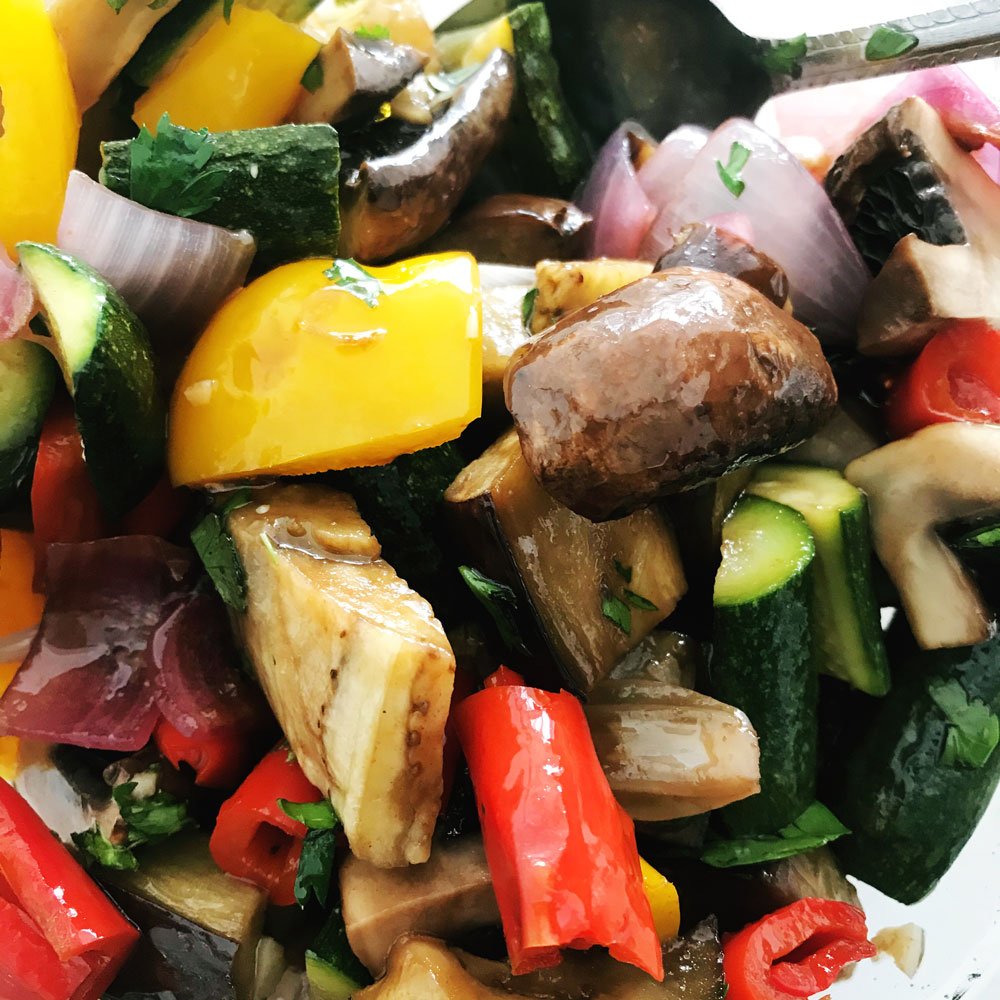
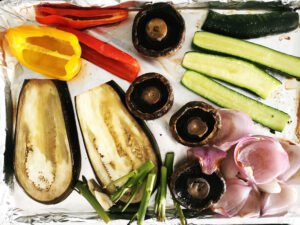
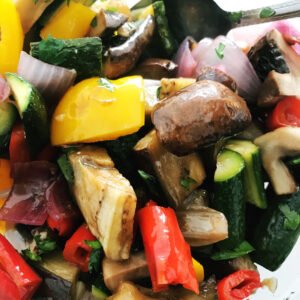
Roasted vegetables as a recipe can do double-duty on Sunday and Monday.
Serve it with Sunday lunch as a side dish with chicken or lamb. Then make sure to set aside a small portion (or use leftovers) to mix with a bowl of penne or linguine for an effortless Monday work lunch. Make it 'gourmet' with a dollop of homemade pesto prepped and already stored in the fridge. If you don't, here's a recipe that's just as simple and fuss-free as this one.
Zucchini provides vitamins and minerals, including vitamin C and potassium. Its high water content helps support hydration, while its fibre contributes to healthy digestion.
Great for immunity plus it contains sulphur compounds and antioxidants that support overall health. It's also known to support healthy blood pressure and cholesterol levels as part of a balanced diet.
Parsley
This herb is rich in vitamin K (just like Kale), which supports normal blood clotting and bone health. It also supplied vitamin C and antioxidants. This herb is also good for those with eczema (though not a remedy or treatment) as it is not inflammatory – it contains quercetin and carotenoids.
Red onion
It contains antioxidants called anthocyanins, which give them their distinctive burgundy colour. Red onions also provide fibre and prebiotics - good support for a healthy gut.
Olive oil
Olive oil, especially extra virgin olive oil, contains monounsaturated fats which support heart health. It also produces antioxidants and helps the body absorb fat-soluble vitamins from vegetables.
3Bell peppersMix of yellow and red. Cut into chunks and remove all seeds before roasting.
2MarrowsZucchini. Cut it half before roasting.
1Red onionRemove skin and cut into quarters.
1BrinjalEgg plant. Slice into 1cm thick slices.
2TBSPOlive oilRegular has higher smoke point, don't use extra virgin (better for salad dressings).
2-4Garlic clovesSkins removed
1/4cupItalian flat-leaf parlsey
1/4cupBalsamic vinegar
Method
Preheat the oven to 180 degrees celcius
Place all the vegetables on a flat roasting tray covered with aluminium foil. Drizzle over olive oil and coat all over with a pastry brush. Alternatively, toss all the veggies in olive oil in a separate bowl before placing on the tray.
Keep the garlic and parsley aside. Add the garlic halfway through the bake to prevent it from burning or crisping. The garlic should be mashable and golden brown.
After 25 minutes, remove the vegetables from the oven and allow to cool.
Slice the vegetables to your desired size.
Add the parsley and mix the vegetables together to distribute it evenly.
Drizzle over Balsamic vinegar and serve.
Notes
Cook's tip:You can leave the mushrooms whole during roasting and chop them roughly once cooled before dressing.Vegetables cook well in the airfryer on the veg setting - this is usually 180/190 degrees celcius for exactly 25 minutes. Remember that the smaller the vegetable or 'chunk', the faster it cooks – so it's best to pull out the basket at intervals and check for colour and softness.
Disclaimer: The content of this article is not offered as professional medical advice. It is nutritional insight that should be followed with discretion and/or in consultation with your healthcare practitioner or physician as it pertains to your health and/or health conditions. Always consult your doctor before embarking on any dietary changes if you are suffering from chronic condition. Use the information provided at your sole discretion. See our Legal Policies for more details.
When a client asks you how long something takes to complete, don’t make the time it takes your starting point for deciding what to charge.
Instead, consider what the product or service is worth and what you need to charge for it.
Just because something takes you twenty minutes to create doesn’t mean you should charge for twenty minutes of work only.
More than likely, it takes you so little time because you’ve acquired the skill, experience or talent to produce it in such a short space of time.
Remember that cheeky retort attributed to Picasso?
“But you did that in thirty seconds.”
“No, it has taken me forty years to do that.”
The Value of Being Good at What You Do
You see, the work might take twenty minutes, but the ability to do it in twenty minutes is another matter entirely.
I’m not advocating lying or being dishonest about the time something takes. I’m advocating being more confident about the value of your skills and abilities.
Your responsibility is to deliver what you’ve promised, on time and to the agreed specifications. Your client’s responsibility is to decide whether what you’re offering is worth paying for.
And your responsibility to yourself is to know what your work is worth.
Value your hourly rate. It’s there for a reason. But don’t let the time it takes you to do something become the only measure of its value.
Sometimes, being good at what you do means making something look easy.
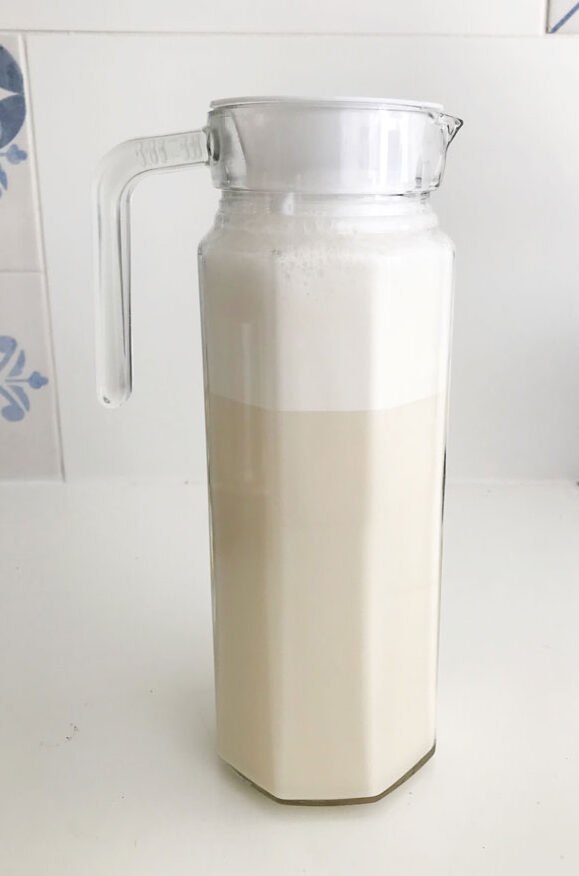
If you're looking for a healthier nighttime drink, try this natural chocolate milk. It's a plant-based recipe for a calmer evening.
Making nut-milk by hand sounds like a fuss and a little messy, but fear not, because you only have to make it every three days if you commit.
There are also faster alternatives like the nut-milk machine - a little pricey but may be worth the investment.
If using bottled almond milk suits your lifestyle better, go got it - it is effortless after all. Just bear in mind that it contains preservatives because it lives on the shelf before it's bought.
Whichever alternative you choose, try this quick and simple recipe that'll bring a little calm and nutritional goodness into your slow-down evening.
How to make almond milk.
Almond & Raw Cacao Milk Drink
A drink made with homemade almond milk, raw cacao and honey, and vanilla.
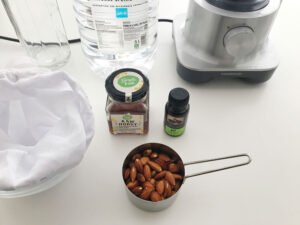
1cupSoaked almondsSoak overnight for 2-4 hours until soft (activated)
4cupSpring waterAlternative: Filtered water
1tspVanilla extract
1tspRaw HoneyAdd more depending on taste
1tbspRaw cacaoAdd more depending on taste
Equipment
1 Nut milk bag Alternative: nut milk-making machine.
1 Glass carafe Alternative: glass jug, jar or milk bottle.
1 Glass bowl Alternative: plastic
Measuring spoons
Method
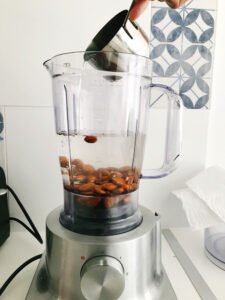
Soak 1 cup of almonds overnight in spring water.
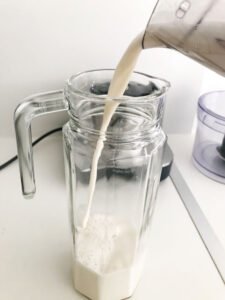
Pour 4 parts/cups spring water into the blender.
Drain the water from the almonds first, then place it into a blender.
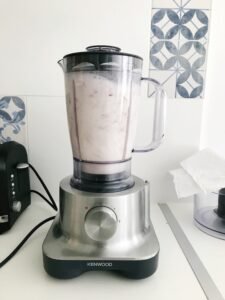
Blend until the almonds are fine and and bubbles appear at the top of the milk
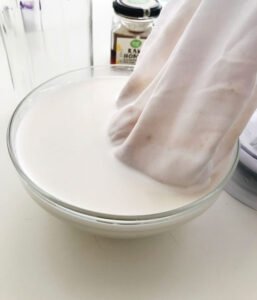
Pour it into the nut milk bag already placed inside a glass bowl. Make sure the drawstring is folded over the outside edge of the bowl. This makes tranference easier.
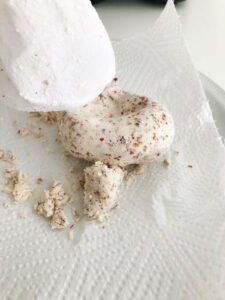
Squeeze out all the milk and set the almond pulp aside.
Pour the milk back into the blender and add the vanilla extract and raw honey. Blend until well combined.
Decant into a clean glass jug with a tight-fitting lid and store in the fridge for up to 3 days.
To make Chocolate milk: Before decanting, add the raw cacao and blend for 30 seconds until well combined. Alternatively, put the raw cacao into a glass add 1/4 cup of almond milk and whisk with a handheld milk 'frother' to combine. Top it up with more natural almond milk.
Disclaimer: The content of this article is not offered as professional medical advice. It is nutritional insight that should be followed with discretion and/or in consultation with your healthcare practitioner or physician as it pertains to your health and/or health conditions. Always consult your doctor before embarking on any dietary changes if you are suffering from chronic condition. Use the information provided at your sole discretion. See our Legal Policies for more details.
I've compiled this list of WFH Airfryer meal ideas designed as an interchangeable menu. One that you can mix-and-match - the intention is to be low fuss and speedy, without having to get up too often.
It's effortless and relatable.
Best of all it's simple recipes with simple ingredients for a typical 5-day week, work-from-home grind.
Crack the eggs, place in ramekin, set it according to recipe.
Easy 2-in-1 Egg Toast
https://za.pinterest.com/pin/436427020162345502/
Meal prep required:
Grease the bread with olive oil; crack the egg over the bread; set it and forget it; season when done.
Call it an Omelette or a Frittata
https://za.pinterest.com/pin/57209857760196742/
Meal prep required:
Crack the eggs into the parchment, stir to combine; add toppings; grate cheese over top; set it and forget; season when done.
3 Airfyer WFH lunch ideas:
Easy tortilla 'pizza'
https://za.pinterest.com/pin/436427020162546889/
Meal prep required:
Take out one tortilla, wrap or roti; crack the eggs; stir in cottage cheese; add toppings; grate some cheese; set it and forget it; garnish with rocket/arugula when done.
A Gourmet Toastie
https://za.pinterest.com/pin/436427020162494965/
Meal prep required:
Grease two slices of bread with olive oil; layer with cheese + cold meats; grate more cheese over top; set it and forget it/
The healthiest 'chip-n-dip' lunch - no oil, no need to peel potatoes
https://za.pinterest.com/pin/822188475768331657/
Meal prep required:
Grease frozen or ready cut chips with olive oil; place into basket or parchment; set it and forget it; season with natural sea salt or dip into vegan mayo or a preservative-free homemade pesto.
3 Airfyer WFH dinner ideas:
Easy Falafel for a poké bowl, salad or pita
https://za.pinterest.com/pin/436427020162199474/
Meal prep required:
Make ahead dough and freeze it on Sunday or throw together ingredients in a food processor and combine for 60 seconds; rolls into balls; place on parchment; set it and forget it; serve with yoghurt (out of the tub).
A Meaty Monday done easy
https://za.pinterest.com/pin/436427020162345360/
Meal prep required:
*Pre-cut steak on Sunday and freeze it.
Place steak, broccoli (store-bought, pre-cut, pre-washed to save time) and seasoning into the basket or parchment; set it and forget it; season with black pepper when done.
The Simplest Chicken Breast Dinner
https://za.pinterest.com/pin/1097963584195207538/
Meal prep required:
*Defrost chicken breast mid-afternoon.
Spray chicken with olive oil; season with spices (leave herbs and cheese to mid-bake or it'll burn; set it and forget it; garnish with herbs when done.
Conclusion: Did the meal sequence save you time, reduce effort or ensure that you didn't skip any meals?
The whole idea of this is to save you time, meal prep effort and clean up energy.
Working from home feels convenient, but more often it's not. I've had many colleagues tell me how they hate working from home because they're constantly eating (meaning there's more pile-up and clean-up) and they often get distracted with meal prep or groceries running out. The pain point is that you need to be at your desk doing you day job and there's no time to worry about what you're going to eat and how.
Airfryer cooking is great because:
you cut out dishwashing by using store bought parchment
you can prep raw meat, fishcakes, falafel, tortillas, stock up on eggs, pre-cook rice to freeze, on the weekend ready to airfry and serve during the week.
There are thousands of quick and simple airfryer recipes on Pinterest – take a look at the board. You'll see I've only scratched the surface. The idea is to make another WFH day effortless and simplified for eating. And to ensure that no meals are skipped because meal prep is too much of mission.
These examples let you know that it can be minimalist, delicious and effortless.
Time-saving tip for cleanup: In the dinner examples above, the food processor jug will need to be washed, so that's extra time. at this point, you've logged off, so whatever dishes accumulated during the day can be combined with this, leaving you with only one cleanup for a full WFH day.
Disclaimer: The content of this article is not offered as professional medical advice. It is nutritional insight that should be followed with discretion and/or in consultation with your healthcare practitioner or physician as it pertains to your health and/or health conditions. Always consult your doctor before embarking on any dietary changes if you are suffering from chronic condition. Use the information provided at your sole discretion. See our Legal Policies for more details.
Styling salads is one thing, but the mechanics of it could become another 'job' unless you're savvy with ingredients. That requires knowing your ingredients, how to buy them, store and meal prep like a chef.
I've dedicated this post to visually unpacking what goes into a range of well-known salad recipes and a few obscure ones to give you an idea of how best to strategise your meal prep.
Another factor worth noting is that knowing what goes into your salad recipes affects your budget. Ingredients, especially organic ones are generally not cheap no matter where you in the world.
Everything beautiful and delicious when styled and plated into little bowls as seen in the reference images below.
Make a list of factors to consider when building your salad recipes:
Look closely and take inventory of how much the ingredient packaged, will cost you.
Be realistic, beyond appetite appeal and check whether that ingredient aggravates any allergies you may have.
Which salad ingredients has beneficial or nutritional components.
Be honest about cravings - which ingredients would you prefer to eat and which not so much
Is there anything you're willing to try and be okay with discarding or donating if gone unused - that affects the budget?
Let's take a look at how recipe developers engineer their salad recipes. If you've always been someone who 'throws' together a salad, these flat lays will literally give you an aerial shot of what goes in and what surprisingly stays out.
You never really what you're eating right? Unless you make a dish yourself, you're mostly guessing at what you're tasting and smelling. But, if you have allergies, weight-loss goals or a simple motivation to eat healthy, you'll want your salads to align with what you need and want to consume.
Making salads everyday can become a budget concern because you're meal prepping with fresh, volatile ingredients. Fruits and vegetables will go off if you're not organised and attentive. As a full-timer, I know how tricky that gets when most of your attention is not on what's going in your salads. All I care about is which salad I'm going to eat because I'm already stressed and hungry (WFH). But, if you're not careful about deteriorating fruits and veggies and everything else that goes in it, you might be spending more by discarding expired ingredients. It's worth considering if what goes in it is better bought cut-chopped-washed and ready to eat than prepping from scratch.
Now that I've mentioned work and eating - time is an ultra important factor when organising salad recipes.
Are you someone that likes to be in the kitchen, cooking, chopping, prepping and cleaning even if you're a stay-at-home?
How much time can you allocate to designing and building your salad, per day or per weekend? Remember these are fresh ingredients, so time might be the most underplayed yet crucial meal prep factor.
So, lots to contemplate. I bet you never thought all these factors go into building a salad. Now you can consider what goes in and what needs to stay out.
Here's another volatile ingredient worth mentioning if used in organic form and that's raw honey. Which do you prefer - raw or processed? I'd recommend not using raw honey heated because of nutritional constituents breaks down, and the aroma and flavour can change. For dressing a salad, I think the bottled, processed kind will be fine. Though creamed raw honey is delicious - here's the one I always use (not sponsored).
I love this because you can easily alternate between the sweet potato and butternut, depending on what's available to you. Even carrots, they're sweet too. But, it's not the sweetness I'm calling out, it's the beta-carotene in any orange veggies. It's very high in anti-oxidants and other nutritional goodness.
This one's even better for gut health - blueberries and peaches are high in fibre. Those with existing IBS, may want to skip this one. On a lighter note, blueberries are a great belly-flattening fruit too. And cucumber is perfect for hydration - set aside some cucumber slices and add it to your water to sip throughout the day.
Any pesto elevates a salad into more than a side dish mainly because of its rich, deep flavour. Cannellini have so much nutrition built into them and a great source of protein if you prefer a vegan option.
It's not the cheapest alternative to couscous, but it is gluten-free and very high in protein. Chickpeas are really versatile - save for falafel or use the tin juice to make aquafaba (the juice makes vegan egg whites when whipped).
Citrusy Chicken Salad
https://za.pinterest.com/pin/436427020162709083/
No salad roundup is complete without adding some shredded chicken. Get creative with this well-known source of protein - try torn pieces of roast chicken, ginger-poached poached chicken breast cut into cubes or air-fried slices of roasted masala chicken breast.
cook's notes: swop regular soy sauce for low-sodium for tamari or coconut aminos
I can't overstate the health benefits of beetroot. From helping to lower blood pressure, to aiding digestion because it's high in fibre, to improving fitness for endurance sports due to its nitrate content (which help blood vessels relax allowing for the flow of more oxygen).
You don't have to eat them raw, try these variations in a salad:
Steamed beetroot - milder flavour but you don't lose any of the natural constituents
Roasted beets - sweeter, tastier flavour
Pickled and brined with vinegar - tangier and more acidic, especially out the jar
Pears are excellent for people with skin allergies. It's very low in salicylates (allergen) which causes inflammatory reactions in the skin. It's also rich in polyphenol antioxidants and provitamin A which supports skin health and helps with wound healing.
Conclusion: Why build it yourself when you can get storebought?
You could, but it's a different experience because you have to take what is available without having to know exactly what's in it. Visual appeal usually dictates the purchasing decision anyway.
The salad recipe builder however, was designed to help you think about what you’re building a salad with and why. To promote choosing ingredients consciously for the goodness inside it - the nutritional components beneficial to building optimal health. But beside that, the tool was created to make a salad fun to eat because it’s yours – designed by you. And then, if there’s time, 'styled' by you too – this curated list will inspire you to get creative as well.
Disclaimer: The content of this article is not offered as professional medical advice. It is nutritional insight that should be followed with discretion and/or in consultation with your healthcare practitioner or physician as it pertains to your health and/or health conditions. Always consult your doctor before embarking on any dietary changes if you are suffering from chronic condition. Use the information provided at your sole discretion. See our Legal Policies for more details.
Just when you think it's another visually enviable arty or artsy, over styled or wannabe artistic sensibility space, this one, you almost miss.
Can you spot it?
If not, here's what it is:
it's personalised without saying so,
there's no attribution to any artistic achievement,
there's no bragging,
there's no artistic clichés.
It's a cultivated, personalised and individualised artistic space that, when inspected closely, you actually see the bits or artefacts that the owners made for memory, identity or self-expression — except they treat it like a non-branded artefact. The owner's individuality is blended into the overall cultivation but absolutely informs the composition — it's just done unpretentiously. It's like it's not for show except for the homebody who inhabits it, the work-from-home creative who doesn't admit it or the unfettered attitude of an owner or family member who doesn't even notice they live in a colourful, richly diverse environment.
How to set up a kitchen for everyday healthy cooking
Here are a few favourites that spell 'artistic cozy' to me:
A caveat – these are not just interior spaces, but include all manner of objects, surface design, and an outerior and even clothing that speak to this unsubscribed sensibility.
Nothing says individual like handmade ceramics
https://za.pinterest.com/pin/510806782747569333/
Playful but not trending
https://za.pinterest.com/pin/436427020162009817/
Stylishly aware but not following
https://za.pinterest.com/pin/436427020162047489/
Curated yet unrecognisable
https://za.pinterest.com/pin/417075615515454615/
The labels are trendy but the urge to sartorialize with bold colour is individualistic
https://za.pinterest.com/pin/436427020161219393/
A brilliant example of not even trying
https://za.pinterest.com/pin/436427020161689773/
The stripes look retro and inherited or hand-sewn. The comic artwork needs no explanation
https://za.pinterest.com/pin/436427020162009798/
A touch of obvious personal direction
https://za.pinterest.com/pin/503136589645377877/
A minor detail, but imagine more of this sensibility around the space
https://za.pinterest.com/pin/218002438215107034/
A playful and personalised expression of existence
https://za.pinterest.com/pin/436427020161207310/
Conclusion: Is artistic cozy just colourful and slightly copycat?
I don't think it is. If you're not convinced perhaps take a further look on my curated board.
It feels like play but mostly it stands out as not following, unsubscribed and completely independent.
It's adding to the colour conversation, it doesn't shun any urge to curate with deliberateness and it undoubtedly sartorializes except there is a subtle distinction. It says "it's mine", "it belongs to me".
I learnt that ageing with dignity is not about simply resigning oneself to what is. In other words - letting things go because you're 'choosing your battles'.
I'm all for calm and ease-and-flow - living with as few complications as possible.
But, an insight was revealed to me this week – there is a quietly bolder side to ageing with dignity intact. The phrase has been flogged by younger influencers more than older ones and it's the idea of 'living unapologetically'. More often than not it's been attributed to being loud-and-proud, passively aggressive, a friendly kind of rude, or a take-it-or-leave-it characterisation. Nothing synonymous with older, slower, midlife or older folk with accumulated life experience and genuine wisdom.
Ageing unapologetically doesn't mean being a 'mean old lady' or curmudgeon. It can be a quiet and serene version of strength and power.
So, how do they do it?
They know what they've been through,
have a genuine non-judgmental undertanding of their past,
and they know how and why they say NO.
Their take-it-or-leave-it is well-informed and isn't an invitation to confrontation. The answer is either yes or no without justification.
I'm still pondering it. Saying it over and over again like a mantra because it's good. "Don't justify, don't explain (unless it has utility)".
I like it. It's calm. And it feels good not to start a sentence with "sorry".
Natural, wearable nails are perfectly beautiful but that doesn't mean it needs to look unpolished or dull. Intentional subtlety is a powerful style statement akin to an old money mentality or a curatorial sensibility that knows that reduction (editing) is an art.
Effortless style is epic and that interpretation is subjective but when it comes to nails, the effort is quite literal. Nails need maintenance and there's only so much time in a day whether you're married or single. From Monday to Friday, what most ladies and some men care about is 'done'.
In the spirit of low-lift beauty fixes and style alternatives, here' are 10 calm's a roundup of nails I think are timeless and always look no matter which office or event you find yourself in.
10 Calm, versatile and wearable nails that go with everyday style:
There are multiple ways to iterate on the natural nail, but you'll be surprised that it's not the only colour that says 'calm' and 'wearable'.
Understated class - stands on it's own and doesn't compete with your clothes
https://za.pinterest.com/pin/1147010598882759238/
Wearable nails that are glam without the 'bling'
https://za.pinterest.com/pin/960955639259133731/
A grown up version of ballet slippers that actually resembles it
https://za.pinterest.com/pin/873065077784914483/
Milky opaque clouds
https://za.pinterest.com/pin/1051942425486161682/
Barely there and effortlessly natural
https://za.pinterest.com/pin/658370039315611006/
Oaty and opaque - confident without obvious 'colour'
https://za.pinterest.com/pin/1031676227159566525/
Wearable doesn't mean natural-only - think unobtrusive
https://za.pinterest.com/pin/884746289447480319/
When you want to exude red confidence, without looking 'extra'
https://za.pinterest.com/pin/1087971222515172258/
Surprisingly stealthy and effortless - works well for work and weekend
https://za.pinterest.com/pin/1098526534111633840/
A colour that feels like flesh and perfectly wearable
https://za.pinterest.com/pin/476748310587377043/
Conclusion - if these are wearable nails, then what isn't?
These examples represent easy-to-maintain manicures and it also signals the visual aesthetic of being 'polished' without looking overdone.
It's about interpretation – if you're wondering about the opposite. There's nothing wrong with colour but apply colours and finishes that allow your personality and innate style to come through.
Wearable is not about 'performance'. It's part utility and purpose - practicality.
But, it's also about being realistic. To make a statement without being outrageous, without looking for attention if you don't need it. It's about being groomed without looking and more importantly (for you) feeling 'dressed-up'.
It refers to being effortless and about ease-of-use.
Wearable nails needs to reflect back at you (in the mirror) – "I didn't try too hard".
If there’s one wardrobe staple that will see you through all seasons, it’s a good jacket.
The blazer has the ability to cover up any outfit that feels in adequate. It can make anyone’s everyday style feel more than what it is - to make any outfit feel polished.
A blazer makes your entrance or appearance feel chic and accomplished even when your confidence is ‘so-so’.
It can dress up the most distressed blues and make a well-worn-in boyfriend jeans look upscale. The plainest dress will feel expensive underneath it. And when you’ve had some kind of an outfit malfunction all you need to do is throw on a blazer and your ensemble is fixed.
Something about it makes any well-heeled wardrobe feel incomplete without it.
There are different styles of blazers and what you choose depends on your destination, your mood, your location, the occasion, your budget as well as the season.
Here’s a round up of blazers that feel timeless, though some may feel like it’s trending and some like it’s harking back to the 80s. Either way, it makes a statement without having to do too much in throwing it together. Effortless, in other words.
Here’s a roundup of 10 blazers to choose from (or invest in all as wardrobe staples:
The everyday ‘androgynous’ blazer
https://za.pinterest.com/pin/436427020157608853
The casual but chic office blazer
https://za.pinterest.com/pin/436427020157607769
The classic town-and-country tweed done ‘sexy’
https://za.pinterest.com/pin/143200463147425912
A blazer in a bold colour is not ‘loud, it says ‘confident’.
https://za.pinterest.com/pin/436427020157343878
The black single-breasted blazer - a wardrobe staple
https://za.pinterest.com/pin/69524387998113913/
Double-breasted blazer - remembering the 80’s but no doubt a classic
https://za.pinterest.com/pin/1138777455822202635
The timeless linen jacket - nothing says ‘effortless chic’ like this one
https://za.pinterest.com/pin/757941812333169500
Your ‘go-to’, night-on-the-town jacket in velvet
https://za.pinterest.com/pin/436427020157387711
The cropped jacket - this short blazer does double duty for day and nighttime
https://za.pinterest.com/pin/758504762242088802
The epic suede jacket - with blazer vibes
https://za.pinterest.com/pin/436427020157530000
Conclusion - finding one for every season
These blazers only scratch the surface of how far you can go with building a collection of 1,2 or many. Each style lends itself to multiple versions of style, nuances in the foundational cut, detailing and most importantly colour and fabric (texture). Next time we’ll explore fabrics and how that influences personal expression and everyday wardrobe curation.
In the meantime, if you liked this post, you’ll love this one.
Say thanks!
Give a shoutout to Waylon Hobson on social or copy the text below to attribute.
Does the visual appeal of a salad influence which type we eat, the recipe we choose or how we would build one?
I've been curating hand-painted swatches and textile design inspiration this week and it got me thinking about colour design and food. Particularly salads because it’s the easiest dish to infuse with colour without even trying. It then led me to investigate food design as well as painting with vegetables dyes, sculpting with food, etc. It's all over Pinterest - nothing new. Collecting, curating and ultimately editing my research prompted me to dig a little deeper.
What I paused to consider:
Does it really stop at pure colour design - creating a pretty dish just for the sake of it.
What about the ingredients?
What if we styled salads not only for presentatibility but also for nutrional appeal.
It doesn't sound original - all salad recipes have some nutritional and health conscious intent buried within the recipe.
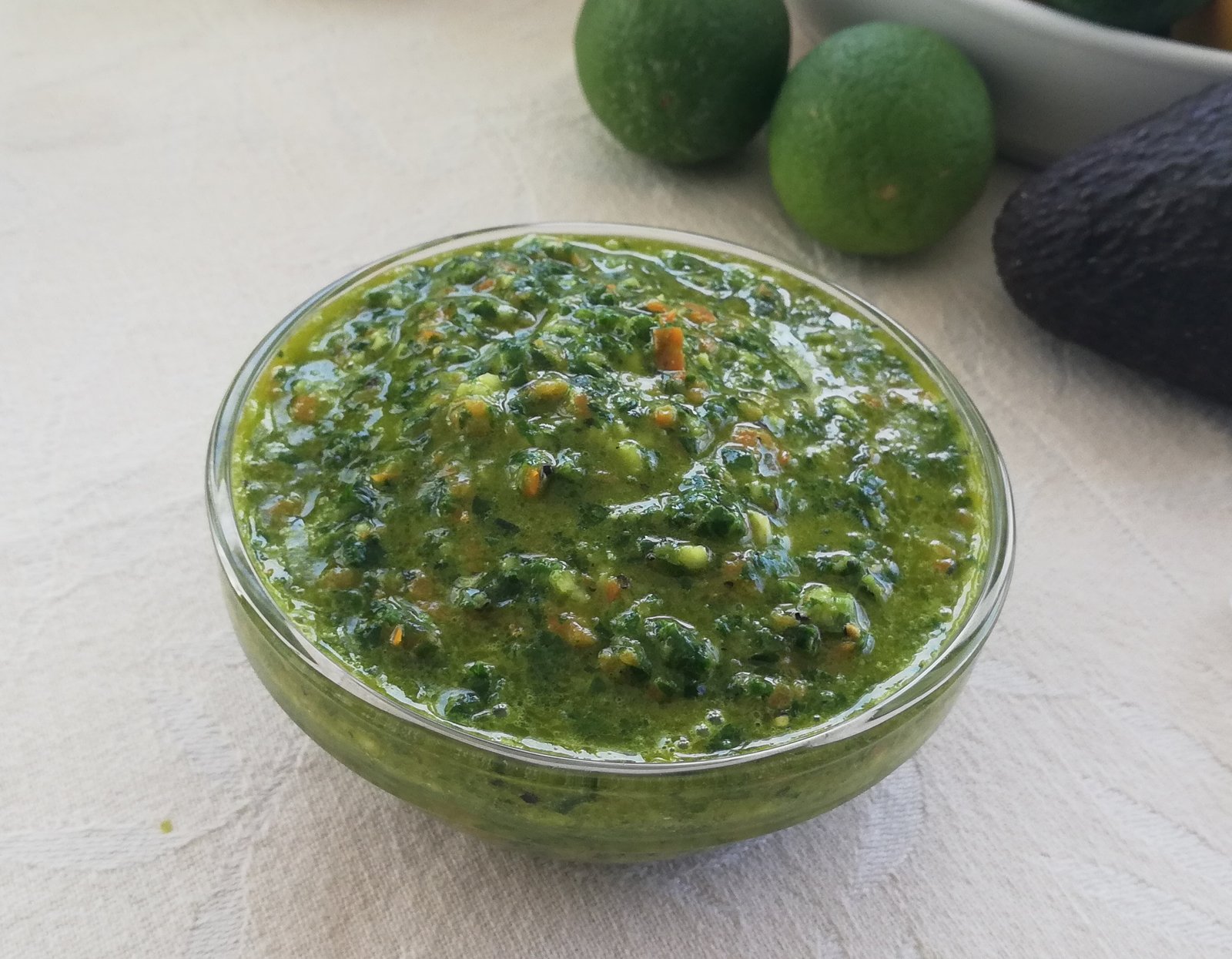
Kale Pepper Pesto Recipe and why it’s eczema-friendly.
Could we style a salad based on individual needs and culinary appeal - what if each salad satisfied a particular need, desire, taste, flavour craving, flavour combination craving for the individual? The nuances could become interesting.
I'm still thinking on it because the idea has many angles.
For now I'll leave you with a curated list of what I see as versions of a styled salad in visual terms. Plus, a simple tool to introduce you to ‘styling’ a salad recipe built with your nutritional needs and cravings in mind. The idea is to come out with a salad combination of flavors and ingredients entirely tailored to how your mind works and in support of your eating habits. It won't be a generic recipe, but a salad built and styled entirely by you.
10 Styled salads that make you think about visual appeal, taste, nutrition and eating habits.
Styled Beetroot Salad
https://za.pinterest.com/pin/436427020159374655
Ever been put off by beetroot? Here are some key health benefits to help inspire and perhaps change your mind:
Good for cardiovascular health
Supports good digestion
Excellent for endurance sport - the nitrates can improve how muscles use oxygen.
You don't expect to find raspberries mixed with baby spinach, but this styled salad is not 'thrown-together'. It's nutritionally balanced across the spectrum. Take a look:
Blueberries and blackberries make any dish look luxurious and beautiful. But they're also each packed with potent nutritional value. For both, here's what you need to know:
Both are high in fibre
High in antioxidants
Both are said to contribute to supporting cardiovascular and cognitive function
Blackberries are particular good for immune (Vitamin C) and digestive health
Now's a good time to pay tribute to the humble tomato. You just expect it to be there, completing any salad ensemble with it's essential umami flavour. For those you need a refresher, here's why it's good for you:
They are well-known for lycopene, a carotenoid which is an antioxidant
Contains Vitamin C - great for immunity
Has beta-carotene which converts to Vitamin A - good for eye health
Love the pink version. But, what are the nutritional benefits in it – is couscous gluten-free by any chance? Unlike it's gluten-free alternative quinoa, couscous does contain it. But, there are other benefits you need to know about:
It's grain and rich in carbohydrates
Contains Vitamin B - thiamine and niacin
Does contain some plant-based protein, but no as much as chickpeas or eggs
Rocket (Arugula) adds taste and style to any salad. In fact, I'd swap out a regular green for rocket if I had to choose. That peppery taste gives any salad a kick without having to load up on extra dressing (especially if it comes out of a bottle - more on that in a later culinary nutrition post). Here's what you need to know about this cruciferous veggie that only seems like decoration, yet it's not:
Just like Kale, it's a good source of Vitamin K - good for bones as it contains calcium
Visually, the way it’s presented - it needs to make you stop to contemplate what’s in it. It needs to arrest you long enough to get curious. The best styled salads surprise and delight you. You don’t expect whole foods to look like a painting when assembled with curatorial intent. And you especially don’t expect fruits and vegetables to be anything other than foods we have to eat.
Styled salads transform the everyday, ordinary and often overlooked into something extra-ordinary, reinventing or simply refreshing it’s identity and nutritional meaning. Reminding us to enjoy cheap ingredients as they are available in an inspiring way.
Now, I know it can look like a lot of effort. Most people prep’ salads to ‘go’, ie. quick work lunch or fast salads after a too-long work day. But, take a cue from the idea that a styled salad is transforming something simple, cheap, overlooked, or even shunned into something you can and want to eat even in the form of a tiny bowl or side plate.
Don’t overthink it. Have fun with it. If you have zero time for creative hobbies after work - style a salad and play 'art director' at home.
Disclaimer: The content of this article is not offered as professional medical advice. It is nutritional insight that should be followed with discretion and/or in consultation with your healthcare practitioner or physician as it pertains to your health and/or health conditions. Always consult your doctor before embarking on any dietary changes if you are suffering from chronic condition. Use the information provided at your sole discretion. See our Legal Policies for more details.
I’ve been thinking about what it means to be effortless. Which inevitably lead me to researching hair for the mere fact that it requires maintenance, ie. effort. While culling and curating I realised that effortless hair didn’t necessarily mean short crops per se.
I saw a common thread that resonated with me and this was it:
The photos depicted an intentional lack of being composed - a lack of being posed or styled. But more specifically, the subject and the hair wasn’t over-identifying with a style or belonging to anything but itself. Some haircuts were almost unrecognizable, non-descriptive, not belonging to any movement or social commentary - bland.
But this resonated especially:
If the hair was not belonging to any particular style, it was offset with an undetected confidence and presence in the subject. As if they were saying ‘this is what I want’ not this is what I should have.
The effortless big white shirt & blue jeans staple
Have a nut, skin and other histamine-induced allergy?
Here's a pesto recipe that actually contains zero nuts or dairy - the usual suspects of inflammation.
This recipe is about reducing inflammation if suffering from Eczema. So, how does the recipe do it? And which ingredients make it safe for allergy suffers?
But, why is it good for Eczema?
Kale
This rich green veggie is rich in carotenoids that have an antioxidant effect which reduces that inflammation.
Clear Eczema Naturally: Best Foods for Healthy Skin
This flavourful favourite contains an anti-inflammatory compound called Diallyl Disulphide.
Bell peppers
These particular peppers contain the plant compound (flavanoid) Quercetin as well as Vitamin C which both reduce the levels of histamine.
Oilve Oil
The main component of this dish is olive oil which is rich in oleic acid that helps with very dry kin - great for cracked scaly Eczema patches.
So, there's need to take an histamine to reduce the inflammation of allergic reactions like Eczema.
What else can you use this condiment dish for?
Pestos are generally versatile. You can spread it on toast, add it to soups, use it as a savoury dip, add it to pasta, antipasta, mezze or use it to glaze roasted vegetables fresh out the oven.
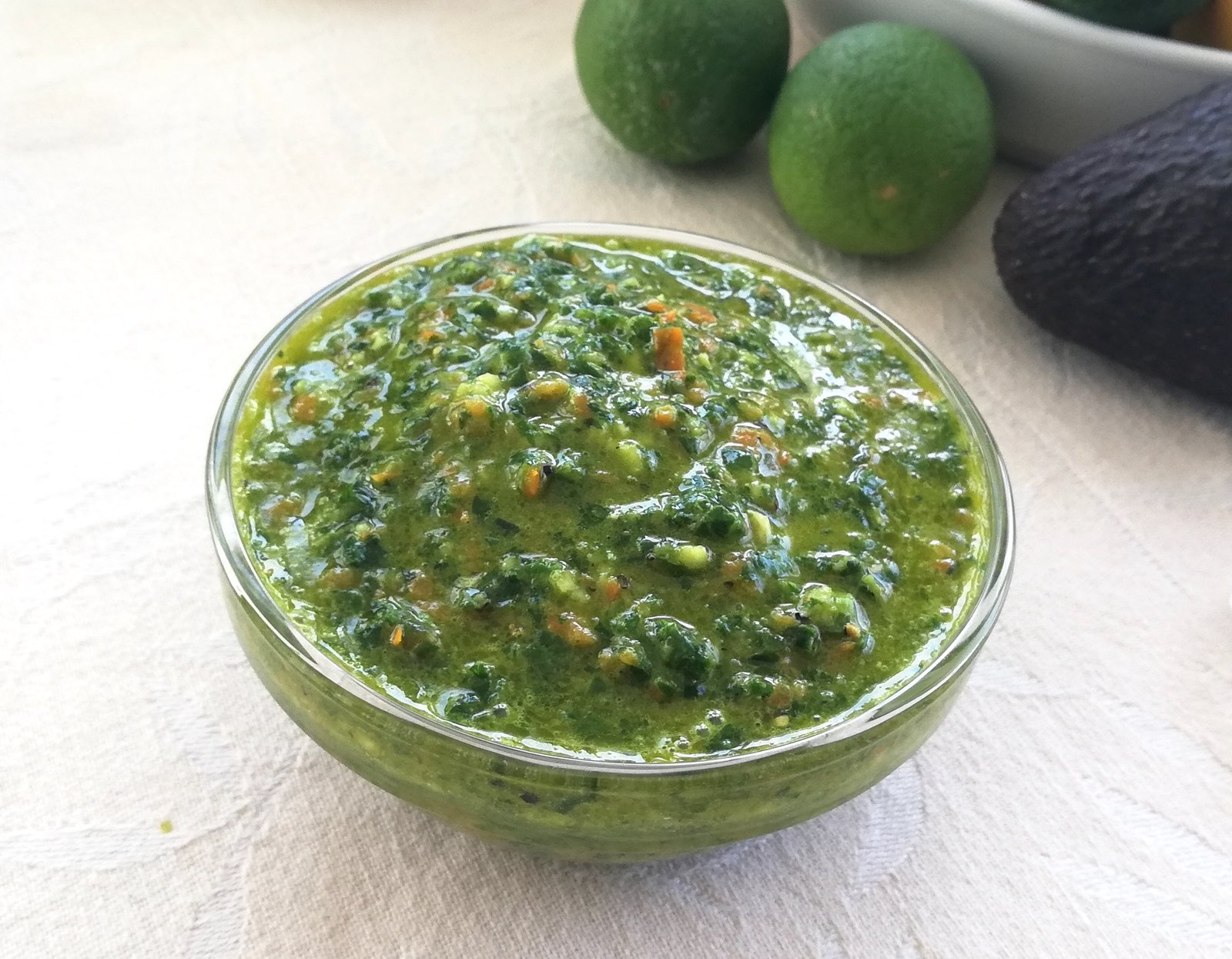
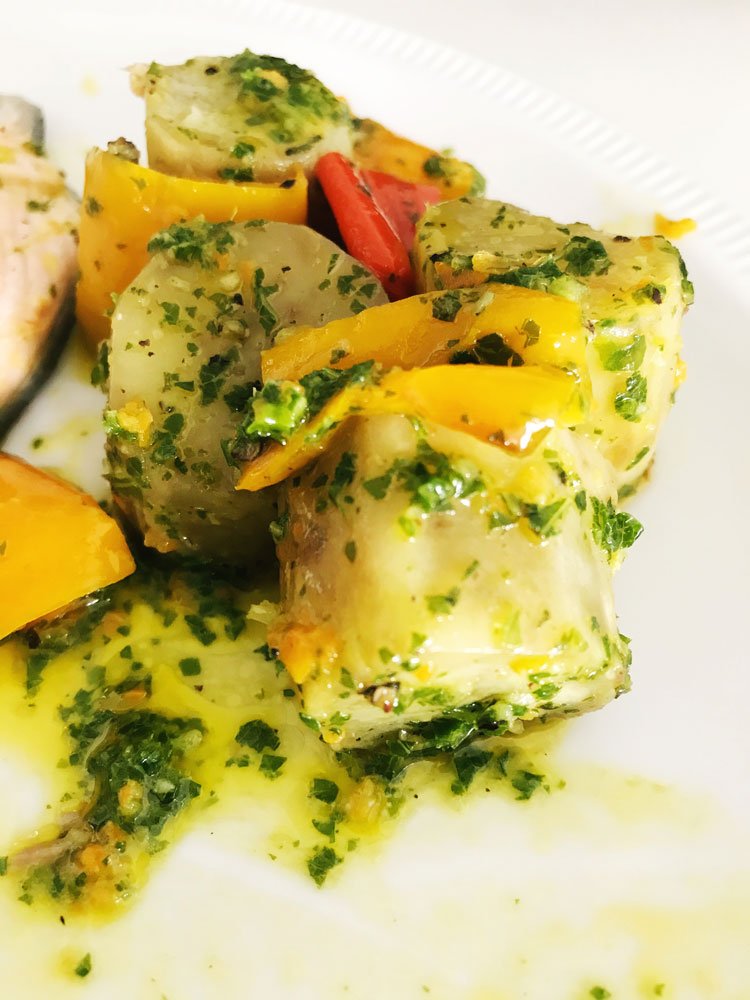
kale pepper pesto over roasted vegetables. Original photo by Fayrooz Abader for NBL.
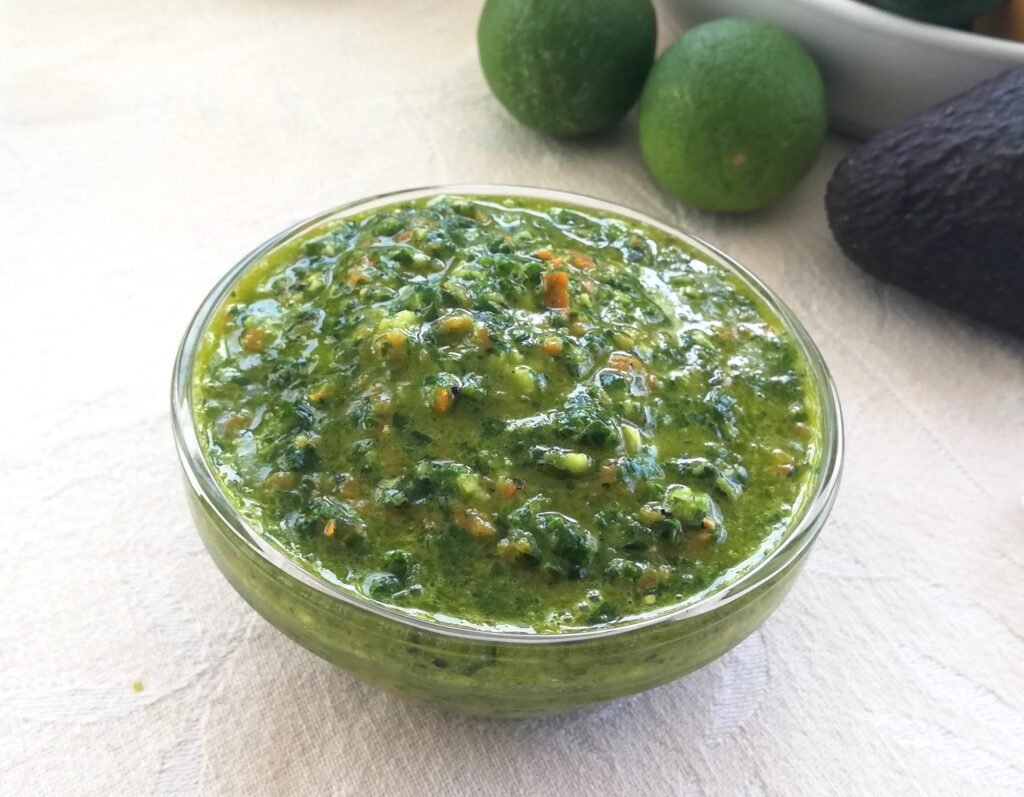
Kale Pepper Pesto
High in antioxidant Kale and anti-inflammatory garlic and Bell peppers. This pesto contains no nuts or dairy.
1cupKale leavesMassage the Kale with seal salt and lemon juice to soften.
1cupBasil leaves
1Small Bell pepperRoughly chop
2tspNutritional Yeast flakes This is a non-dairy replacement for Parmesan or Pecorino (dairy).
4clovesGarlic
1tbspLemon juiceFreshly squeezed.
1/2cupOlive OilExtra Virgin
1tspSea salt
1tspBlack pepper
Equipment
Food processor If you don't have a food processor, use a pestle and mortar to grind and mix by hand.
Method
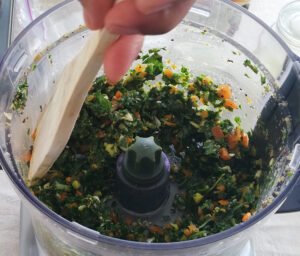
Place the dry ingredients into the food processor except the olive oil.
Pulse to chop the peppers and leaves until they are fine, then process on normal speed.
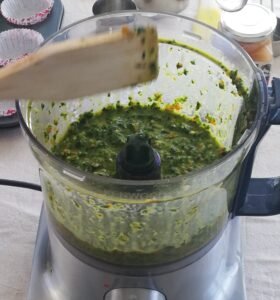
Now start pouring in the olive oil through the feeder and blend until you have a saucy consistency.
Next add in the lemon juice and blend until the pesto is well combined and creamy.
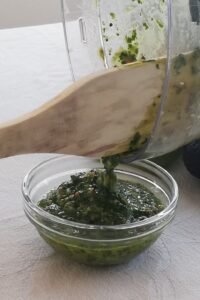
Pour into a bowl and set aside.
Notes
Cook's notes:
This pesto is great for spreading onto gluten-free bread or seeded crackers.Will keep in the fridge for 4-5 days.If you love cooking raw food dishes, you'll love this salad builder tool.
Disclaimer: The author of nichebloglab.com and the articles and recipes hosted on this website, does not give medical, physical or mental health advice directly to any specific individual. In the references to it, the phrasing is used to illustrate a point or give context to the information. It is not related to the specific condition of any specific individual. Always consult your healthcare professional for physical and mental health or CBT advice. The recipes published on this site do not advocate or advise on food consumption or dietary requirements as it pertains to any specific individual. Consult your healthcare professional for advice on food allergies and dietary restrictions. See our Legal Policies for more details.
This is hardly a trend, but more like a mandatory bookmark in a capsule wardrobe story.
Uniforms don't inspire and can make you feel like you're living up to any identity.
Sometimes, all you want to do is 'signal' - not make a statement - that you're chic, but totally relaxed about it.
Nothing says that better than a big, crisp white shirt coupled with your favourite blues. And those blue jeans can be anything from distressed, boyfriend cuts to sexy stovepipe, classic mid-blues.
Once the shirt is on, it's 'on’.
And don't forget to turn up those collars and finish off with a pair of oversized shades.
A short list of favourite big-white-shirt moments:
I pulled a few favourite looks this week from my board that's chic and easy - these ladies are keeping it effortless and easy.
Or they're making it look like it was no trouble at all?
Which is how personal styling should be - effortless.
Leaving you more time to enjoy being sartorial and having fun with it.
Signalling maturity while being casual
This should be a staple in any woman's wardrobe at any age. There's always going to be a moment when you need to either look a little older or feel that way - sometimes you just want to 'give' casual sophistication. This one you can do daytime as well as early evening when you don't want to be the one that looks overdressed.
https://za.pinterest.com/pin/436427020162606453/
The only way to look smart and streetwise at the same time
You can only pull this off with a great sneaker, preferably a brand name. It's edgy without trying to be provocative. And let's be honest, this is work attire as we know it in creative environments. Don't worry, the clients will get it - if you're thinking about showing up to meetings wearing this combo. Ultimately, it's all about the shirt and I absolutely love a buttoned up white shirt. It's instantly dressy and can be buttoned down last minute to suit a quick change of plan. That's how we like to live right? With clothing doing double duty when we need it.
https://za.pinterest.com/pin/1013732197412484750/
Understated, sporty and a little preppy
Yes, the shoes do 'make' it. But, pay attention.
It would've been meaningless were it any other shirt but these cool, casual and slightly oversized white ones.
https://za.pinterest.com/pin/68748564507/
The perfect white canvas coupled with a hijab accent
This one's delightful and a personal favourite. I particularly like the accent piping (finish) on the sleeves and shoulder seam. And the slight flare of the back makes it look comfortable without feeling like loungewear. There's also something utilitarian about it. Perhaps it reminds me of a painting artist's overall? My point is, it's loose and effortless, while the colourful details affirm the intentionality of it. Style is never accidental even when it's just thrown together.
https://za.pinterest.com/pin/436427020162521006/
The white mass is perfectly balanced with a bold, but delicate pump
The upturned collar will never go out of style and nothing denotes strong and independent like that little, self-directed detail. Second to that are the red pumps. It's daring and sassy without trying – effortless.
Or perhaps the sassy red pumps are a secret nod to the pointy collar.
https://za.pinterest.com/pin/436427020162514404/
Effortless glamour without even trying
I couldn't help adding this because it depicts what I mean by effortless, the best. The intention is always to be stylish, to have some aspect of glam, polish or 'put-togetherness' before we leave the house.
This one says it all.
How? The makeup (polish) and the shoes (perfectly glam). The rest doesn't have to try too hard.
https://za.pinterest.com/pin/482870391297295300/
Conclusion
If you're only allowed one splurge this month, spend it on an oversized white shirt. Better yet, wait until you can invest in a good quality one. That might mean buying 'designer' - but choose the right one. One that fits your everyday style. If Pringle is not your energy, get one from G-Star or a well-sourced budget-buy instead. Be intentional.
This effortless vibe doesn't always require designer labels to be functional. But, the style is timeless and that means you'll want to wear it for a long time, without buying a new one every other month because the quality is poor. Something worth considering.
If you need to first experiment with which variation of this style works for you, experiment with budget choices until you find the right look for you.
You’re probably wondering how much you’ll have to change and what it’s going to cost you. Once you commit to experimenting with culinary nutrition, preparing your kitchen does not need to be a daunting endeavour, nor does it have to be costly. Whether you live in a studio apartment or a large family home, your kitchen just needs to function optimally and smartly.
Preparing your kitchen
Photo: pexels-kakarh
Here are the first steps to preparing your cooking space:
Clear your counter tops. Yes, that means wiping down and then surface disinfecting. Make like the chefs do and make it spotless!
Group types of foods. Eg. Group flours together; nuts & seeds; grains and so forth.
Rearrange cabinets so that foods, utensils and eating ware are all housed separately.
Next:
Glass-jar all ingredients and waterproof label them with MNF1 and EXP2 dates.
Check all utensils and food processing equipment. See what you’ll still need to buy or borrow (kitchen equipment checklist).
Create a light and temperature appropriate space for fresh produce.
Separate areas in the cabinets, shelves and fridge for CN foods and ingredients.
Note: If you’re living with people, don’t convert them to your way of eating. Be open-minded. Keep cooking and inspire them with your nutritious meals!
Photo: gregorio-cavana-unsplash
Checklist for CN kitchen equipment:
Blender. A Vitamix or similar will do. Preferably a vented one in case your ingredients are still warm. Chef’s note: Safety first.
Food Processor. A basic version with three settings is sufficient ie. A Pulse, Slow and High speed setting.
Chopping Knives. A Chef’s knife (there’s only one kind) and a Pairing knife.
Chopping board. Wooden or Marble is best. You’ll have to ditch plastic after a whileonce they start emitting a smell. That smell is usually bacteria.
Juicer. A centrifugal machine is pricey but a worthy investment. Otherwise a Nutribullet. If neither are an option, use your Blender and your nut milk bag3.
Mixing bowls. Three sizes ie. Large, medium, small.
Pyrex dish
Skillet. Non-stick or cast iron.
Nut milk bag
Grater. The traditional stainless steel box-style is perfect if you already have one.
Peeler. Invest in a good brand. They usually come with well-designed handles for safe gripping and control. I recommend OXO or Victorinox.
Spiraliser. There are many versions and brands to choose from. See the version I use in my kitchen.
Ice cube tray. The flexible silicone ones are easier for removing frozen cubes.
Glass or Stainless Steel Carafe. For homemade milk or juice.
Mason jars. For storing ingredients or homemade condiments. Resealable zip-lock plastic bags are fine but not for longer than 3-6 months. Even if it states ‘BPA free’!
Nickel-free Stainless Steel cookware. This is a durable and cost-effective option. Cast iron or ceramic is good as well but more costly.
references
1 MNF - Insert the manufacture (or when you made it) date or purchase date.
2 EXP - Insert the expiration, ‘use by’ or sell by date.
3 Nut Milk bag – Use a nut milk bag to strain pulp left over from juice made using a Blender.
Disclaimer: The author of howtodesignideas.com and the articles hosted on this website, does not give medical or mental health advice. In the references to it, the phrasing is used to illustrate a point or give context to the information. It is not related to a specific condition or any specific individual. Always consult your healthcare professional for mental health or CBT advice. See our Legal Policies for more details.
No matter the season, there's always room for dessert whether served warm or cold.
Here are seven frozen desserts you need to know, if you're a student of baking or patisserie. Or simply a home cook learning to make their own ice cream.
Below I describe what each dessert is, how to make it and how it's meant to be served.
This is a traditional ice-cream made with a custard mixture plus sugar and flavourings.
How is it made?
This is a churn-frozen dessert. Its mixture becomes frozen with the churning and rotating action of an ice-cream maker/machine. During the churning action, air becomes incorporated into the mixture causing it to increase in volume.
How is it used?
Traditional ice-cream is eaten as a standalone frozen dessert or served as an accompaniment to other frozen desserts or puddings.
Gelato
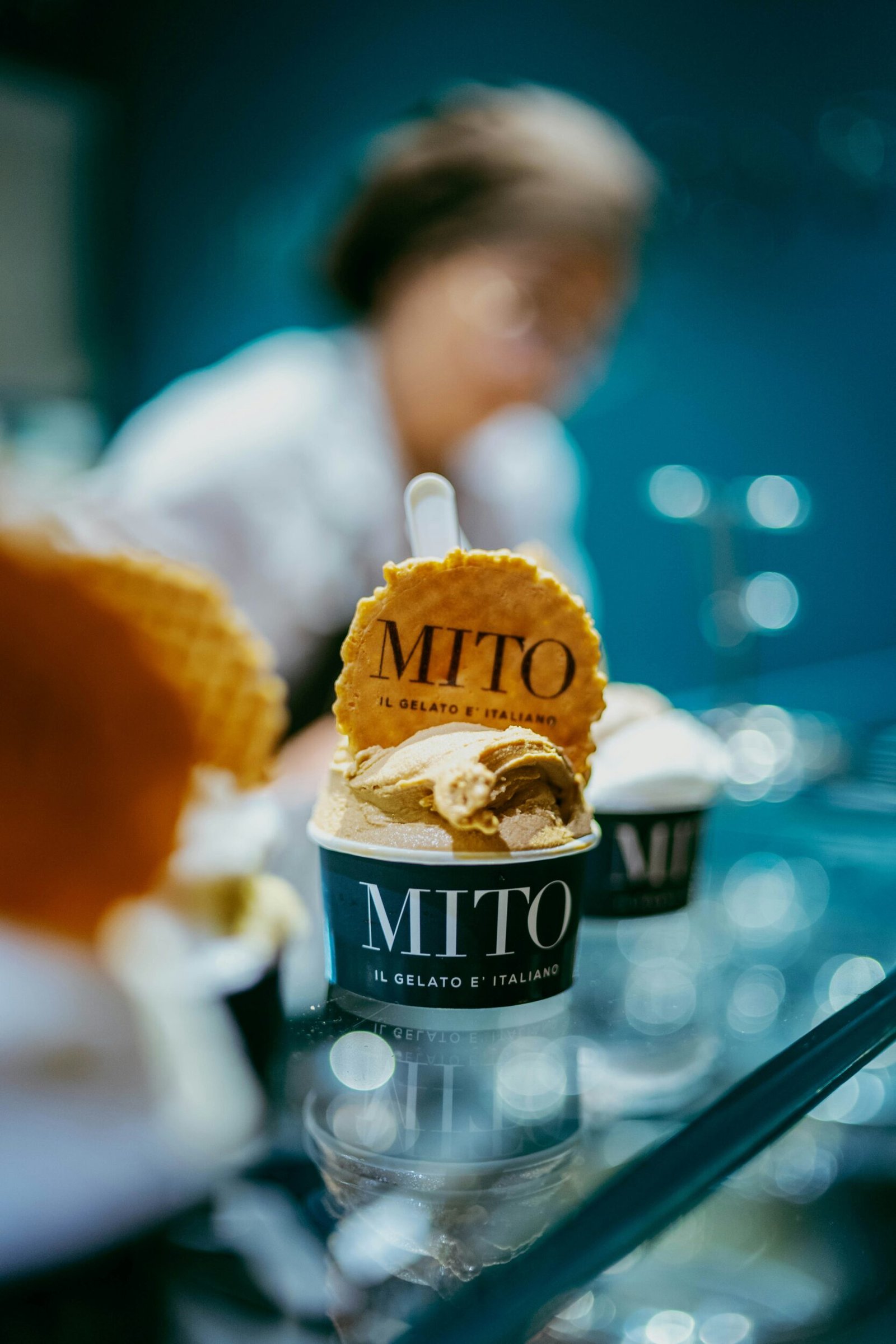
Italian gelato. Photo: tommao-wang-unsplash
What is it?
It is similar to traditional soft-serve ice-cream and is more intense in flavour.
How is it made?
This is a churn-frozen dessert. Its mixture becomes frozen with the churning and rotating action of an ice-cream maker/machine. Italian gelato is denser than traditional ice-cream as less air is incorporated into the mixture during the churning process. Made with full fat milk, egg yolks and sugar or sweeteners.
How is it used/served?
It is a semi-frozen dessert served as scoops or as a topping on a wafer cone.
Sorbets
Red Sorbet. Photo: shelley-johnson-unsplash
What is it?
It is a frozen dessert made from fruit juices, water and sugar.
How is it made?
This is a churn-frozen dessert. Its mixture becomes frozen with the churning and rotating action of an ice-cream maker/machine. The churning action keeps the ice crystals small while incorporating air into it.
How is it used/served?
It is served between courses to cleanse the palate or as a refreshing first course.
It is a frozen dessert made from fruit juices, water and sugar.
How is it made?
This is a churn-frozen dessert. Its mixture becomes frozen with the churning and rotating action of an ice-cream maker/machine. The churning action keeps the ice crystals small while incorporating air into it.
American sherbets contain milk, cream and egg whites. The egg whites increase in volume and smoothness during the churning process.
How is it used/served?
Served as a standalone dessert item or as an accompaniment to other desserts, or incorporated into a frozen dessert recipe.
Referred to as ‘scratched ice’. It is coarse, crystalline ice that is scratched (while still frozen) to create shavings. It is a frozen dessert made from fruit juices, water and sugar. The ice crystals are larger than sorbets.
How is it made?
The mixture is stirred (not churned) while freezing. It does not contain egg whites.
How is it used/served?
The frozen shavings are created at service and must be consumed immediately or it will solidify into a solid mass. Served with whipped cream or eaten with brioche (typically experienced in Sicily, Italy).
It is an ice-cream or sorbet that is set and shaped into a shaped container. An example is a ‘Bombe’ which is set into a smooth domed mould.
How is it made?
The mould is lined with two/more layers of contrasting ice-cream or sorbet, after which the bombe mixture is added. When it's ready to be served, it is sliced and the colourful stripes are then revealed.
How is it used/served?
It is presented as a slice of ice-cream. Brandy, Kirsch or fruit purée can be added to balance the richness. Nuts or glacé fruit can be added for texture.
Still Frozen Dessert
Still frozen dessert. Photo: pexels-evgeniya-davydova
What is it?
It is a frozen dessert made from milk, cream, sugar, flavourings and egg whites.
How is it made?
This dessert not churned during the freezing process. Air is incorporated into the mixture by whipping the base and/or folding egg whites into it to lighten it.
How is it used/served?
It is used to create Parfaits (photo), Soufflés or Semifreddo.
If you liked this post, you'll love this snack recipe.
Disclosure: While this publication uses AI tools for data collection and analysis support, the research questions, hypotheses, and core insights are the human author’s original work.NBL may receive a commission from some referral links mentioned in this article.
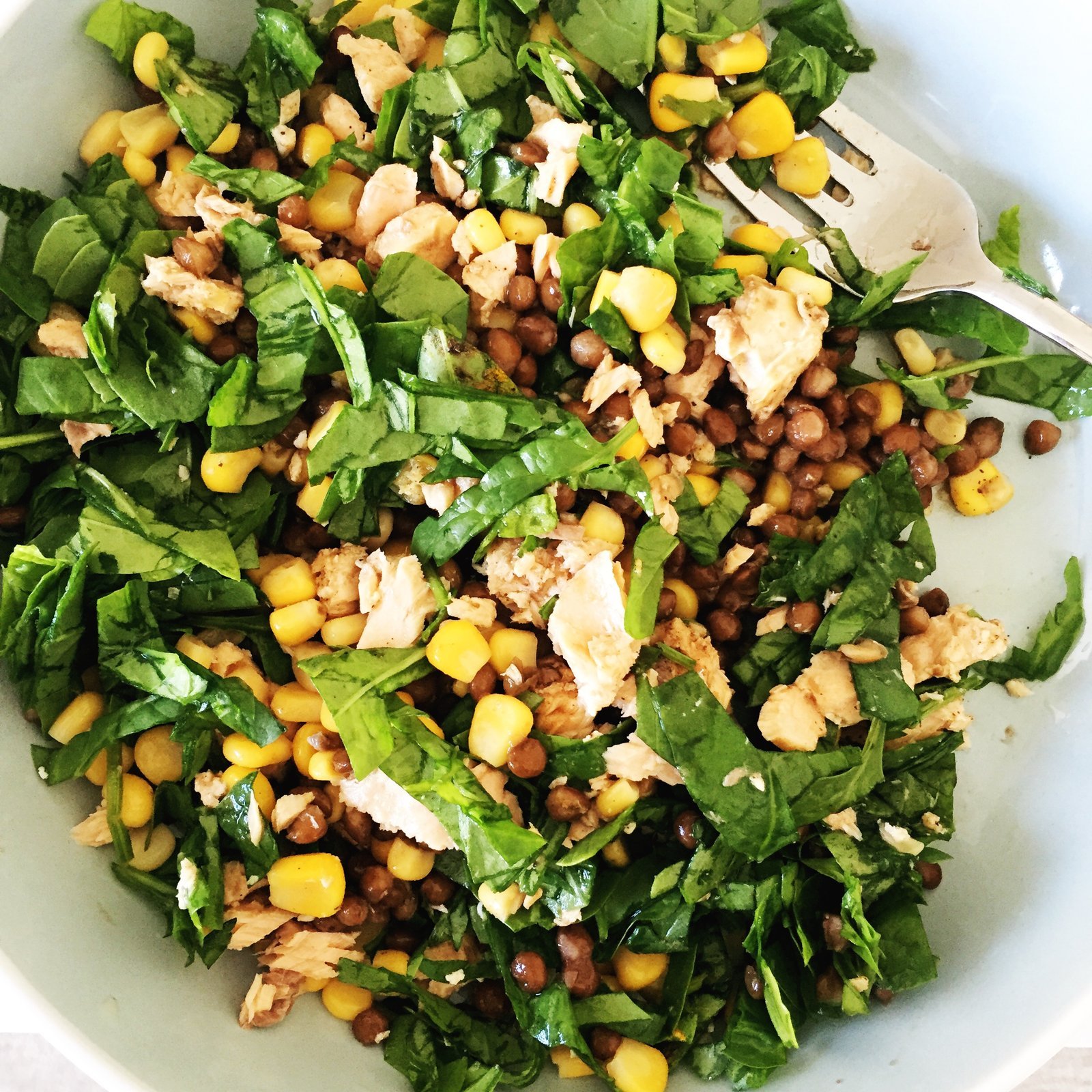
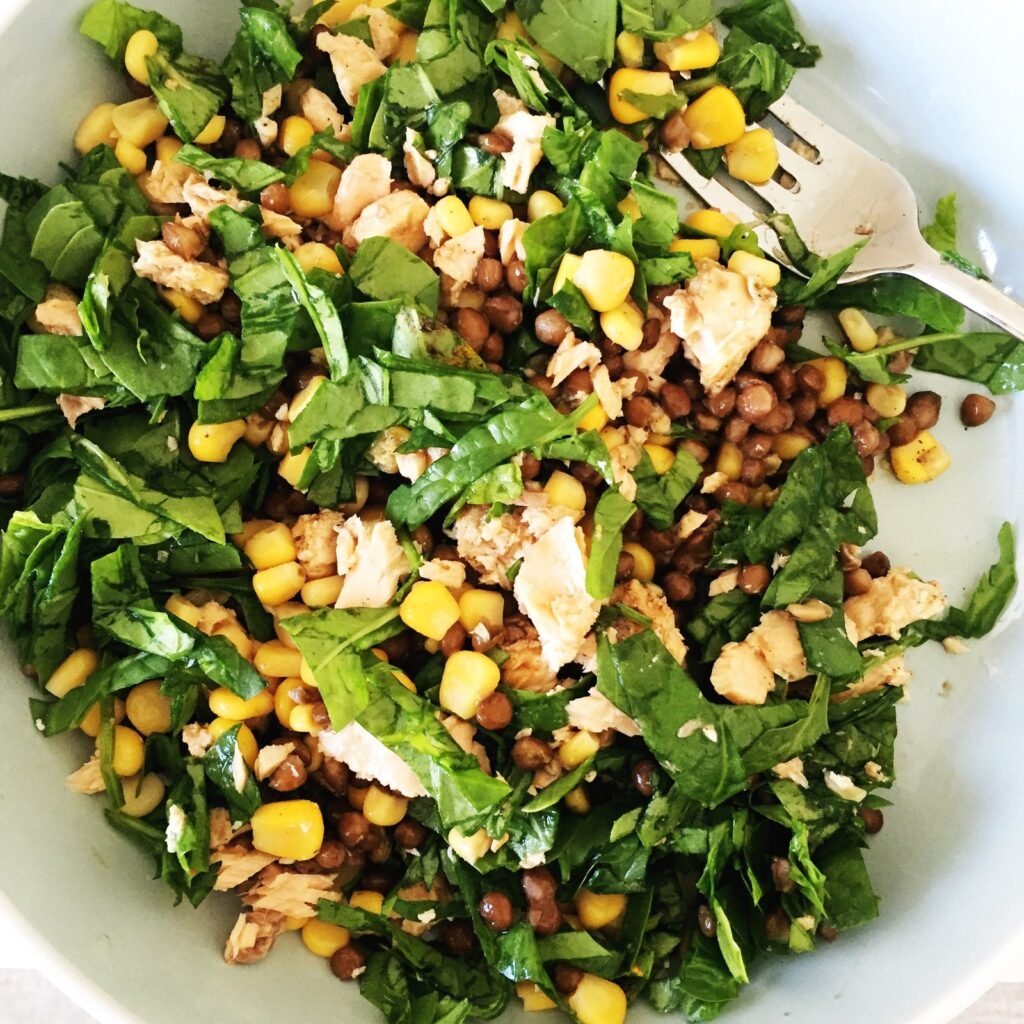
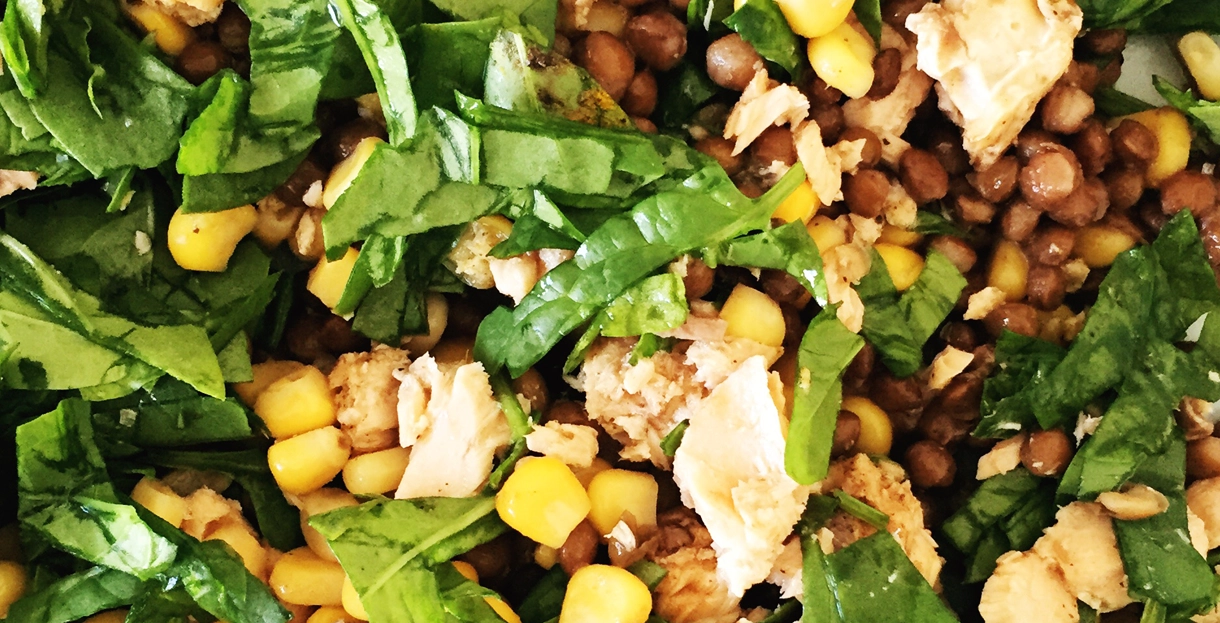
A healthy, delicious, and easy Salmon salad is so easy to make, it's got lots of color and the earthy tones of the brown lentils give it a rustic, farmhouse appeal.
This salad does not need to be expensive given the Salmon ingredient.
I used just one 400g tin of cooked salmon and shredded it by hand. A huge saving and still delicious and full of nutritional value.
What's in this salad?
Lentils
Lentils are a versatile and nutritious ingredient that forms the hearty base of this salad.
Packed with protein, fiber, and essential minerals, lentils add a satisfying earthy flavor and a satisfying texture.
Their nutty undertones complement the other ingredients while providing a healthy dose of plant-based protein.
Sweet Corn
Sweet corn kernels bring a burst of natural sweetness and vibrant color to the salad. Their crisp, juicy texture contrasts beautifully with the tender lentils and delicate salmon.
Rich in vitamins and dietary fiber, sweet corn adds a refreshing element that elevates the overall taste profile and provides a delightful crunch.
Baby Spinach
Baby spinach leaves lend a fresh and vibrant green element to this salad.
They are tender, mild, and packed with nutrients like iron and antioxidants, making them a fantastic choice for a salad base.
Their delicate, slightly peppery flavor pairs harmoniously with the other ingredients, providing a nutritious and flavorful bed for the salmon and sweet corn.
Salmon
Succulent and rich in Omega-3 fatty acids, salmon takes center stage in this salad. Its flaky, tender flesh adds a burst of seafood flavor and a healthy dose of heart-healthy fats.
Grilled or baked to perfection, salmon's mild yet distinct taste complements the earthy lentils, sweet corn's sweetness, and the freshness of the baby spinach, creating a harmonious and satisfying combination.
Something you can use: If you want to eat healthy but don't know where to start, you'll love this salad builder tool.
Salmon-Salad-with Brown Lentils. Original photograph by Fayrooz Abader for NBL.
Nutritional Benefits
Lentils
Excellent source of plant-based protein and dietary fiber
Rich in essential minerals like iron and folate
Low glycemic index helps regulate blood sugar levels
Contains antioxidants that combat inflammation and reduce chronic disease risk
Sweet Corn
High in fiber, aiding in digestion
Natural sugars provide quick energy
Rich in vitamins C and B3 for immune and skin health
Contains antioxidants, such as lutein and zeaxanthin, for eye health
Baby Spinach
Good source of vitamin K for bone health and folate for cell repair
Contains antioxidants like vitamin C, E, and beta-carotene
High fiber content supports digestive health, while phytonutrients may reduce chronic disease risk
Salmon
Abundant in heart-healthy Omega-3 fatty acids (EPA and DHA)
Excellent source of high-quality protein for muscle growth and repair
Rich in vitamin D for bone health and B vitamins (B12 and niacin) for energy metabolism
Contains selenium, an antioxidant that protects cells and may have anti-cancer properties
Conclusion
This salad is so easy to throw together. It really is a no-cook, super-fast meal.
If you're looking to target an Omega-3, iron-rich, gluten-free meal, this is the one for you.
It will also save you time with meal prep because you can fix this for dinner and a work lunch for the next day.
When it comes to finding a dietary solution to chronic skin inflammation, salmon is a great dish to start with.
Not only is it a rich source of omega-3 essential fatty acids, but it also contains important trace minerals like zinc and vitamin E.
So, if you're looking for an easy and delicious way to get more benefits from salmon, read the post for my skin-soothing Ginger Poached Salmon recipe.
Don't forget to subscribe. If you liked this recipe, you'll love this one.
Fayrooz
Easy Omega 3 Salmon Salad with Brown Lentils
A healthy, delicious, and easy Salmon salad is so easy to make, it’s got lots of color and the earthy tones of the brown lentils give it a rustic, farmhouse appeal.This salad does not need to be expensive given the Salmon ingredient.I used just one 400g tin of cooked salmon and shredded it by hand. A huge saving and still delicious and full of nutritional value.
400gramCooked Spinach1 Can of cooked salmon chunks - can use home cooked poached or baked salmon and torn into shreds by hand
Basic salad dressingBasic Standby Salad Dressing to coat / drizzle over - no need to add salt and pepper as it’s already in this dressing. A basic vinaigrette of olive oil, lemon juice, apple cider vinegar, maple syrup, salt & pepper is perfect.
Equipment
Tin cap operner
Chopping knife
Cutting board
Method
Cut baby spinach leaves into ribbons (chiffonade cut)
Rinse and drain brown lentils and sweet corn.
Place all ingredients into a large mixing bowl, except the salmon
Pour over the salad dressing
Pour over the salad dressingWith your hands, turn over the ingredients until everything is well coated.
Pour over the salad dressingWith your hands, turn over the ingredients until everything is well coated.
Tip this into a wide salad bowl of serving plate
Place the shredded salmon pieces all round over top, as you like.
Notes
Keeps in the fridge for up to 3 days but I don’t think you’ll have any left after day 1.It’s delicious, filling and loaded with nutritional ingredients. See the nutrition index and nutritional benefits of each ingredient below the recipe.Remember that salads that coated with dressing (as opposed served on the side) will moisten the greens, so when storing in the fridge it will lose the crisp texture after 1-2 days.If you love making raw food dishes, you'll love this salad builder tool.
Disclaimer: The author of nichebloglab.com and the articles and recipes hosted on this website, does not give medical, physical or mental health advice directly to any specific individual. In the references to it, the phrasing is used to illustrate a point or give context to the information. It is not related to the specific condition of any specific individual. Always consult your healthcare professional for physical and mental health or CBT advice. The recipes published on this site do not advocate or advise on food consumption or dietary requirements as it pertains to any specific individual. Consult your healthcare professional for advice on food allergies and dietary restrictions. See our Legal Policies for more details.
The heart chakra out of all the chakras does hold the answer to solving a lot of problems within ourselves. And it’s also the area that can alleviate the effects of triggers because a lot of our problems lie within how and what we think of ourselves.
When we have a poor or harshly judgmental self-image, or we have been bullied, mistreated, or lost everything, the only solution I believe is:
Self-love.
When talking about self-love, the chakra this is associated with is the heart.
Why is healing the heart chakra a solution to dealing with triggers?
All of our chakras have a role to play in alleviating pain and bringing us back into alignment.
But, I find that a lot of our conditioning and self-inflicted wounds are caused by a poor self-image.
Our self-image is derived from how and what we think of ourselves - how we perceive ourselves with others and what we expect of ourselves. As you know, we are naturally hard on ourselves. It’s intuitive.
Expectations are a tricky thing
We’re also quick to complain that others are expecting too much of us and we often downplay or suppress the pressure we put on ourselves to perform, reach, achieve, accumulate, or solve something.
High, challenging, or impossible expectations are a factor that influences our self-image. It instills in us to have a competitive relationship with our inner voice, which in this context manifests as our inner critic.
That inner critic is the one that confirms whether we’re a coward for not living up to those expectations or a winner when we do.
Being separate from yourself
I have found in my experience that when triggers happen, or even panic attacks, they can sometimes be inflamed or amplified based on how I’m feeling about myself.
In your case, You may not even be aware that you’re feeling good or bad about yourself. You may not even be aware that you like or don’t like yourself at that moment.
When this happens, the reason might be that you’re not present at the moment to acknowledge it. It’s like you’re disconnected from yourself or in denial.
Loving yourself more
It may sound corny to some, but I find the best way to come back to a good place - when someone or something triggers you, or you’re triggering yourself with rumination- is this:
Say to yourself
“I value myself”
“I am grateful for everything I have”
“I return to me. Always”
“I am already enough”
“I choose HAPPY”
These mantras work to support the heart chakra.
You need to remind yourself when all else fails - because triggers can be powerful on some days - that:
you love yourself
you respect yourself
nothing can touch you
that you trust yourself
Know that self-love is your protector.
TIP Asking yourself “Do I trust myself?” and replying “Yes, I trust myself”, can be very empowering. This is a great mantra to practice when you are in doubt or when you are facing a competitive FOMO (fear of missing out) trigger. I’ve found this to work well with FOMO when it comes to impulsive spending
You do need to talk yourself up to yourself. Muster the courage to do it.
The healing energy of natural, energy Crystals
What crystals to carry with you during the day, to support your heart chakra:
Rose Quartz
This is a beautiful light pink crystal. It is so feminine and truly my favorite. For me, it is the color of romance. Girlish and pretty, I find it comforting, as it connects me to my inner girl-child. It does make me feel loved and cared for, especially on extra sensitive days.
Green Aventurine
This is a very ‘lucky’ crystal that is light, blue-green. Green is a soothing color that….
Malachite
This emerald green crystal has beautiful dark green, rhythmic wavy lines running through it as though it’s washing through the grain of the stone. It does resemble elegant, waves. It is a stone associated with wealth and the heart and is known to heal by supporting the release of anger and strife - all connected to what we might hold in the heart.
I recommend you wear them as crystal bracelets. You can get some beautiful, chic, and delicate ones like these.
Wear them on your left arm - the powerful, beautiful, healing qualities are drawn in through your left hand.
TIP If you want to send or give out this energy to the world, wear it on your right arm.
Crystals are a beautiful and subtle way of holding these energies close to you when you’re unable to burn incense, or sage, or meditate to clear your energies, align your chakras, or return to the center.
It can help you at work or generally when you’re outside of your home and away from your protective space.
How to eat for your heart chakra
Whether you are experiencing a trigger, dealing with the aftermath of a panic, or keeping your mental health in check, it is good to be aware of how your diet affects your mental health.
While there are many approaches to this and we’ll get into that in another article, it can be a delightful and self-soothing approach to ‘eat for your chakras’.
I take the art of healing and aligning the chakras quite seriously but, there’s always room for levity…in a supportive way of course.
Thinking of food and the different colors of different foods can be inspiring and uplifting.
So, I encourage you to indulge in as many things that bring you ‘up’ and fill you with joy and a feeling of being enriched.
And if you love food as much as I do, then eating for your chakras will inspire you to get cooking and search for recipes that will be a delight for your senses as well as support the energies of your healing centers.
For your heart chakra, I recommend you eat foods that are pink, light green, or deep green.
The foods listed below are delectable and have so many nutritionally healing qualities too.
I cannot overstate the value of journalling every morning. It is brilliant for setting intentions, but also for practicing gratitude first thing in the morning before anything else happens.
I believe you can practice gratitude any time of the day. You can even journal to write out your thoughts during the day if something happens and you need to self-soothe. You should be able to do this whenever your need to and that also means being able to do it more than once a day if that is necessary for you.
There are no rules.
The morning, however, is better because it gives you a gentle and thoughtful start to the day -as opposed to sprinting through breakfast, shower, and commute to work or rushing into your home office to check emails.
Try morning journalling as a way to set intentions, release what is on your mind, and unpack your dreams if nothing comes to mind - it’s perfectly okay to be faced with a ‘blank’ page - just give thanks for what you have within you and around you, at that moment, on that day.
Trust me, it’s enough. Whatever you journal is the right thing. It will always be enough, like you.
When journalling for the heart chakra, I like to write mantras or affirmations in bright pink with either a pink art pen or a neon highlighter. As long as it makes me feel - the way it makes you feel is important, not what you think is ‘right’ - like it’s from and for the heart. That means it needs to be pretty, romantic, pink, beautiful, soft, feminine, and of course a high, positive frequency.
Start with an affirmation that affirms your love for yourself eg. “I LOVE myself”
Write a second affirmation that affirms your commitment to taking care of yourself eg. “I give myself what I need right now because I LOVE myself”
Write a third affirmation that affirms you are feeling loved right now eg. “I am LOVED, I am cherished, I am filled up with JOY”
Once you have stated that upfront, you should immediately sense a shift, even just a subtle one. You should feel confident and less anxious (if you are prone to that)
After this, you can carry on in free flow or bullet point form and journal out the rest of your thoughts.
Conclusion
I hope these tips have helped you gain insight into how you can support, heal and align your heart chakra.
Do download my free journal printable here, with all the above journal prompts for your heart chakra. Download and print these as many times as you like.
If you liked this article you’ll love this one on Healing the root chakra - what to do when you experience a trigger
I hope you enjoy these and feel free to leave me a comment if these helped you, I value all feedback.
If you liked this post, then you'll benefit from reading about culinary nutrition - food and they we way cook has an affect on our emotions at different times of day. It'll definitely get you thinking.
A food philosophy is sometimes based on a deep conviction one holds about a topic or environmental issue. Or, simply a lifestyle choice or habit informed by past or present experiences. It could also be a set of personal beliefs or values.
What is a food philosophy?
When I started studying culinary nutrition back in 2020, I was tasked to come up with a food philosophy. Assuming all newbie students have some idea of what their mission with food and health was.
I didn’t. I just wanted to learn how to cook healthy.
But, I was forced to think and really consider what that was.
Why was I there and what did I want to achieve with my culinary nutrition course?
When I began to contemplate it, I soon realised that I actually did have ‘eating values’.
I thought I just wanted to learn how to bake gluten-free from the experts.
But it was indeed a set of values I had subconsciously held all along.
This is what a food philosophy is:
It is a set of principles, usually individual but not limited to, which guides food choices and eating styles.
These principles can be dictated by health conditions, ideological beliefs about environmental sustainability and farming methods. Or it can even be influenced by eating styles as well as an awareness of what is beneficial for building optimal health.
My commitment to cleanliness, purity, minimalism, honesty, and authenticity drives my food philosophy in cooking, food preparation and eating.
So, in my culinary practice, I strive to maximize flavor and eat mainly unprocessed foods. I do this to eliminate artificial ingredients as well as seasoning substitutes used to imitate natural flavors.
I believe what is nourishing should be just as flavourful as regular food.
My goal is to maximize a few essential ingredients to create food that is delicious and satiating. As well as boosting essential daily nutrient intake.
8 Values that underpin a culinary nutrition practice are:
To cook with fresh raw ingredients: Remove shelf-stabilising ingredients by eating freshly cooked meals. In other words, know what you're consuming and how it's prepared.
Use naturally grown and harvested ingredients. Don'tuse or eat anything 'fake' - I know you're consuming and how it was created
Use natural flavours derived from whole foods or plant-based ingredients: Don't use no fake flavours.
Nutritious food should be easy to cook or assemble. Understand what you’re eating because it makes it easier to put together.
Healthy food swops. Use natural ingredients that taste as close as possible to your favourite ‘regular’ food. Without worrying about sacrificing your health.
Culinary innovation. Become more creative and innovative with whole unprocessed foods and flavours. You can do this once you gain a deeper understanding of its nutritional role and cooking potential.
Adopt an eating style that has staying power. Knowing that I can create flavour in all my meals is a strong motivation to sustain this way of eating. As well as staying on this path of wellness and ‘clean-ness on the inside’.
Take responsibility for your good health: The healing, prevention and maintenance of health challenges is ultimately my responsibility. This way of cooking and eating makes me feel like my food and health is not in someone else’s hands.
Thinking about what you like and dislike on your ‘table’ or in your pantry will always be dictated by your or your family’s lifestyle and health goals.
This is a great place to start. Look at your buying patterns, what’s in your grocery cart, and what you generally crave.
Hopefully, it is along nutritional lines or a general sense of well-being and common sense.
Conclusion
You don’t need to be a certified culinary nutritionist or holistic health practitioner to know what is good or bad for your health.
Observe what you won’t compromise on in terms of eating style and ingredients. Investigate what those represent to you and what nutritional value they contain.
You’ll immediately see a pattern and soon you’ll understand and become aware of what you stand for when it comes to types of foods, what you’re eating, and where it comes from.
This is the beginning of developing your personal food philosophy.
So you see, having a food philosophy is not just for the ‘professionals’.
Disclaimer: The content of this article is not offered as professional medical advice. It is nutritional insight that should be followed with discretion and/or in consultation with your healthcare practitioner or physician. Always consult your doctor before embarking on any dietary changes if you are suffering from chronic Eczema. Use the information provided at your sole discretion. See our Legal Policies for more details.
There is no cure for your Eczema but there are foods that could help you clear Eczema naturally.
You can’t create the absent skin barrier that sets all Eczema sufferers apart from everyone else. But there is an alternative to the treatment and healing of Eczema symptoms that does not require conventional prescriptive drugs.
What you eat plays a huge role in how your skin behaves. It’s safe to say that eliminating certain foods can change the condition of your skin. But including certain foods can also add beneficial nutrients that improve the quality of your skin and assist with how your body responds to the inflammatory reactions that cause the symptoms of Eczema or Atopic Dermatitis.
Below is a list of Eczema-friendly foods – and why they’re good for you – to include in your meal plan or existing recipes.
Use these to inspire you to try a non-conventional approach to treating and healing Eczema symptoms.
Foods that can help you clear Eczema naturally - include it in your recipes or enjoy on its own:
These vegetables are rich in carotenoids, especially carrots which are loaded with Beta-Carotene, a powerful fat-soluble antioxidant. The effect of these antioxidants reduce inflammation where there is an Eczema patch on the skin.
Kale nutrition
It’s dark and leafy in color and shape but even richer in nutrients and minerals. It contains vitamins C and K. And it has anti-inflammatory and cancer-fighting properties.
Kale contains double the amount of Vitamin C than Spinach and is also lower in a plant compound called Oxalate (Oxalic acid) that can inhibit the absorption of minerals and nutrients3.
Kale is a nutrient-dense leafy green vegetable that is high in vitamins, minerals, and antioxidants.
One cup of kale contains more than your daily recommended intake of vitamins A, C, and K, as well as calcium, potassium, and iron.
Carotenoid-rich Kale
Carrot nutrition
It’s a good source of Potassium, which can help regulate blood pressure and reduce the risk of stroke. This carotenoid-rich vegetable does this by reducing inflammation.
Carrots are a great source of vitamin A, which is essential for healthy vision, immune function, and skin health. And it's high in Fiber, which can help promote satiety and support digestive health.
Carrots overall are excellent for weight loss and I eat it daily in a carrot and red lentil soup.
It’s a well-known plant-source of provitamin Vitamin A and contains Beta Carotene, a powerful antioxidant which helps prevent free radical damage to cells.
It's also got Vitamin C that boosts immunity by helping the process of wound healing.
It contains Vitamin K1 which plays a significant role in blood clotting, important during injury for stopping blood flow. Fat-soluble Vitamin K1 is important for heart and bone health.
Both Vitamins C and K1 have anti-inflammatory and cancer-fighting properties.
Another benefit of carrots is its insoluble fiber content which promotes regular bowel movement.
These gorgeous fruits are high in antioxidants and it contributes to the production of Collagen which gives skin it's structure. Hydrolyzed collagen is known to contain antibacterial properties which is great for Eczema skin as it can be susceptible to infection.
Mango also contains Vitamin E, an antioxidant that has appeared to reduce inflammation5. It contain Vitamin A and C which are both antioxidants that have an anti-inflammatory effect.
Spinach nutrition
Spinach is rich in Vitamin C which is an antioxidant and helps prevent the oxidation of cells. Cancer is also brought on by free radical damage in cells, so it’s crucial to get as many antioxidant benefits (which prevents it) from these ingredients.
It also helps reduce inflammation.
Spinach also facilitates the production of collagen in the body, L-Carnitine, and some neurotransmitters2. Water-soluble Vitamin C helps absorb minerals such as Iron which is beneficial if you are anaemic or have an iron deficiency.
Spinach contains Vitamin K, also known as Phytonadione, It's essential for blood clotting and it's also important for bone and heart health. The vitamin is referred to as K1 and can be found in plant foods like dark, leafy greens such as Broccoli, Kale, and Spinach.
Clear Eczema naturally by adding nutrient-rich Kale, Carrots, Mangoes, Sweet Potatoes, Spinach and Red Cabbage to your recipes
Red cabbage nutrition
Red cabbage is rich in antioxidants and other compounds that can help fight inflammation.
It's also high in Vitamin C, an antioxidant, so it helps protect against oxidative stress. It has been reported that a deficiency in Vitamin C can aggravate atopic dermatitis1 symptoms, something to keep in mind if you have this particular type of eczema2.
Red cabbage, like many red and purple fruits and vegetables, contain flavonoids called Anthocyanins. It plays an antioxidative role in fighting chronic inflammation.
Celery nutrition
This fragrant and versatile fresh ingredient is high in potassium and is beneficial for suppressing inflammation. Its leaves add an extra layer of flavor and work well as a herb replacement.
If you wondered what gives Celery its famous smell, it's a chemical called Coumarins. Celery is known for its anti-inflammatory benefits. It also contains Vitamin A which is beneficial for skin health.
Sweet Potato nutrition
Sweet Potatoes are rich in carotenoids that have an antioxidant effect which reduces inflammation.
It’s are also rich in Vitamin C which reduces the levels of histamine and is an antioxidant that protects the skin from allergic reactions. The orange coloured sweet potatoes are even more nutritious as they contain a concentrated amount of the antioxidant Beta-carotene which is powerful for maintaining skin health.
Heal Eczema Naturally with these two Superfoods - Garlic and Ginger
Ginger nutrition
This centuries-old medicinal food reduces inflammation and contains essential oils that interrupts the chemical reaction that occurs when inflammation occurs. Great for the healing and prevention of an Eczema ‘flare-up’.
It also contains Gingerol, a potent anti-inflammatory that has an antioxidant effect2. Antioxidants reduce the effects of free radical damage ie. the oxidative stress on cells.
Garlic nutrition
This flavour powerhouse contains an anti-inflammatory compound Diallyl Disulphide. Garlic is best eaten raw or lightly cooked to get the maximum benefit of this nutrient.
Garlic also has great antibacterial and anti-fungal properties, which can help boost the immune system. It's packed with Vitamin C, B6, and Manganese - all important nutrients for your overall health.
Omega 3-rich Fish such as Salmon, Mackeral, Herring and Fresh Tuna can suppress inflammation in Eczema
Salmon nutrition
You can eat any cold water fatty fish. The idea is to get as much Omega 3 and Omega 6 benefits from it. So try mackerel, herring, cod, sardines, and pilchards also. These fish contain Polyunsaturated fats.
Salmon is a great source of omega-3 fatty acids, which have been linked to numerous health benefits, including a reduced risk of heart disease.
It also contains magnesium which can provide a mood boost and many other brain and mental health benefits. Magnesium helps reduce anxiety during an Eczema flare up thereby reducing the urge to scratch and aggravate the skin.
Salmon has a high level of Omega 3 fatty acids which can actually turn off the inflammatory reaction.
This delicious and versatile vegetable contains Quercetin and Vitamin C which both reduce the levels of histamine that induces the allergic reactions in the skin.
Bell peppers, in particular red ones, have much more antioxidants than their yellow and green counterparts. It contains Quercetin (the yellow and green ones also have it), a natural antihistamine that can reduce the chronic inflammation induced by allergies, for example, Eczema.
Bear in mind that these peppers contain a moderate amount of amines and salicylates, which are natural chemicals found in the skins of certain vegetables.
Some people are allergic or sensitive to this. So, get yourself tested for it or do a simple elimination-and-reintroduction test at home.
Cannellini Beans nutrition
These beans contain a powerful antioxidant called Ferulic acid that enhances the effect of carotenoids and prevent free radical damage.
Cannellini beans are a good source of Folate. These beans contain a powerful antioxidant called Ferulic Acid that enhances the effect of carotenoids and prevents free radical damage in skin cells.
It also enhances the effects of Vitamin E, another powerful antioxidant. Cannellini beans are rich in Zinc, which is good news if you suffer from very dry or too oily skin because it will correct the imbalance. Zinc is highly beneficial in the recovery process as it helps with wound and tissue healing - good for Eczema patches are exposed, bleeding or ‘weeping’.
Avocado nutrition
Rich in the anti-inflammatory Omega 9 fatty acid known as ‘Oleic Acid’. Find it in Olive and Avocado Oil.
Avocado is delicious anytime of the day, at any meal time.
It is rich in Omega 3 Essential Fatty Acids that are essential to heart health as they reduce inflammation and protect blood vessel walls. They help with the normal contractions of blood vessel walls.
Avocados contain Vitamin E that is essential for skin health as it maintains and improves the condition of elastin in the skin (keeps skin supple) and helps protect the skin barrier.
It also contains Potassium, another micronutrient is essential for heart health and can help lower blood pressure.
Avocados are high in antioxidants. These compounds are most famous for its cancer-fighting benefits. It’s important to include as many into every meal you consume.
Apricot nutrition
Contains Catechins (flavonoids) that suppress the activity of substances that switch on inflammation.
Apricots contain Beta-carotene, a precursor to vitamin A that is essential for maintaining skin health. Beta-carotene helps repair skin tissue and reduces inflammation, perfect for Eczema.
Prawn nutrition
If you have seafood sensitivities, then this food will not be an option for you.
Prawns are high in Zinc which is beneficial for wound and tissue healing - perfect for cracked and ‘weepy’ Eczema patches.
The nutritional constituents help to modulate inflammation by regulating the body’s immune responses and so reduces the aggravation of an eczema flare-up.
Pear nutrition - Choose a fruit that's the most alkaline for eczema
This is the most alkaline fruit you can eat. It is good for skin health, particularly if you have eczema or psoriasis, because it's the lowest in amines and salicylates.
Pears contain a high level of Vitamin C, a powerful antioxidant which benefits cannot be overestimated.
This fruit is the lowest in Salicylates which is a natural compound found in foods which can induce sensitivity reactions.
Pears are delicious and very alkaline, making them gentle on skin conditions and beneficial for the health of skin in general .
Conclusion - How Anti-Inflammatory Foods Can Help You Clear Eczema Naturally
So when conventional methods for treating your Eczema don’t work or are just breaking the bank, try changing your nutritional intake instead, by incorporating more of these eczema-friendly foods
A constructive approach is to include the right foods for your skin condition into your diet. Don’t just follow a process of elimination. Embrace a process of inclusion to create balance and maximise your nutritional intake to treat and possibly heal your Eczema symptoms for the long term.
Also, don't negate the medicine / treatment. If you suffer from chronic eczema, keep applying your treatment during flare ups as per doctor's orders, but explore what the foods are about (alongside that) especially during remission. See which ones you like, are able to cook with and which ones you don't have any allergic reactions to - remember the amines and salicylates factor.
Always consult your doctor / healthcare practitioner before embarking on any dietary changes.
If you liked this article, you’ll enjoy this tool.
Disclaimer: The content of this article is not offered as professional medical advice, but is merely nutritional insight that should be followed with discretion and/or in consultation with your healthcare practitioner or physician. Always consult your doctor before embarking on any dietary changes if you are suffering from chronic Eczema. Use the information provided at your sole discretion. See our Legal Policies for more details.
Healthy Snack - Toasted Coconut Tamari Chips
Here's a great snack alternative to sometimes greasy and always salty, fried potato chips.
Even packaged, baked maize chips, whether it claims to be MSG and tartrazine-free, is not considered healthy.
I know the irresistability of reaching for a packet of chips in times of stress or even boredom, especially while binge watching a favourite show.
So, this is exactly why having a nutritional alternative is vital to have in your healthy cooking repertoire.
Toasted Coconut Tamari Chips is just such a healthy snack. And if you're not a fan of coconut, don't shy away from this recipe. The addition of the umami flavour from the Tamari sauce kicks it up a notch and makes it taste like a savoury snack.
And if you're watching your calorie intake, fear not. The raw coconut chips are healthier than the dessicated kind which are processed and contain lots of calories.
Golden toasted tamari coconut chips (flakes)
Nutritional ingredients
Coconut flakes (chips)
This ingredient is not just a delicious addition to breakfast and desserts. I discovered this recipe through my collaboration with a nutritionist, so I owe this recipe to Anita.
It's one of the best snack recipes I've learnt to cook because it's so easy to throw together and I absolutely love it.
Raw coconut is a healthier choice than the dessicated kind which contain a high amount of calories.
Coconut is also regarded as a ‘warming’ food, so it has the effect of making one feel a sense comfort and ease.
Tamari Sauce
This sauce is a gluten-free, low-sodium alternative to the classic and much loved soy sauce. Soy sauce is a classic ingredient in Asian cooking and also tastes wonderful as a topping on a bowl of pure mushroom soup.
Another alternative to Soy sauce is Coconut Aminos.
Himalayan Salt (Pink Salt)
I always cook with this salt as a healthy alternative to iodated, table salt. It's a mild salt, so when cooking with it, be aware that this mildness may cause you to add more just to get your desired flavour.
More salt is never a good idea, flavour your meals in moderation. If you still crave saltiness, then try adding natural (non-irradiated) spices and/or fresh lemon juice.
What does that mean? It’s a combination of anti-viral, anti-fungal and anti-bacterial properties.
Coconut is high in electrolytes, calcium, potassium and magnesium.
It also aids digestion and reduces inflammation.
Good fats: Coconut is high in fat, but in a good way. It’s a saturated fat meaning it is solid at room temperature (coconut oil) and turns to liquid when heated.
Naturally derived fat is healthy, but it’s the hydrogenated (pumped full of hydrogen) saturated fat that you need to avoid.
Coconut is a medium-chain fat and a great source of energy. Our bodies will burn through it so it’s less likely to be stored as fat.
Being a plant-based food it also contains an essential amino acid called Leucine which is associated with muscle health and repair.
FUN FACT: Did you know you can use Coconut Sugar as a sweet alternative in sweets and desserts?
It’s naturally gluten-free and free from GMOs. Perfect for vegans and it’s also sold as unrefined and unbleached.
Where does it come from? The coconut palm tree produces a nutrient-rich "sap" that comes from it’s coconut blossoms. This sap is low GI (35) and is a source of multiple minerals such as amino acids, B vitamins as well as Vitamin C. It has an almost neutral pH so that alkalinity is good for gut health.
Coconut sugar has a strong, caramel flavour and is not as ‘sweet’ as sweetener, honey or maple syrup. It’s not my first suggestion to sweeten coffee or tea, but there’s nothing wrong with trying it if you like. However it’s a great sweet ingredient for baking recipes.
Tamari
Tamari is known for multiple nutritional benefits and it’s most famous for being gluten-free. So, it’s great news if you need to eat allergen-free.
It’s also high in protein and can aid digestion.
The brown pigment that gives it it’s colour contains a high level of antioxidants and therefore has anti-cancer benefits.
It contains multiple minerals such as zinc (good for tissue repair), copper, manganese and potassium (good for blood pressure and heart health).
Conclusion
The health benefits of this simple, healthy snack are quite incredible. And the next time you reach for a condiment, think about the nutritional benefits of Tamari.
Coconut oil is a staple in my pantry and for anyone practicing culinary nutrition. It’s also an amazing ingredient in natural homemade beauty products such as deodorant and toothpaste.
So, if the nutritional benefits of Coconut haven’t inspired you yet, give this healthy snack a try. You’ll soon be hooked enough to consider this nutritional ingredient in more recipes at home.
Fayrooz
Toasted Tamari Coconut Chips
Toasted Coconut Tamari Chips is made from raw coconut flakes. It's low in calories and full of umami flavour - the perfect healthy snack and a tasty alternative to greasy potato chips.
PinchHimalayan Salt / Pink SaltCan omit the salt. It's all a matter of taste and preference
Equipment
oven
Method
Heat convection oven to 120 degree celcius.
In a glass mixing bowl combine the coconut flakes and Tamari sauce.
Using a mixing spoon, toss the Tamari through the coconut flakes. Make sure it's all lightly coated.
Spread the coconut flakes across the baking sheet. Make sure there is no clumping so that the flakes bake evenly.
Place the baking sheet in the heated oven and bake for 20 min. At 10 min (halfway) mix and turn the coconut flakes so that it all 'browns' evenly.
If you prefer it crunchier and darker, bake it for an extra 5-10 minutes.
Once baked, add the Himalayan salt to season or you can omit the salt if you prefer.
Notes
Cook's notes: For a darker, golden brown colour and crunchier texture, bake in the oven for an extra 5-10 minutes.If you love making raw food dishes, you'll love this salad builder tool.
Disclaimer: The author of nichebloglab.com and the articles and recipes hosted on this website, does not give medical, physical or mental health advice directly to any specific individual. In the references to it, the phrasing is used to illustrate a point or give context to the information. It is not related to the specific condition of any specific individual. Always consult your healthcare professional for physical and mental health or CBT advice. The recipes published on this site do not advocate or advise on food consumption or dietary requirements as it pertains to any specific individual. Consult your healthcare professional for advice on food allergies and dietary restrictions. See our Legal Policies for more details.
Choosing a career path based on something that you think you’re good at is an obvious choice. It seems like the easiest and most sensible thing to do.
But, defining your career path should be based on the following:
Knowing the difference between what comes naturally and what you're good at. And why one is better than the other.
On getting hung up on the obvious. Doing what's expected. And adjusting to fit.
So you invest time and money into it, not forgetting the emotional and physical commitment.
It's all you think about and it's all you talk about. It becomes a conversation starter when you’re socially awkward or you want to be heard.
The truth is, having any direction is better than none at all. It gives you a sense of purpose or let's use a trendier phrase…’a sense of agency’.
But what happens when it becomes unfulfilling even when the money is good?
No project or commitment is easy, but doing what is right for you should feel natural – the way you are in your most mundane moments. It shows up in the things you do proactively, not out of obligation.
Doing what feels natural is not the same as doing what you’re good at.
The latter implies a learned skill, process, method, or behavior that is repeated self-consciously.
The former is what happens intuitively unaffected by preconditioned notions or behaviors and is repeated unselfconsciously.
“How did all this come about? Have I done something wrong?”
The drama sometimes starts at the point of childhood. Certain traits and talents become obvious to people around you and then you become conscious of it.
In my experience, I was always good at drawing but not conscious of it. Until people around me started pointing it out. All of a sudden I was something.
I got cloaked in the identity of an artist, a drawer, and a ‘talented’ person - and I conceded.
As I got older, I became interested in other things but felt obliged to live through that identity instead. It was created for me and accepted by me because it made total sense, ie. I was a good drawer. None of it was fake.
It just never brought me lots of money or happiness. It came naturally, yes, but it never felt like my true nature.
My true nature is the stuff I do to pursue and feed that artistic thing.
It's the fact that I write more about it than actually doing it.
The tips, advice I give and observations I make about it rather than sitting down and being in the process of actually making it.
It's nothing new, we always rise to the wrong occasion.
Does one path need to be swapped out for the other? No. Rather be aware of how they co-exist. Both should be nurtured in tandem.
Be aware of what you’re practically good at that gives you a sense of purpose.
Also, be aware of the things that don’t require a learned process or behavior.
Using my example: Drawing constantly is just a learned behavior we discover for ourselves and which we interrogate through repetition. Then someone experienced teaches us techniques that facilitate that repetition until we eventually master it. So this becomes the thing that we’re good at. It's not our true nature. It only creates a sense of belonging because you’re adding to a conversation. That’s important, but so is what makes us feel independent and fulfilled.
The thing that comes naturally - that makes us pursue drawing intuitively - is our curious nature, the passion to observe, investigate and interrogate a thing (object) or collect visual information about something. That is actually the thing that's bringing fulfillment. The drawing is the vehicle.
Being aware of the differences can improve the quality of your life not just financially but emotionally as well.
What is the Solution? How do you discover what your natural path is?
Try this:
Observe what you’re doing around that ‘thing you’re good at’.
What would you rather be doing instead?
Pretend money isn’t an issue and that everything is free. Don’t think about what you ‘would like to be doing’.
What are you doing? Write it down.
It needs to be effortless and every repetition of it should feel like the first time, ie. like ‘it never gets old’.
That's a clue. It's the essence of a career that is right for you.
For example, again, I am always writing about what I’m going to draw through lists and research. And I’m always decluttering without motivation, meaning I love clarity. So, I’m always looking for information and ‘how-to's’ and constantly learning. In fact, I've made learning a lifestyle by choice - spontaneously and without financial motivation. I use it as an excuse to avoid drawing - I know I can draw, but it's not an issue. I do it well, but on a psycho-emotional level, my true nature is that of a searcher.
I’m not a collector of art materials but a hunter and gatherer of information about it.
No surprise I create and write content for multiple blogs. It's the thing I would do more for zero money.
Conclusion
I am a huge proponent of pursuing what feels effortless and doesn't require you to try too hard.
Reinvention is fun and keeps things fresh. But, that shouldn't be toyed with. It's best left for fashionable or temporal pursuits.
When it comes to defining how you spend your days and the conversation you want to be adding to for the rest of your life, that requires thoughtful observation. You need to invest the time to become highly self-aware and comfortable with using your intuition.
Intuition and instincts are not the same - in my opinion at least. Instinct is how you respond in a situation, usually in a fight or flight scenario. It kicks in pretty fast. Intuition, on the other hand, is a slower, deeper process and one that you should pursue developing to your advantage. It works wonders in business, of which your career path forms part.
Subscribe below to get the latest blog posts and more.
Not all hobbies, especially therapeutic ones are meant for everyone.
Below is a list of insights to help you understand whether this practice is indeed right for you.
Let's take a look.
Bullet journaling is right for you if :
you want to uncover your thoughts
to make notes of your triggers
to document your physical symptoms that are triggered by your thoughts
to get clear on what you want
to be clear on what you don't like
to list your dreams
to make notes of what you dreamt about (ie. dreamwork)
to find clarity in muddled thoughts
to write down your goals
to get clear on what your desires are
to write down how your want to manifest your desires
to set intentions in point form
to set intentions by writing them out clearly
to understand and compartmentalize your thoughts in a clear concise manner
Do your journalling pages need sections?
As mentioned before your can style your pages manually with titles or section titles as it pertains to how you compartmentalize your thoughts or thought patterns.
What I mean by this is, if you notice recurrent themes in your writing.
These themes will be based on what is on your mind. It could be triggering thoughts relating to anxiety, worry, and stress. Or it could be themed relating to positive affirmative thoughts ie. 'happy' triggers relating to joy, self-esteem, confidence, etc.
Do you need to buy a special book for journaling?
I started off using whatever notebook I had at home and in my unused home office. I didn't go out and buy a special one, mostly because my freelance income was low, so budgeting was a huge factor.
For you blank or lined, hard cover (perfect bound) or spiral bound will do. It just depends on what you're comfortable with.
Here are my previous journals in all shapes and sizes. These are from the last 2 years. So you can see, it doesn't matter what form or thickness it is.
Choose a book that you're comfortable with and if spending as little money as possible is something that you're comfortable with, then that's valid.
If you have absolutely nothing to write with at home, are unable to borrow something from the office, or are tight on a budget this month - your next option is to use your smartphone or tablet. You can easily download a journalling app if you're so inclined.
I simply use the Notes app on my iPhone. Yes, I use it in conjunction with handwritten journaling. And it works brilliantly.
Can you use digital notes for journaling?
I'm an obsessive list maker even though I sometimes don't always stick to it.
But, more specifically I make bullet lists - using my iPhone Notes app - of my thoughts and ideas as they happen. That's because they sometimes pop into my head if I'm experiencing a trigger as I'm sitting down at a coffee shop or walking and just contemplating stuff.
It's impossible to control your thoughts all the time.
When I'm anxious, I grab my Notes app and type it down. I find this especially helpful when I suddenly realize a solution to a problem I've been grappling with.
Sometimes the lightbulb flashes in the most unexpected moments.
Journalling has always been synonymous with a book that flips open, whether it be a diary or notebook. It all comes from a traditional context of pen and paper.
Currently, there are no strict rules and it's always open to interpretation.
That interpretation should be dictated by you ultimately. Because it is your experience, more specifically your healing experience. So grab your Notes app if you have to at the moment.
Coming back to these two reasons and how to start bullet journalling:
It will calm your nervous system
It will comfort and soothe you when you're feeling fearful or insecure
Now, use these two daily journal prompts (based on the above) to help you get started.
You can niche down to more specific things to write in your bullet points.
For now, if you're a beginner, start with these:
Daily journalling prompts - affirmations to put down on the blank page:
I am showing up for myself today
I am happy
I am stronger every day
I am in perfect health
I am always making the right decision
I am patience
I am not missing out
I am always attracting
I am always receiving
I am filled with joy
I am filled with love for everyone
I am filled with love for myself
I am loved and respected
I am a magnet for love and support
I am always giving love and support
Everything in my life is effortless
Daily journalling prompts for general gratitude and to put things into perspective:
I am grateful for all the food in my fridge and pantry(abundance)
I am grateful that I can cook from scratch (abundance)
I am grateful for all the money I have in my bank account (abundance)
I am grateful for all the knowledge I already have (self-acceptance)
I am grateful for boundaries
I am grateful that people respect my boundaries
I am grateful for the safety
I am grateful for my perfect health - it's important to use this one even if you're not in a state of good health
I am grateful for the roof over my head - it's important to use this one even if you're in temporary accommodation
I am grateful for the clothes that I have (abundance)
I am grateful for my education (abundance) - even if it's just a high school diploma
I am grateful for this cup of tea or coffee (abundance)
Setting a schedule for bullet journalling
As I mentioned there is no 'right' time of day for journalling, though I recommend mornings, first thing.
What I do suggest is making it regular. Even if you just start with five minutes with a cup of tea every morning.
I've made my morning journalling ritual enticing by using a beautiful cup, of good quality 'high vibe' tea so I make the experience luxurious. Now, you don't have to become someone else just to do this. I mention 'luxury' simply because it's a word that resonates with me. I'm not referring to my relationship with money either.
As you are journalling, and as your process grows, you will start to notice words come up spontaneously as you write about your thoughts and feelings.
These words might trigger words for feelings or thoughts that are associated with feelings of joy, comfort, ease, calm, dreams, and security (emotional). Those words will eventually conjure up visual associations.
In my example, a beautiful cup and good quality tea conjure visual cues and trigger sensations of being pampered and feelings of abundance.
This makes me feel good.
And let me tell you, above all else, feeling good and feeling goodabout yourself is going to be the lifelong goal of your journalling experience.
Trust me - and I'll explain in further articles - this sense of feeling content is the answer to everything regarding personal development, anxiety issues, and more.
Conclusion
This is a basic outline of how to start bullet journalling as a beginner. If you're a seasoned writer or journal writer, perhaps you were just reading this as a refresher. In that case, I hope it's inspired you.
Remember, that self-care and self-healing practices are not prescriptive. So keep your writing experience relaxed and flexible.
If at any time you feel that your anxiety is becoming more intense. Stop writing. Put your pen down. Close your journal. And simply walk away or stare out the window.
Go easy on yourself. Have patience with yourself.
It's not a quick fix - though the gratitude practice makes you feel better in a matter of seconds - and it is a process. You must allow yourself the time to grow with it.
So, start minimally for maximum effect. Start with a few sentences in each of the two sections above. And when your mind starts to veer off course and the anxious thoughts pop in - which they will, there's nothing wrong with it - don't fight those thoughts, just observe them, and calmly come back to the page.
Your writing and writing style will also evolve with time.
Disclaimer: The author of howtodesignideas.com and the articles hosted on this website, does not give medical or mental health advice. In the references to it, the phrasing is used to illustrate a point or give context to the information. It is not related to a specific condition or any specific individual. Always consult your healthcare professional for mental health or CBT advice. See our Legal Policies for more details.
If you've ever wondered how to begin this practice, this is an easy-to-follow and effective guide to help you start & continue with confidence.
Journalling can be intimidating for most people. Th every thought of the blank page and what to fill it with and quite frankly some people will tell outright that they're not a writer.
Starting a journalling practice can lead to a lifelong hobby and in my opinion, it is such a worthy and honorable craft.
You really can make it into a unique experience for yourself and hopefully get to share your tips with other people too.
In this article, I'll discuss what bullet journalling is, how it can help, how to get started, and tips for moving forward with it. Bear in mind, this is just a basic outline to help your start. It's for everyone, but mainly targeted at beginners. There is so much more to journalling in terms of self-care, personal development, mindfulness, and spirituality and they all deserve articles of their own. So I will be dedicating more time to this by writing separate blog posts on those specific areas.
For now, let's get into bullet journalling as beginners or as a refresh.
Journalling for healing in general
I can't overstate the value of journalling every morning before you start the day and more importantly, before anything else happens. It's okay if you struggle some mornings to get started. Sometimes you just want that cup of coffee or tea to set the mood first. That's perfectly alright. Imperfection is always better than perfection.
Writing a few points (bullet points) down first thing is great for setting intentions for the day and practicing gratitude.
Saying a few words about what you're thankful for when nothing else comes to mind, is the best and easiest way to start a bullet journal page.
You can practice gratitude any time of the day, be it in writing or simply with your thoughts - being thankful for what you have as it is right now.
It will comfort and soothe you when you're feeling fearful or insecure
Reasons to journal any time of the day:
To unpack your dreams whether it was inspiring or distressing
To give thanks for what you have as it is
To be grateful for what you have right now when things are unstable, or when the future is uncertain
If you're feeling depressed
If you're feeling anxious
When you're feeling confused or uncertain and you need to clarify your thoughts
If you're feeling overwhelmed by your current circumstances
When you need to self-soothe or need to be comforted but nobody is around to do that for you
If you are a natural writer and have trouble expressing yourself in a traditional writing context
If you have struggled with confidence/self-confidence
Making a list of your thoughts and experiences is a way of actualizing and empowering yourself
If you would like to start a self-care ritual and want journalling to be a part of that experience
If you want to get clear on what you want about for example money, job, business, family, travel, etc
What does a traditional bullet journal look like?
Journals can vary from a blank moleskin journal, or blank artist sketchbook to a diary with printed lines. The decision as to what you write in will be up to you. It will be based on what you're comfortable with.
If you live with a partner or family perhaps you need a journal with a lock and key. After all, these writings are meant to be private and for your eyes only.
To start with, it's best to get a thick book with black or lined pages, one with no section dividers or anything fancy.
I prefer lined because it's easier to write sentences that way and it takes the frustration out of trying to write neatly. You need to be as calm as possible, that's always the objective - to be as calm, relaxed, and unhindered as possible. And this will make the process enjoyable.
What could your bullet journal look like?
It's meant to be a thick wad of paper, that you can keep writing in without having to tear pages out. And that's because the narrative is usually ongoing from page to page with no chapters as such.
However, you can title your pages as you want because the process is yours and the thoughts pertain to your life – that can help you.
So, if you feel inclined to write titles on your pages, by all means, go for it.
But, it's not limited to titles only. People apply all kinds of nuances to it, to personalise the experience.
You could add motivational stickers, visual prompts such as icon stickers and more.
Can you write free-flow in your journal?
Yes, absolutely! That's just another journalling style. It works well when you're more of a novelist than a communications style of writer.
Conclusion
Now you know what this practice is all about and why people enjoy it and find it meaningful.
Follow along in Part 2 to find out if bullet journalling is actually right for you, personally.
Plus, discover a list of daily journalling prompts to help get started today. This section will give you the confidence to start immediately.
Disclaimer: The author of nichebloglab.com and the articles hosted on this website, does not give medical or mental health advice. In the references to it, the phrasing is used to illustrate a point or give context to the information. It is not related to a specific condition or any specific individual. Always consult your healthcare professional for mental health or CBT advice. See our Legal Policies for more details.
I prefer non-toxic cleaners in my home when it comes to hygiene and home cleaning.
It's good for families as well as those suffering from skin allergies.
Here's an all-purpose cleaner that's easy to make and you can use ingredients that you already have.
If you don't these ingredients on hand, it's really cheap to buy or to include in your next grocery run.
Why make an allergen-free DIY all-purpose cleaner?
DIY cleaners are much less expensive because you can make the ingredients you already have in your kitchen
Non-toxic especially when you have kids around
Some toxic ingredients in certain store-bought solutions contain ingredients that are harmful to the skin, especially those with Eczema or contact Dermatitis
Ingredients
1/4 cup White wine vinegar
2 Tbsp Bicarbonate Soda (Baking soda)
3 cups of Still Water - preferably use distilled or purified water
1/2 Lemon - Juice the lemon, freshly squeezed is better
4-5 drops Tea Tree oil - this is optional; you can use an alternative oil such as Lemon oil, Lavender oil, Orange oil, or Eucalyptus oil.
Method
Use a clean spray bottle. Pour all the ingredients into the bottle and shake well to combine.
Add drops of essential oil. Shake to mix well.
Spray onto any surface. Spray, scrub, and then wipe with a clean, damp microfibre cloth.
How to store your natural, all-purpose cleaner
Make sure you store it in a cool, dry place. You'll need to shake well before every use after it has been standing for a while.
Disclaimer: The author of howtodesignideas.com and the articles hosted on this website, does not give medical or mental health advice. In the references to it, the phrasing is used to illustrate a point or give context to the information. It is not related to a specific condition or any specific individual. Always consult your healthcare professional for mental health or CBT advice. See our Legal Policies for more details.
Integrating specific foods and nutrients into your cooking and meal-planning practice is what culinary nutrition is all about.
What culinary nutrition is not about
It is not just about healthy eating.
It's nutritional therapy grounded in the practice of cooking and meal planning.
Healthy eating isn't just what you read about in fitness blogs and social media.
It's actually about the actual practice of good eating habits and especially, getting consciously involved in prepping, acquiring and harvesting of those ingredients.
Nutritional therapy may be academic discourse in one context but in general, all you need to know is that it's about how your body functions and what it needs for optimal health.
Is it a diet or a practice?
Culinary nutrition is the actual practice of integrating nutritional elements into your eating rituals. And this the rewarding bit - building the knowledge of what you're consuming and how you're consuming it.
What culinary nutrition is all about
I know the hardest part of adopting healthy and nutritious habits is having to give up the comfort foods we love because they are not nutritionally beneficial or don’t contribute to building good health — mental or physical.
So, most of us forego the opportunity to at least try a healthy food diet.
Or some of us try it and incorporate too many cheat days, or they binge on the “bad” foods.
Conversely, some take “eating plans” too seriously, with an overzealous approach, and ultimately deprive themselves of certain foods that may be beneficial.
Culinary nutrition is the perfect alternative approach, as it encourages knowledge-building and experimentation through cooking and food preparation.
It is not about a rigid, limiting or eliminating eating regime.
Rather, it is about inclusivity — of all nutritious, whole and fresh foods — and only a small amount of exclusion where the state of health, dependent on the individual or family, demands it.
Furthermore, it does not exclude any particular eating style. Which is a relief - meaning, it's a cooking and meal-prep style that's completely versatile and compassionate (actually). How many of you have felt judged or 'failed' when unable to keep up with strict diets that promise everything?
Do you have to give up comfort food?
Culinary nutrition works with the way you already like to eat.
It's a philosophy which subscribes to a mindful, informed and thoughtful — conscious — way of acquiring, preparing and consuming your food.
So, where's the fun in it?
When it comes to playing around in the kitchen - even if you don't like to cook - this is an opportunity to learn to cook with raw, whole, fresh and, more importantly, unprocessed food.
The recipes are actually full of surprises and easy to assemble if hard-core ingredient alchemy is not your bag.
It's really game-changing if you want to create healthy eating habits with staying power.
I don’t believe in giving up comfort food completely. Life is about living fully.
That means indulging in diverse flavours and ingredients and giving in to cravings on occasion.
But, as you know, thoughtfulness — moderation and consideration for our emotions and current state of health — makes all the difference between overindulgence and deprivation.
I advocate for neither of these.
Educating yourself on how to make healthy food swaps for your favourite “comfort” foods means that you can indulge in your favourite meals while not sacrificing optimal health.
It's about knowledge, not trending appliances.
Knowledge is still power, and if you already love to cook, culinary nutrition will be life-changing in the kitchen.
It will no doubt positively affect other aspects of your life too.
Yes, soon you’ll be slowing down and spending more time outdoors — even if it’s just on your apartment balcony — as you’ll instinctively want to be closer to all things natural.
Disclosure: While this publication uses AI tools for data collection and analysis support, the research questions, hypotheses, and core insights are the human author’s original work.NBL may receive a commission from some referral links mentioned in this article.
If you're cooking for one, turning on the oven isn't always worth the effort.
Whether you're working from home, living in student accommodation, travelling, or simply looking for quick meals, ready-to-assemble no-bake meal kits can save both time and money.
Unlike traditional meal kits that require cooking, these options are designed to be eaten straight away or assembled in just a few minutes. Some are complete meals, while others are nutritious snack or breakfast solutions.
The data below is tailored to South African consumers but the concept can be applied universally.
Easy Budget-Friendly No-Bake Meal Kits for One (2026 Buyer's Guide)
Below is a comparison of affordable single-serving no-bake meal kits and similar ready-to-eat products available from international retailers, with notes on shipping and suitability for South African buyers where applicable.
Buying comparison
If you're choosing between products, price, availability and intended use are usually the deciding factors.
Product
Serves
Price (USD / Approx. ZAR)
Ships to SA?
Best For
Rating
Daily Harvest Smoothie Bowl Kit
1
$7.99 / R144
Limited
Breakfast
★4.4
Love With Food Snack Kit
1
$6.50 / R117
Limited
Snack
★4.2
GoodFood No-Cook Bento
1
$6.99 / R126
Regional
Lunch
★4.3
SnackNation Protein Box
1
$8.50 / R153
Limited
Office lunch
★4.5
Graza / Oloves Mezze Kit
1
$5.50–9.00 / R99–162
Yes (selected retailers)
Light lunch
★4.4
Overnight Oats Kit
1
$4.50 / R81
Some sellers
Breakfast
★4.3
Single Wrap Kit
1
$6.00 / R108
Limited
Lunch
★4.0
Mason Jar Salad Kit
1
$7.25 / R131
Some sellers
Office lunch
★4.4
Niche Blog Lab/ The Search Editorial: Buying comparison table for no-bake meal kits for one
Product details
Once you've narrowed your shortlist, here's what each kit actually contains and how much preparation is required.
Product
Contents
Prep Time
Dietary Options
Notes
Daily Harvest Smoothie Bowl Kit
Frozen fruit, vegetables and toppings
2–3 min
Vegan, dairy-free, GF options
Freezer friendly
Love With Food Snack Kit
Snack bars, nuts and spreads
5–7 min
Vegetarian, GF options
Good value sampler
GoodFood No-Cook Bento
Greens, protein and dressing
2–4 min
Vegetarian, pescatarian
Similar local options available
SnackNation Protein Box
Cheese, crackers, nuts and protein snacks
Ready to eat
High-protein, keto options
Shelf stable
Graza / Oloves Mezze Kit
Olives, hummus and crackers
0–2 min
Vegan options
Imported speciality item
Overnight Oats Kit
Oats, chia and dried fruit
5 min + chilling
Vegan, GF options
Lowest-cost option
Single Wrap Kit
Wrap, vegetables, spread and protein
3–5 min
Vegetarian, pescatarian
Easy to customise
Mason Jar Salad Kit
Layered salad with dressing
1–2 min
Vegetarian
Reusable container
Niche Blog Lab/ The Search Editorial: Product details table for no-bake meal kits for one
Key findings for no-bake meals:
Best value
The Overnight Oats Kit is the most affordable option at roughly R81 per serving, making it ideal for budget-conscious breakfasts.
Fastest meal
The SnackNation Protein Box and imported mezze kits require virtually no preparation and can be eaten immediately.
Best breakfast
Daily Harvest continues to be one of the strongest options if you prefer nutrient-dense breakfasts and have freezer space.
Best office lunch
Jar salads and protein snack boxes are portable, require no heating, and travel well.
Best option for South African buyers
Imported brands can be expensive to ship individually, so it's often worth looking for similar chilled salad kits, wrap kits and ready-to-eat lunch boxes from local supermarkets and speciality retailers. These usually offer better value once shipping costs are considered.
Should you buy a no-bake meal kit?
A no-bake meal kit makes sense if you:
live alone
don't enjoy cooking every day
need quick work lunches
want portion-controlled meals
travel frequently
have limited kitchen facilities
However, if cost is your biggest priority, buying the ingredients separately and assembling your own versions can reduce the price per meal by 30–60%.
These products remove oven-based baking and roasting from the equation – perfect for those who don't have an oven, whether it's an affordability issue or living situation (students).
Instead, it's convenience products that remove oven-based baking and roasting from the equation, while still offering a more balanced alternative to takeaway food.
For South African shoppers, the best value often comes from finding local equivalents rather than importing branded international kits.
Supermarkets also stock similar chilled salad bowls, overnight oat jars, wrap kits and protein snack boxes, all aimed at delivering convenience at a lower overall cost.
Disclosure: While this publication uses AI tools for data collection and analysis support, the research questions, hypotheses, and core insights are the human author’s original work.NBL may receive a commission from some referral links mentioned in this article.
Every few years, someone declares blogging dead.
Let me clarify that. The statement still come up in my feed, so it actually feels more recent.
But, this year the declaration has more weight behind it than usual, because for the first time the thing replacing it isn't another platform — it's a different way of finding information altogether. So it's worth separating the noise from what's actually happening.
The short version
Blogging isn't dead. Really, it's not.
The version most people (like me) learned it as — chase keywords, rank on Google, monetise the traffic with ads and affiliate links — is the part that's struggling now.
That model was always more fragile than it looked: it was dependent on one search engine's favoured information clusters, and it was vulnerable to a single algorithm update wiping out a year of work overnight. Remember the panic every time Google published an algo' update?
So what's replacing that struggling version if any?
Not a content format. Actually, it's a different question entirely.
Do you remember or do you still instinctively ask yourself: "will this rank on Google?"
What you should be saying now is: "how do I get AI to cite this content?
That shift in content strategy has a name — Generative Engine Optimization, or GEO — and it's become the thing every serious content strategist is scrambling to understand in 2026.
Not one of my content columns asked "what do I actually know that nobody else does."
Fayrooz – Editor, Niche Blog Lab
The move is not theoretical - here's why:
I ran a content operation under the old model for years — a recipe and wellness blog, built and eventually sold, with a planning sheet that tracked exactly what that era rewarded:
keyword variants,
Pinterest descriptions,
and affiliate links slotted next to every post.
I went back to that spreadsheet recently and honestly, it felt like opening a time capsule.
Every column was built to answer "what does the algorithm want," .
Not one column asked "what do I actually know that nobody else does."
That's not a criticism of the blogging or content site model — that strategy did work, for a while, for a lot of people.
That outdated spreadsheet (though some parts still relevant) is just evidence of how completely the ground has moved.
What actually signals authority now
Strip it back, and the things AI systems weigh when deciding what to cite aren't mysterious.
They're closer to what a good human editor has always asked of a piece of writing:
Lived expertise — not "I researched this," but "I've actually done this, I know why it does or doesn't work and here's what nobody else mentions."
A real point of view — a specific angle (how you want the reader to understand and process the information) or framework – not a polished rewrite of whatever's already on page one.
Something to point to next — continuity establishes authority too – a next step for the reader who's now convinced, whether that's a deeper guide, a tool, or a way of working with you directly.
None of that is content-marketing jargon dressed up in new letters.
It's the same instinct that made magazines (where my love for editorial was born) worth reading before the internet existed — someone with real experience, saying something specific and with an angle. Instead of everyone saying the same generic thing slightly differently.
And you know influencers love flogging that last bit - don't do any thing different; copy(!) – "they just want to hear your version of it."
Mmm...I'd use that last one with care and a high level of self-awareness. That spin is not really what we're on about in this article.
We're talking about creating genuine authority that's worth citing by AI. No copycat tactics – that belongs in a different conversation.
Picking a topic, without the keyword spreadsheet
The old SEO way: type a phrase into a keyword tool, pick whatever had volume and low competition, target it by writing about it.
It's closer to: what could you write fifty posts about and not run dry?
Why is the question posed that way? Notice the volume (fifty) and the intent (not run dry) = something you won't get bored of clearly is something you are already enjoy and have tons of knowledge on; that amount of knowledge will enable you to generate lots of posts or articles; that kind accumulative publishedknowledge will signal authority and trust.
It's not automatic, you still need to ensure that what you put out carries substance. Don't publish jargon just for the sake of quantity.
What do you find yourself explaining to friends without being asked? Where does your attention go on its own, before anyone's paying you to have an opinion?
There isn't one right answer to those.
That's the point — the topic that's right for one person's energy may be wrong for another's, even inside the exact same niche. And the same questions don't stop at a single post.
still exists, but it rewards traffic at a scale most blogs will never reach, and that scale is getting harder to hit as more discovery moves into AI summaries instead of search results.
The newer income stack rewards something different: depth of trust with a smaller number of people.
Editor's note: 6/7-Figure bloggers are outliers – start-a-blog-and-make-money is not a guaranteed strategy you can simply copy and expect returns from. Most of those creators use it (especially the ones who post those cringy income reports) to get traffic and attempt to sell you their method. Phew! Finally, it's said.
A blog or content site can be monetised. That's all the strategy you need to be aware of when you start out.
The rest will be tailored to what you are able to do in practicality.
So how do you monetise with relevance?
It could be a digital product solving the specific problem the blog demonstrates real expertise in.
A coaching offer, where the blog is the evidence and the conversation is the actual product.
A paid newsletter tier for the readers who want more than the free posts.
Consulting, for the people who read the thinking and want it applied to their own situation.
None of that needs huge traffic. It needs the right few hundred readers who trust the person writing and editing the site — which loops straight back to expertise, point of view, and a next step worth taking.
The thing nobody's saying out loud
Here's what the "blogging is dead" panic misses: the flood of generic AI-written content didn't shrink the opportunity for a real voice — it raised the noise floor.
There's more mediocre, interchangeable content online right now than there's ever been, which means a specific, lived (usually highly individualised), opinionated post stands out more than it did five years ago, not less.
The fear is "I've missed the window."
That's not really the case – especially if you're in midlife (hello! lived experience).
Reality is closer to: the window for generic content has closed.
For someone who actually knows something and says it plainly, the window just got wider.
– This creator niche really excites me as we're moving toward more tactile, human-delivered products. It's created a huge gap for voice-led, unique points of view particularly sought after by people who have actually lived and have genuine, uncontrived wisdom to share. Those are midlife creators and founders – you can't fake life experience.
One home base, not five platforms at once
A practical note before the gut-check: pick one place to be the record, the headquartered voice — the blog — plus one or two channels to point back to it.
Beginners often spread thin across four or five platforms and build authority nowhere.
Blogging takes on many forms – the most common alternative we know as vlogging. That's video, usually Youtube. But, the truth is, any platform that allow you to post a journey or an ongoing narrative is what the term 'blog' or 'blogging' originally defined.
Based on that a single home base, consistently fed, beats a scattered presence every time. Bear in mind, one of the tenets of building an audience is the ability to set and manage an expectation of showing up. How much of that you want to take on as performance or not will be up to you.
Here's a tip for leaning in the right direction: Build on a platform that suits your energy. Not everyone has the stomach to be on camera. Conversely, not everyone likes to write.
If you already have a blog: here's three questions, not a full audit
Before deciding whether to retire it or rebuild it, consider these:
If someone read everything on this blog, would they know something true about you they couldn't get from ten other blogs in the same niche?
Does the content lead anywhere — a product, a service, a next step — or does it just end? Is the journey obvious?
Are you proud of what's there, or quietly hoping nobody reads the early stuff?
Uncomfortable answers aren't a verdict. It's illuminating. This is a taste of what a blog or business strategist would ask you.
Interrogative questions illuminate truths. You can also view it as data to use to reinvent, pivot or build from scratch. None more true than when building a personal or eponymous brand.
It's just the starting point for the next decision.
Where a publication fits into this
This is the part that matters if you're running a blog and wondering whether to retire it.
A blog built purely to catch search traffic is genuinely more exposed than it's ever been.
A blog built as the visible record of real expertise — a place where the thinking happens in public (Substack is a brilliant example of this model) — is arguably more valuable now than at any point in the last decade, because it's exactly what both human readers and AI systems are short of.
That's the difference between a content farm and a digital publication, and it's worth being honest with yourself about which one you're actually running.
Editor's tip: A blog is a journal – see it as a story narrative, like a book (novel). A content site (commonly referred to as a blog sometimes, like NBL) is all about the angle. This one's closer to journalism or magazine content.
If you're sitting with a blog that's seen better traffic and trying to work out whether the fix is more content or a different model entirely, that's precisely the conversation a Blog Audit is built for — an outside, editorial read on what you've built versus what it could be doing for you now.
Editor's review: The bar is lower than the fear-mongering suggests
You don't need a seven-figure blog or a decade of growth-hacking case studies to read this terrain clearly.
You need to have paid attention,
to have done the work somewhere real,
and be willing to say something specific (instead of provocative or controversial unless it serves a purpose) instead of something safe.
That's knowledge, not credentials — and the reader in front of you still decides what to do with it.
That's always been true. It's just more visible now.
Resources
Ready to invest in hosting?
For your hosting: Ready to build a recipe site with WordPress or a fast AI-build? Get 20% off hosting with Hostinger. It’s what I run my own sites on, and it’s the first thing I recommend to anyone starting a niche project. Grab the discount here.
Ready to build your first recipe site with WP Delicious?
For building revenue with your recipes: Once you've installed your site and customised your header and top nav, write your first recipe post. Don't be nervous. Just keep the recipe simple and helpful.
For keyword tracking: Once your site is live, tracking the right keywords is what separates guesswork from strategy.
I used this keyword tracking tool to build — and successfully flip — a food and nutrition blog with only five tracked keywords. Focused, intentional, and it worked. Start tracking yours here.
Still unsure about your niche?
Work with me to uncover your ideal niche – I use real-time search intent research so you don't waste time guessing.
Or perhaps you need to know what type of niche suits your blogging energy – in that case, start here.
Subscribe below to receive the lab updates.
Here's the system I built in 2023. Here's what I'd change with an editor's eye now.
Yikes. That's genuinely the only word for it.
I sat down to write a piece about whether blogging is dead, dug up an old content-planning spreadsheet from 2022, and walked straight into the realisation that I'd been practising something called Generative Engine Optimization — GEO, the discipline every marketer is suddenly racing to learn — three years before it had a name.
Not because I studied it.
Because I was an editor before I called myself one, and editors keep their eye to the ground whether or not there's a credential attached.
So let's start where you'd expect: is blogging dead?
No. But the version most of us learned is.
Here's the split nobody's naming clearly enough. There are two completely different things both wearing the word "blog."
The engagement
One is a traffic machine — chase keywords, rank on Google, monetise the clicks with ads and affiliate links, repeat forever.
That's the model I learned from Neil Patel's newsletters (still get them daily — short, no upsell theatre, just facts, genuinely one of the few I keep).
It's how I built and flipped Crave Nutritional Cooking.
It worked. But, it also required constant feeding, and it lived or died by an algorithm I didn't own.
The P.O.V
The other is a publication with a point of view — something that exists because someone has expertise and a take, and the content is the proof, not the product.
That one isn't dying.
It's the only version that survives what's happening to search right now.
The system I built in 2023
I found the receipts — a spreadsheet, seventy-something recipes deep, with columns for "Monetisation," "Keywords research — Google," "Pinterest description," hashtags stacked on hashtags.
It is, structurally, a perfect artefact of the traffic-machine model — and there's nothing wrong with having built it. It's just not what gets rewarded anymore.
What that sheet never asked:
what do I actually know that nobody else does?
It asked what Google wanted to hear. It never asked what I had to say.
What I'd change with an editor's eye
Three columns, not thirty:
Expertise signal — what do I know, from lived experience, that proves authority here?
POV / angle — what's the take that makes this worth citing, not just another rehash of page one?
Digital product to surface — where does this topic point, once someone's convinced?
That's it.
No keyword stuffing, no Pinterest hashtag soup.
Just: what do I know, what do I think, what do I sell.
Turns out that's also, almost word for word, what the research on AI-cited content says works — original experience, a clear point of view, and trust signals that earn the citation rather than beg for it.
I didn't learn that framework anywhere. I just built it the way I build everything: by asking the question first and finding out later that it had a name.
So where does NBL fit?
This is the part I keep circling.
NicheBlogLab still has "blog" sitting right in the name, and for a while that felt like something to apologise for — like I'd outgrown the word.
don't think that anymore.
NBL was never the traffic machine.
It's the second kind — a digital publication where the editing is the product: the audits, the strategy, the POV.
Keeping "blog" in the name isn't nostalgia. It's reclaiming a word the internet flattened, the same way "editor" got flattened into "designer" for a couple of decades before I un-flattened that one too.
Blogging isn't dead.
The blogger-as-keyword-chaser might be.
The editor underneath it, the one who actually has something to say — that's the only version of this job that was ever going to last.
Field note: built GEO on instinct, three years before it had a name. Should've trusted the eye sooner.
Ready to invest in hosting?
For your hosting: Ready to build a recipe site with WordPress or a fast AI-build? Get 20% off hosting with Hostinger. It’s what I run my own sites on, and it’s the first thing I recommend to anyone starting a niche project. Grab the discount here.
Ready to build your first recipe site with WP Delicious?
For building revenue with your recipes: Once you've installed your site and customised your header and top nav, write your first recipe post. Don't be nervous. Just keep the recipe simple and helpful.
For keyword tracking: Once your site is live, tracking the right keywords is what separates guesswork from strategy.
I used this keyword tracking tool to build — and successfully flip — a food and nutrition blog with only five tracked keywords. Focused, intentional, and it worked. Start tracking yours here.
Still unsure about your niche?
Work with me to uncover your ideal niche – I use real-time search intent research so you don't waste time guessing.
Or perhaps you need to know what type of niche suits your blogging energy – in that case, start here.
If you read the original Polyjobber (Side-hustler) guide and thought yes, but does any of this actually pay into a South African bank account — you're asking exactly the right question.
I'm South African. I went through this myself.
Most affiliate guides are written by Americans, for Americans, pointing to Amazon Associates as the obvious starting point.
What they don't tell you is that Amazon doesn't pay directly to SA banks.
Neither do most of the big international programs. You need a workaround — and nobody bothers to explain what that workaround actually is.
This article is that explanation.
The research is real and SA-specific.
The programs listed here are ones that either pay directly via EFT to South African bank accounts, or have a clearly navigable route to getting fiat into your hands.
No gift cards, no "US bank account required." and no vague promises.
The Reality About South African Affiliate Income that Nobody Mentions
The original article flagged payment access as the number one barrier for South African affiliate marketers — more than time, more than content, more than tech. That's not a small thing. If you can't actually receive the money, the commission rate is irrelevant.
Here's the lay of the land:
Issue
The Reality
What to Do
Most US affiliate programs
Pay via PayPal or direct US bank only
Use Payoneer as your bridge
Amazon Associates
No direct SA bank payout
Payoneer required
Gift card programs
Not real income
Skip entirely
Local SA programs
~10 pay direct EFT
Start here
Tax
Affiliate income is taxable in SA
Declare as "other income" on your ITR
Payout delays
EFT: 2–5 days / PayPal→Payoneer: 1–2 weeks
Factor this into cash flow planning
Niche Blog Lab: The Direct Payment Barriers to South African Affiliate Marketers | June 2026
Affiliate Programs That Pay Direct to Your SA Bank Account (No Payoneer Needed)
These are the cleanest options.
EFT → straight to FNB, Absa, Standard, Nedbank, or Capitec.
Program
Commission
Recurring?
Minimum Payout
Why It Works for SA
HostAfrica
5% lifetime + R500 sign-up bonus
Yes — lifetime
R1,000
Sticky product, recurring forever, local company
New Oaks College
33% per student registration
No
None
High per-sale payout, education niche, no minimum
NuLengths
10–30% sliding scale
No
None
Local SA beauty brand, any SA bank
Exness
Up to $800 per active trader
No
1 active trader
High CPA, SA operations, bank transfer
Sage Software
Variable
No
Agreed schedule
Established SA brand, Impact platform
OfferForge
Varies by offer
No
Varies
CPA network with SA-specific offers
Niche Blog Lab: Affiliate Programs That Pay Direct to Your SA Bank Account | June 2026
Best starting point if you want zero friction: HostAfrica. Web hosting is a sticky product — people don't switch hosts often — which means your 5% recurs for as long as that customer stays. The R500 sign-up bonus is a decent entry point while you're waiting for the recurring commissions to build.
International Programs (The Payoneer Route)
These programs pay well but require a Payoneer account as your bridge to your SA bank. It's a one-time setup, not an ongoing headache.
Program
Commission
Recurring?
Payout Route
Systeme.io
60% lifetime
Yes — lifetime
PayPal → Payoneer → SA bank
Thinkific
30% monthly
Yes — monthly
PayPal → Payoneer → SA bank
ClickBank
50–70%
No
Payoneer → SA bank
Amazon Associates
1–10%
No
Payoneer → SA bank
Niche Blog Lab: International Affiliate Programs (The Payoneer Route) | June 2026
Key insight: Systeme.io and Thinkific are the two worth paying attention to here. 60% lifetime recurring and 30% monthly recurring are not small numbers — and once someone's on a platform subscription, they tend to stay. That's the kind of commission that compounds quietly while you're at work.
How to Set Up Payoneer for South Africans (Step by Step)
This is the part most guides skip. Here's how to actually do it.
Sign up at payoneer.com
Use your real name exactly as it appears on your SA ID.
You'll need your +27 number and a physical SA address for verification.
Link your SA bank account
Go to Settings → Bank Accounts → Add Bank Account. Select South Africa.
You'll need your account holder name (matching your ID), account number, branch code, and SWIFT/BIC code.
All major SA banks are supported: FNB (SWIFT: FIRNZAJJ), Absa, Standard Bank, Nedbank, Capitec, Investec.
Link PayPal to Payoneer (for programs that pay via PayPal)
In Payoneer, go to Settings → Receive from Global Payment Services and request your PayPal receiving account.
Payoneer gives you a US bank account number.
In PayPal, add it under Wallet → Link a bank account.
Verify with the two small deposits Payoneer will show in your dashboard.
Receive affiliate payments
International programs pay to your Payoneer USD account.
Transfer to your SA bank takes 2–5 business days with roughly a 2% fee.
There's no minimum transfer amount.
Tax and records
Declare affiliate income as "other income" on your ITR14.
Download your Payoneer transaction history monthly and keep records for five years.
VAT registration is only required if you exceed R1 million per year — not a concern for most side hustlers.
Practical tip: Standard Bank and FNB generally process Payoneer transfers faster (around 2 days vs 5). If you're holding USD and watching the exchange rate, you can leave funds in Payoneer and transfer when the ZAR is stronger.
Thinking about building a food niche site?
Here's one fully mapped.
Stovetop cooking is how most people actually cook — yet very few content sites own this angle specifically. The Stovetop Meals Niche Concept Blueprint is a single, researched PDF that maps the niche as a content business: audience insights, content pillars, community positioning, and monetisation paths specific to this niche.
Paystack is not a replacement for Payoneer here — they do different things.
Paystack is a payment gateway and it's a company owned by Stripe: it lets your SA customers pay you for your own products (digital downloads, services, etc.) via card. It does not receive affiliate payouts from international programs, and it doesn't support USD for SA accounts.
Payoneer is a cross-border payment receiver: it lets affiliate programs send you USD, which you then withdraw to your SA bank.
If you eventually sell your own products to SA customers alongside earning affiliate income, you'd use both — Payoneer for incoming affiliate payments, Paystack for incoming customer payments.
For the affiliate side specifically, Payoneer is the tool.
The South African Affiliate Income Timeline (Realistic)
Month
ZAR estimate
USD estimate
1–2
R0
$0
3
R100
$5
6
R1,800
$100
9
R7,200
$400
12
R16,200
~$900
Niche Blog Lab: The SA Income Timeline For Earning Affiliate Income | June 2026
*At approximately R18/USD. Based on beginner affiliate marketing timelines — consistent effort, recurring commission programs, low content volume.
This won't happen automatically. But it will happen more consistently if you choose recurring commission programs (HostAfrica, Thinkific, Systeme.io) over one-time payouts from the start.
The compounding is real — it just requires patience in the early months when it looks like nothing is working.
Conclusion - Your SA-Specific Starting Move
Don't procrastinate. Try this:
→ Two hours. One action.
Join HostAfrica's affiliate programme. Build one simple landing page about web hosting for small SA businesses. Point it at your affiliate link. Then make five Pinterest pins driving traffic to it.
That's Month 1, done.
→ You'll earn the R500 sign-up bonus on your first referral.
→ After that, 5% recurring for as long as that customer stays — which, with hosting, is usually years.
The rest can wait until you know the niche is working.
Discover niche concepts built around identity, culture, and shared community experiences. These blueprints explore content opportunities where audiences connect through lifestyle, personal expression, and cultural interests.
For your hosting: Ready to build a recipe site with WordPress or a fast AI-build? Get 20% off hosting with Hostinger. It’s what I run my own sites on, and it’s the first thing I recommend to anyone starting a niche project. Grab the discount here.
Ready to start tracking keywords?
For keyword tracking: Once your site is live, tracking the right keywords is what separates guesswork from strategy.
I used this keyword tracking tool to build — and successfully flip — a food and nutrition blog with only five tracked keywords. Focused, intentional, and it worked. Start tracking yours here.
Still unsure about your food niche?
Why not Work with me to uncover your ideal niche – I use real-time search intent research so you don't waste time guessing.
On the other hand, if all you need to know is what type of niche suits your blogging energy, you might like to start here.
Disclosure: While this publication uses AI tools for data collection and analysis support, the research questions, hypotheses, and core insights are the human author’s original work.NBL may receive a commission from some referral links mentioned in this article.
There’s a version of affiliate marketing that nobody writes about.
Not the one where you post every day, build a personal brand, spend weekends writing reviews, and eventually — *maybe* — earn $500 a month. That version requires you to want to be a content creator.
A lot of people don’t want to be content creators.
The version nobody writes about is for the person who already has a job, doesn’t want another job, and just wants income that runs without them. Passive. Quiet. Set up once, maintained occasionally. Not a hustle. A system.
This article is for them.
Meet Persona #12: The Polyjobber - The one who wants the income, not the identity
They are 28–42, full-time employed, and probably good at it. These people usually have a two-income household or a mortgage or both — the financial pressure is real but not desperate.
They're not burned out on life, just burned out on the idea of adding another thing that requires daily effort.
This type of person has heard of affiliate marketing, but is not sure if it’s a scam or a side hustle. They do know that they do not want to become an influencer, write a blog three times a week, or film themselves in their kitchens.
If the Polyjobber is you:
You most likely have an iPad or a laptop, with maybe five hours a week if you're strategic about it.
You're are not lazy... you're just already 'full'.
What you need: a low-barrier entry, recurring commissions, and a system she can walk away from for two weeks without it dying.
What you don't need: a content calendar, a niche passion, or a public-facing identity.
Best fit: Niche affiliate site, visual content, Pinterest traffic. Amazon Associates as a starting point. No newsletter required.
The Data Behind This Persona
The Polyjobber isn’t a niche within a niche — they're actually the majority.
So, who are they across the globe? And do they differ based on a country's differing social structure and urban culture?
Let's take a closer look:
International Side Hustle & Affiliate Market Demographics (1st World + Developing Nations)
Niche Blog Lab: International Side Hustle & Affiliate Market Demographics - June 2026
Side Hustle Growth Trends (2024–2026)
Year
1st World Growth
Developing Nations Growth
Global Trend
2024
36% (US)
57% (SA)
42% global
2025
38% (US)
60% (SA)
44% global
2026
40% projected
63% projected
46% projected
Accelerating in developing nations:
73% of SA ages 18–29 now have side hustles (fastest-growing demographic).
Why This Matters
Insight
Your Audience (SA Employed)
1st World Audience
Motivation
Survival income + cost of living
Career flexibility + extra income
Barrier
Payment access (Payoneer needed)
Time + knowledge
Timeline to $100/mo
6–9 months (R1,800)
6–12 months
Preferred programs
Local EFT (Faithful to Nature, HostAfrica)
Amazon, ClickBank
Tech tools
WordPress + Canva (mobile-first)
WordPress + paid plugins
Recurring income priority
High (57% want stable second income)
Moderate (36% want flexibility)
For South Africans: They aremore motivated by financial necessity (cost of living crisis) than 1st World audiences (career flexibility), making them more likely to commit to recurring commission programs like HostAfrica or Thinkific.
Key Regional Differences
Factor
1st World (US/UK/EU)
Developing Nations (SA/India/Nigeria)
Cost of living pressure
Moderate (but rising)
High (inflation 6–10%)
Wage sufficiency
60% say wages cover basics
43% say wages cover basics
Primary income source fear
Job loss + automation
Job loss + inflation
Payment barriers
Tax reporting complexity
International payment access (Payoneer needed)
Preferred affiliate programs
Amazon, ClickBank, Shopify
Local EFT programs (Faithful to Nature, HostAfrica)
Content creation tools
WordPress + paid plugins
WordPress free + Canva + mobile apps
Time flexibility
"Work-life balance" focus
"Survival income" focus
Affiliate income timeline
6–12 months to $100/mo
6–12 months to R1,800/mo (~$100 USD)
Niche Blog Lab: Key Regional Differences, Side Hustle and Affiliate Demographics | June 2026
Key insight: The dominant motivation is financial strategy, not creative ambition. They want a second income that doesn’t require becoming a different person.
Affiliate Program Preferences by Region for Employed People
Risk tolerance matters here. This person has something to lose — stability — so the programs they choose need to be reputable, low-maintenance, and ideally recurring.
Region
Top 3 Affiliate Programs
Why Preferred
United States
Amazon Associates, ClickBank, Shopify
Direct bank transfer, trusted brands
United Kingdom
Amazon UK, Bitly, Revolut
GBP payments, local programs
South Africa
Faithful to Nature, HostAfrica, New Oaks College
EFT to SA bank, ZAR currency
India
Amazon India, Hostinger, Udemy
INR payments, local e-commerce
Nigeria
Payoneer-linked (ClickBank, Thinkific), local programs
USD → NGN via Payoneer
Philippines
Payoneer-linked (Amazon, ClickBank), local Lazada
USD → PHP via Payoneer
Global (all)
Thinkific, Systeme.io (recurring)
30–60% recurring commissions
Niche Blog Lab: Affiliate Program Preferences by Region for Employed People | June 2026
Best & Safest Affiliate Programs for Employed People
Program
Commission Type
Commission %
Risk Level
Best For
Why Safe for Employed
Thinkific
Recurring monthly
30%/month
Low
Online courses
Sticky product, monthly payments
Systeme.io
Recurring lifetime
60% lifetime
Low
Marketing platform
Lifetime commissions, all-in-one
Teachable
Recurring (1 year)
30% for 1 year
Low
Online courses
1-year recurring, established brand
Shopify
Fixed per sale
$150–200 per merchant
Low
E-commerce
Fixed high payout, reputable
Semrush
Fixed + trial
$200 sale + $10 trial
Low
SEO tools
High payout, B2B audience
Amazon Associates
One-time
1–12%
Very Low
Physical products
Most trusted, easiest start
ClickBank
One-time
50–70%
Medium
Digital products
High commissions, but verify products
Niche Blog Lab: Best & Safest Affiliate Programs for Employed People | June 2026
The recommended path:
Start with Amazon Associates (zero barrier, universal trust) → add Thinkific or Systeme.io once you’re earning $100+/month and want recurring income.
Do You Actually Have to Create Content?
Not the way you’re imagining.
You don’t need to write 2,000-word blog posts three times a week. You don’t need to have opinions.
All you need are pages that answer questions people are already searching for — and that’s a much smaller ask than “become a blogger.”
Content Type
Beginner Effort
Conversion Rate
Passive Potential
Best For Non-Writers
Time Required
Buying guides/comparisons
Medium
High
High
✅ Yes (list format)
2–4 hrs per post
Short-form video (TikTok/Reels)
Low
Medium
Medium
✅ Yes (visual)
30–60 min per video
Landing page for 1 product
Low
High
High
✅ Yes (template)
1–2 hrs initial
Product review videos
Medium
High
Medium
✅ Yes (demonstration)
1–2 hrs per video
Pinterest pins
Low
Medium
High
✅ Yes (visual)
1–2 hrs weekly
Email newsletter
Medium
High
High
❌ No (needs consistency)
2–3 hrs weekly
Social media posts
Low
Low–Medium
Low
✅ Yes (quick)
15–30 min daily
Niche Blog Lab: What Kind of Content can you create for Affiliate Marketing? | June 2026
The minimum viable setup: One landing page per product category + Pinterest pins driving traffic to it. No newsletter, daily posting or identity required.
Best Strategy for Beginner vs. Early-Stage Earner to Scale
Stage
Strategy
Content Type
Time Investment
Expected Timeline to First $
Key Metric
Beginner
Niche down + 10 quality posts
Buying guides
2–3 hrs/week
3–6 months
Page 1 Google rankings
Beginner
Start with Amazon Associates
Product reviews
1–2 hrs/week
2–4 months
Click-through rate
Beginner
Create 1 landing page per product
Landing pages
4–6 hrs initial
1–3 months
Conversion rate
Beginner
5–10 Pinterest pins weekly
Pinterest pins
1 hr/week
4–6 months
Pin clicks
Early Earner ($100–500/mo)
Add recurring commission programs
Thinkific/Systeme
2 hrs/week
Immediate boost
Recurring revenue %
Early Earner
Scale to 20–30 posts
Buying guides + reviews
3–4 hrs/week
6–12 months
Traffic growth 50%+
Early Earner
Add video content (YouTube/Reels)
Short videos
2–3 hrs/week
3–6 months
Video views + clicks
Early Earner
Build email list (500+ subs)
Email newsletter
3 hrs/week
6–12 months
Email open rate 25%+
Early Earner
SEO optimization + keyword research
All content types
2 hrs/week
3–6 months
Organic traffic 1000+/mo
Niche Blog Lab: Affiliate Strategy for Beginner vs. Early-Stage Earner | June 2026
Reality check: Most beginners earn $0–$100/month in the first 6–12 months. The Polyjobber approach — fewer, higher-quality pages, recurring programs — compresses that timeline modestly. It won’t compress it to zero.
Thinking about building a food niche site?
Here's one fully mapped.
Stovetop cooking is how most people actually cook — yet very few content sites own this angle specifically. The Stovetop Meals Niche Concept Blueprint is a single, researched PDF that maps the niche as a content business: audience insights, content pillars, community positioning, and monetisation paths specific to this niche.
The criteria here are simple: recurring commissions where possible, low content volume required, and audiences that buy.
Best Niches for Overworked/Employed Affiliate Marketers
Niche
Why It Works for Employed People
Top Products to Promote
AI Software
Recurring commissions, B2B audience
AI writing tools, AI business tools
Smart Home Technology
High-ticket, ever-growing market
Smart plugs, cameras, lighting
Personal Finance
High commissions, stable niche
Budgeting apps, investment platforms
Health & Wellness
Sticky products, recurring sales
Supplements, fitness equipment
Web Hosting/SaaS
Recurring 30–50% commissions
Hosting, SEO tools, marketing platforms
Senior Care/Assisted Living
Stable, growing niche
Senior care services, assisted living
Specialized Software/Professional Tools
B2B, high-ticket
Professional software, business tools
Niche Blog Lab: Best Niches for Overworked/Employed Affiliate Marketers | June 2026
Best starting point for a time-poor person: AI Software or Web Hosting/SaaS. Recurring commissions mean you earn while you sleep — which is the whole point.
Conclusion - The Honest Timeline
Affiliate income is not fast. But it is compounding.
Months 1–3: Setup, no income, learning what works Months 3–6: First clicks, possibly first $10–50 Months 6–12: $50–$200/month if consistent Months 12–24: $200–$1,000/month if you’ve built the right content and recurring programs
This isn’t a get-rich model. It’s a slow-build, low-maintenance income stream — which is exactly what a Polyjobber needs.
The Two-Hour Start
If you’re reading this and want to begin, don’t start with a blog. Start with one page.
Pick one product category in a niche you have mild familiarity with. Build a simple comparison page or buying guide. Join Amazon Associates. Publish it. Then build five Pinterest pins pointing to it.
That’s it for Month 1.
The content can stay thin while you test whether the niche gets traffic. Add to it when you know it does.
This article is updated annually. Data last reviewed: June 2026.
Discover niche concepts built around identity, culture, and shared community experiences. These blueprints explore content opportunities where audiences connect through lifestyle, personal expression, and cultural interests.
For your hosting: Ready to build a recipe site with WordPress or a fast AI-build? Get 20% off hosting with Hostinger. It’s what I run my own sites on, and it’s the first thing I recommend to anyone starting a niche project. Grab the discount here.
Ready to start tracking keywords?
For keyword tracking: Once your site is live, tracking the right keywords is what separates guesswork from strategy.
I used this keyword tracking tool to build — and successfully flip — a food and nutrition blog with only five tracked keywords. Focused, intentional, and it worked. Start tracking yours here.
Still unsure about your food niche?
Why not Work with me to uncover your ideal niche – I use real-time search intent research so you don't waste time guessing.
On the other hand, if all you need to know is what type of niche suits your blogging energy, you might like to start here.
Subscribe below to receive the lab updates.
Disclosure: While this publication uses AI tools for data collection and analysis support, the research questions, hypotheses, and core insights are the human author’s original work.NBL may receive a commission from some referral links mentioned in this article.
Recipe site platforms have been evolving in the evergreen food blogging niche.
Yes, it doesn't stand still — and neither do the people who build them.
If monetisation matters more to you than writing deep dives on eating styles or ingredient sourcing, it's worth looking at what food bloggers are actually doing in 2026.
The landscape has shifted enough that platform choice now has real income consequences.
But beyond reach and revenue, there's a subtler decision most food bloggers skip: choosing the platform that fits your content production energy — not just your content type.
Get that wrong and you'll have a technically optimised site you quietly dread updating.
This is a data-driven breakdown of where food bloggers are publishing, what their audiences are searching for, and which platforms are paying — all scoped to 2024–2026.
Niche Blog Lab – Recipe Site Platforms: Where are Food Bloggers Actually Publishing in 2026?
Food bloggers across platforms
'How many Wordpress food bloggers there are in the world today?'
There's no exact record, yet the same question can be posed about TikTok food bloggers, Youtube food bloggers, and Instagram food and nutrition influencers.
Social media and other platforms offer opportunities to build engagement that helps bring visitors to one, making the amount of food bloggers spread across multiple channels.
Take a look at the stats below.
Platforms analysis from 2024-2026
Platform
Relative abundance (rough estimate)
Noteworthy
WordPress blogs
100,000s+ globally, but no single official count
WordPress powers ~40%+ of all websites; food blogs are a major niche subset.
Instagram food bloggers
1M+ active food‑focused creators
Instagram remains a top visual platform for food; 3B+ users, many food‑focused.
TikTok food creators
500K–1M+ active food‑focused accounts
Short‑form recipe videos dominate here; 1.99B+ MAU on TikTok.
YouTube food channels
100K–500K+ active food channels
2.58B+ MAU on YouTube; strong for long‑form recipe tutorials.
Used for aesthetically shot recipes, meal‑prep content, and lifestyle‑style branding.
YouTube for long-form teaching:
Broad age range (20–50), with older millennials and Gen X particularly strong.
Favored for in‑depth tutorials, slow‑cooking, baking, and “full‑meal” videos.
WordPress food blogs:
Attracts 25–50‑year‑old creators wanting to build assets, SEO, and passive income, not just “viral content.”
Niche Blog Lab – Recipe Site Platforms: Is Podcasting Worth It for Food Bloggers in 2026?
Emerging formats - Podcasting for food bloggers (2024–2026 overview)
Podcasting is growing in food blogging; however, it remains quite niche and is not yet mass-dominant.
Nevertheless, it is worth examining a few key indicators to get a clearer view of the landscape.
First, how many food bloggers use podcasting?
In short, there is no exact "food-blogger podcast" count, which makes direct comparison difficult. Furthermore, food-marketing podcasts — such as the Food Blogger Pro Podcast — are popular among food bloggers as a learning resource, but are not widely used as a primary blog format.
In addition, general podcasting growth points to hundreds of thousands of niche shows globally. However, only a small fraction of these are food-or-recipe-focused.
Yes, some food bloggers run recipe‑ or cooking‑focused podcasts.
But most food bloggers still rely on visual + text; podcasting is a supplement, not a replacement.
Can you “blog about recipes” with a podcast?
You can absolutely blog‑style with your voice, but it’s better as a hybrid:
Voice‑only podcast about recipes
Possible: episodes like “3 One‑Pot Dinners This Week” or “How to Master Weeknight Meal Planning.”
Works best if:
You support it with a simple blog page listing:
Episode + show notes.
Ingredient lists.
Links to affiliate tools or products.
What's better – strictly visual or strictly audio content?
Recipes are strongly visual: people want to see the following :
Step photos.
Video clips.
Embedded recipe cards.
What you'll see is that most food‑focused podcasts are hybrids:
Audio episode + supplementary blog post / landing page with images, links, and a recipe card.
Before you start building, consider this...
What type of blogger energy do you have?
Before you commit to a platform, it helps to know how you actually work. Some food bloggers are built for long-form SEO content. Others create in bursts, or think visually, or need a slower content rhythm to stay consistent. If you're not sure which type you are — and how that should shape your platform decision — the NBL Blogger Persona Tool maps four distinct blogger types by production energy, monetisation path, and platform fit. Worth doing before you default to whatever platform you see recommended most often.
Is podcasting profitable for food bloggers?
Yes, but not immediately. It takes time to build an audience and it won't be a main source of income like a WordPress asset (remember you own that). Podcasting is hosted on someone else's site. It's rented real estate. Nonetheless, here are common monetization paths:
Monetization model for food‑podcasts
How it works
Is it lucrative?
Sponsorships/advertisements
Branded reads in episodes (CPM‑based). resonaterecordings+1
Can be lucrative at 10k+ downloads/episode, but takes time to build. resonaterecordings+1
Subscriber memberships (Supercast, etc.)
Paid tiers for bonus episodes, ad‑free, early access. beehiiv+1
Recurring revenue; powerful if you build a loyal niche (e.g., “budget‑meal‑planning‑only”). beehiiv
Podcasting is not yet “lucrative” for most food bloggers, but it’s a low‑competition channel that can help you stand out if you pick a tight niche (e.g., “30‑minute vegan for busy parents” + audio + email + a blog).
It can be monetisable and build deep engagement, but it’s most effective as a voice layer atop a blog + social stack.
Podcasting can create a personable and 'intimate' layer of conversation about your food or recipes brand in a way that walls of text and images can't. So, perhaps worth considering once you have 30-100 recipe posts where your voice is already coming through and build on that by introducing the audible, human one behind it.
Niche Blog Lab – Recipe Site Platforms: Why People Still Go to Food Blogs, 2026
Why people use food blogs - a behavioral breakdown
There are no exact stats, but from multiple 2024–2026 guides and creator‑survey‑style analyses, below are a few obvious and also a few low-key indicators worth noting:
Main reasons people visit food blogs (a 2024–2026 overview):
Use case
Estimated weight (2024–2026)
Notes
To find recipes
Largest share (≈50–60%)
'Dinner‑idea panic,' special diets, budget meals.
To learn how to cook / improve skills
Large (≈25–35%)
Step‑by‑step guides, 'how not to ruin this dish'.
To follow food‑bloggers’ lifestyle
Moderate (≈10–20%)
'Aesthetic blog + journey' storytelling.
To learn about food‑blogging itself
Growing (≈5–10%)
How to start, monetize, grow a blog.
Other reasons (saving recipes locally, SEO‑driven curiosity, affiliate clicks)
Small but growing
Blog‑to‑PDF/print, curated 'recipe roundups'.
Niche Blog Lab Table: Reasons why people visit food blogs 2024-2026
Stovetop cooking is how most people actually cook — yet very few content sites own this angle specifically. The Stovetop Meals Niche Concept Blueprint is a single, researched PDF that maps the niche as a content business: audience insights, content pillars, community positioning, and monetisation paths specific to this niche.
Hybrid strategies - Pinterest for food bloggers (a 2024–2026 overview)
For almost all foodies and wannabe food bloggers, Pinterest is a marketing container and search engine first, not a “blog” stand‑alone.
Niche Blog Lab – Recipe Site Platforms: Pinterest for Food Bloggers in 2026: Still Worth It?
How most food bloggers use Pinterest
Traffic engine for blogs
Cooks search for “easy dinner ideas,” “meal‑prep breakfast,” etc. on Pinterest; pins drive clicks back to the recipe blog.
Best‑practice: use vertical pins (2:3), keyword‑rich titles, and Rich Pins that pull recipe info (prep time, servings) automatically.
SEO‑style discovery, not social scrolling
Pinterest is search‑driven, not purely social: people use it like “visual Google” for recipes.
Bloggers optimize:
Alt text, image size (1000×1500 px), and multiple pins per recipe post.
Does anyone use it exclusively as a “blog”?
A few “Pinterest‑only creators” exist, but they still usually:
Link to a real site for recipes, email capture, or products.
Use Pinterest Boards as a recipe library, but not a full replacement for SEO assets or monetization depth.
KEY TAKEOUT:
Pinterest = marketing engine + secondary search layer, not a blog in itself.
Niche Blog Lab – Recipe Site Platforms: The Bottom Line on Recipe Blogging Platforms in 2026
Conclusion - The bottom line on established platforms and emerging ones in 2026
The food blogging landscape in 2026 isn't a single ladder to climb — it's a set of parallel tracks, each rewarding a different combination of content format, monetisation patience, and production style.
The data points in one clear direction:
Established platforms like these need to be treated as channels of discovery, not content destinations in themselves.
Google-indexed recipe blogs and Pinterest still deliver the most reliable, compounding traffic for food creators. YouTube rewards consistency and personality. TikTok rewards speed and format fluency. Podcasting, still emerging in this niche, rewards trust-building over time.
Monetisation has matured too.
Display ads remain viable for high-traffic evergreen sites, but affiliate income, digital products, and platform-native monetisation tools are closing the gap — especially for creators who don't yet have that elusive '10K-50K sessions per month' volume to qualify for premium ad networks like Mediavine and Raptive.
The practical takeaway: the "best" platform for a food blogger in 2026 is the one you'll actually publish on consistently, in a format that doesn't deplete you. Blogger (writer and content producer burnout) is real.
If long-form recipe content is your energy (and you have an appetite for SEO), a Wordpress blog-first strategy with Pinterest amplification remains one of the most monetisable setups available.
If you think in visuals and short bursts, short-form video opens different doors.
Pick the platform that fits both your food knowledge and your production energy — then optimise from there.
Want the 10 Steps to a Profitable Recipe Blog checklist for setting up a new recipe blog on Hostinger?
Drop your email below to get it delivered to your inbox.
Ready to invest in hosting?
For your hosting: Ready to build a recipe site with WordPress or a fast AI-build? Get 20% off hosting with Hostinger. It’s what I run my own sites on, and it’s the first thing I recommend to anyone starting a niche project. Grab the discount here.
Ready to build your first recipe cards with WP Delicious?
For building revenue with your recipes: Once you've installed your site and customised your header and top nav, write your first recipe post. Don't be nervous. Just keep the recipe simple and helpful.
For keyword tracking: Once your site is live, tracking the right keywords is what separates guesswork from strategy.
I used this keyword tracking tool to build — and successfully flip — a food and nutrition blog with only five tracked keywords. Focused, intentional, and it worked. Start tracking yours here.
Still unsure about your food niche?
Why not Work with me to uncover your ideal niche – I use real-time search intent research so you don't waste time guessing.
On the other hand, if all you need to know is what type of niche suits your blogging energy, you might like to start here.
Subscribe below to receive the lab updates.
Disclosure: While this publication uses AI tools for data collection and analysis support, the research questions, hypotheses, and core insights are the human author’s original work.NBL may receive a commission from some referral links mentioned in this article.
This article covers the basics for how to start a profitable recipe blog especially if you're a complete beginner.
There’s a reason food blogs are still one of the most reliably profitable niches in blogging — and it’s not just because everyone eats.
It’s because the traffic sources align almost perfectly.
What do I mean exactly?
Look at it this way:
Google loves long-tail recipe searches.
Pinterest was practically built for food photography.
Ad RPMs in the food niche are consistently strong.
Affiliate opportunities — ingredients, kitchen tools, meal kits — are woven naturally into the content itself. You’re not forcing monetization. It lives inside the post.
Niche Blog Lab – How to Start a Profitable Recipe Blog in 2026 — Complete Beginner Guide
What’s changed in the 2026 food blogging stack?
A few years ago, the default pro-blogger advice was Foodie Pro + Genesis.
Nothing wrong with it, except it was expensive, a bit hectic for beginners, and overkill if you’re testing the food blogging niche before committing to it.
Now, there’s a leaner, faster, cheaper setup that gives you the same SEO and schema foundations without the upfront cost.
This post covers what’s available to beginner food bloggers.
Here’s exactly how I would build it. (Coincidentally, this is also the stack I used to build and successfully flip a niche food blog about culinary nutrition.)
Before you start building, consider this...
What type of recipe blogger are you?
Before you pick a niche angle, a theme, or a monetisation model — it's worth spending five minutes on this: What type of food blogger are you? The NBL Blogger Persona Tool profiles four blogger types based on how you actually create — your energy, your content rhythm, your tolerance for SEO-heavy production. Most people build the wrong setup because they copy what works for someone with a completely different working style. Knowing your type first makes everything from theme selection to content planning significantly less wasteful.
Niche Blog Lab – Is It Too Late to Start a Recipe Blog in 2026?
Why Kadence + WP Delicious + Hostinger is the 2026 stack for profitable blog
Yes, Foodie Pro earned its reputation.
But, for those who remember, it came with a Genesis dependency, a learning curve, and a price tag that made people anxious before they published a single recipe.
In 2026, you can skip all that because things just got a lot lighter.
Here's what I recommend:
The new default stack — Kadence (free) + WP Delicious (free) + Hostinger shared hosting — gives you:
A lightweight, fast theme with proper starter templates
Structured recipe cards with built-in schema markup (this is what gets you rich snippets in Google)
A monetisation layer baked into the recipe plugin itself (no pun intended)
Total startup costs that won’t make you wince
You’re not settling - you’re being strategic.
If you want to know more about the best Wordpress themes with a comparisons, read this article below.
Niche Blog Lab – Starting a Recipe Blog in 2020 vs 2026: What’s Actually Different
The 10-Step Blueprint for a Profitable Recipe Blog in 2026
Step 1: Decide your domain strategy
Do you want a new brand or a subfolder (a page on your existing blog or website) — be intentional about it.
What’s a standalone domain?
This is a dedicated website, and its address will be straightforward, like this example ‘healthykitchen.com’.
This model will give you a clean canvas and will be easier to flip as a single digital asset.
What’s a subfolder?
This is basically a single page (with code or script) that you add to your website's public folder or make into a subdomain. It lives in the back-end of your site under the main domain. If you choose this route, you do not need to buy a domain.
Your content’s address will look something like this: yourblog.com/recipes.
This model is fine if you’re only testing the niche or your content before committing to a fully managed site.
*The rest of the article will follow on as if you’re setting up a brand new website.
Once you’ve decided on a standalone domain, register your domain directly in Hostinger (or your preferred domain registrar) and point it to a fresh WordPress install.
Niche Blog Lab – How to Set Up a Recipe Blog on WordPress — In the Right Order
Step 2: Install WordPress via Hostinger
*If you’ve chosen a different domain registrar, simply replace Hostinger with that one in the instructions that follow.
Select Themes → Add New → search “Kadence” → Install and Activate. After that, install the Kadence Starter Templates plugin. These are readymade templates - you get a usable design without starting from a blank page.
Select Add New → search “Delicious Recipes” → Install and Activate.
In the plugin settings:
set your recipe slug (I use ‘/recipes’)
set a default image size
Check that schema markup is switched on
What is schema markup for?
Every recipe you publish from here will include structured data, which tells Google how to display your content as a rich result.
TIP: Site and content structure are more important than ever for SEO. Use every opportunity to give clarity to your content through structure - think:
subheadings,
breadcrumbs,
permalinks,
slugs,
categories,
and most importantly, coherence - it needs to make sense to search engines
Content clarity will increase your chances of ranking and getting cited in AI. Intentional structure builds authority, and authority is what AI looks for when culling data for another user.
Step 6: Add your affiliate link inside the plugin
This is the part most people skip, which is exactly why you shouldn’t.
In Delicious Recipes:
Go to:
Settings → Monetization → Affiliates
Next, enable “Display Powered By.”
Paste your WP Delicious affiliate link into the field – this adds a small CTA at the bottom of every recipe card pointing to your affiliate URL – making this a passive income from your tech stack, running from day one.
Stovetop meals – 10 easy and affordable recipes with ingredient lists
Inside WP Delicious, add a new recipe and add data to—
title
description
ingredients
method
prep time
cook time
difficulty (label as easy, beginner, intermediate, expert, or advanced)
main image (make sure it has appetite appeal, even if you’ve taken it with a phone camera; make the image vertical and high quality so it does double duty as a Pinterest pin (content marketing)
Don't skip any of these seemingly mundane details. Specifics add to searchoptimisation. Giving the user details that will enhance their experience builds trust with them.
Start with recipes that have real search demand and are easily identifiable. For example, aim for targeted titles such as “easy 30-minute vegan dinners,” “budget keto breakfasts,” that kind of territory. These types of recipes are low competition but have high intent.
Niche Blog Lab – What Should Your First 10 Recipe Blog Posts Actually Be?
Recipe post vs recipe card - what’s the difference?
Have you ever wondered if you need both? Here's an explanation.
What you need to know
Aspect
Recipe post / article
Recipe card
What it is
The full blog post that lives at its own URL and can include story, tips, photos, FAQs, and the card itself.
A structured block inside the post that holds the core recipe details in a compact layout.
Main purpose
Tell the story around the recipe, answer reader questions, build trust, and give context for search engines.
Make the recipe easy to read, follow, print, save, and show clearly to search engines as a “recipe.”
Typical content
Intro, who it’s for, when to serve it, key tips, substitutions, step‑by‑step process shots, troubleshooting, storage, internal links.
Title, image, ingredients, step‑by‑step instructions, prep/cook time, yield, notes, sometimes nutrition and ratings.
Length
Can be long-form: multiple sections, headings, and images.
Short and scannable: just what someone needs to cook or bake.
Reader behavior
Great for readers who want explanations, tips, and process photos before committing to the recipe.
Ideal for “just give me the recipe” readers who scroll or jump straight to the card.
Where it lives
Its own blog post in your CMS (e.g., a WordPress post) that you promote, link to, and share.
Embedded inside that post, usually added via a plugin or block and not meant to stand alone.
Niche Blog Lab 2026: Recipe post vs recipe card - what’s the difference?
Niche Blog Lab: What's the difference between a Recipe Post and Recipe Card
Optimisation
Aspect
Recipe post / article
Recipe card
SEO role
Targets keywords, supports topical authority, adds helpful content and internal links around the recipe topic.
Provides structured data (schema) so Google, Pinterest, etc. recognize it as a recipe and can show rich results (ratings, times, image).
Design & layout
Flexible layout: you design sections, image placement, and story flow any way you like.
Pre‑designed layout with consistent typography and fields so every recipe looks and behaves the same.
Printing & saving
The full post is rarely printed because it’s long and includes lots of extra content.
Often has a dedicated “Print” button and clean layout designed specifically for printing and saving.
Editing workflow
You edit like a normal article: text, headings, images, links, SEO settings.
You fill in fields (title, ingredients, steps, times, etc.) in a form/interface, and the card is generated for you.
Reusability
Harder to reuse as-is; each post is written for a specific angle or keyword.
Easier to reuse, clone, or update globally (e.g., adjust nutrition or timings across multiple posts if your tool supports it).
How beginners should think of it
“This is my full ‘meets the reader where they are’ article about a dish.”
“This is the clean, structured recipe box at the heart of that article.”
Niche Blog Lab 2026: Recipe post vs recipe card - what’s the difference?
Niche Blog Lab – Recipe Blog SEO in 2026: What Beginners Actually Need to Know
Step 8: Optimise for Google and Pinterest
For search engine optimization, do the following:
Install Rank Math, AIOSEO, or Yoast (currently used on NBL). Use it inside a post to insert meta titles and descriptions — the schema side is already handled by WP Delicious, so you’re not doubling up, just layering.
Don't skip meta titles and descriptions - it's important for how your site shows up in search – be sure to hook the user as they're scrolling for the right link to click.
If your user doesn't see immediately what your site is about or how it can help them, you lose them. Think of it as if you're leaving money on the table when selling digital products on your site.
For content marketing consider this:
Aside from being visually inspiring, Pinterest pins serve one main purpose – to market your content.
Populating your post with tons of pins can be a distraction when your recipe content is the highlight of the article.
Here's a solution: When you have lots of pins (that you want repinned by other users), bury them inside the article so they're unseen. How? By selecting the hide feature for each pin after you've placed them.
How to hide optimised Pinterest pins inside your article without it distracting from your main content:
Go to:
Click the '+' icon inside the WP post editing mode
Select Image (top left)
Upload your pin graphic
Align it as you wish
Attach a link to it if necessary
Now, select your image(pin) so that the little block toolbar pops up again
Click the three dots in the top right corner of this bar – it will release a drop-down menu
In this drop-down menu, scroll down and select Hide
Watch the pin disappear (don't worry, it's still there)
Save your draft
Click Preview to load the post.
Now click the Share icon in the top-right of the browser bar
Select Pinterest
A new window will pop up – can you spot your hidden pin?
Select as many pins as you want
Select a board and click Save
You're done!
How to add a Pinterest pin button to your images with Weblizar Pin It Button:
Go to:
WordPress dashboard–Plugins
Click Add Plugin
In the search, copy and paste this: Weblizar Pin It Button On Image Hover And Post
Install and Activate
The PinIt plugin will appear in your WP panel on the left
Select your preferred settings
TIP: Why is a 'Pin It' button important on a recipe site? Recipes are the most pinnable visual content on Pinterest. Your objective is to market your content, so you need to use every asset on your site to double up as marketing. displaying pins inside posts and pages, makes it easy for a user to pin your recipe content. this allows you, the creator, to do less marketing 'lift' so you can focus on writing more posts.
When optimising for Pinterest, use an optimised format and make your images 1000×1500px.
Exploit your board titles and descriptions as well - it should be keyword-rich and strategic, not 'clever'. Pinterest is a search engine. Treat it like one.
The resources below will help you get started on your Pinterest content marketing journey.
Get the Pinterest Pin Design Spec Sheet for Bloggershere.
Affiliate links: Ingredient links via Amazon, kitchen tool recommendations inside posts. The content earns while it’s indexed.
Email capture: A simple lead magnet — “Free Weekly Recipe Pack,” a meal plan PDF, a shopping list template — captures readers before they leave. Use MailerLite or Kit.
Aim for 10–20 evergreen recipes with solid SEO foundations before you start worrying about more content and pinnable pins.
See the first 10-20 recipes as critical mass. Once that first surge is done, the blog will start to take shape, as well as your editorial voice.
Then look at your data (not before): spot where the traffic is coming from, what’s converting, and what’s not.
If the site is performing well (hundreds to thousands of views or sessions, not 'tens'), you’ve got two directions — scale it, or package it and flip it.
Either way, you built something real.
Niche Blog Lab – Recipe Blogging Is Still Profitable in 2026 — Here’s the Evidence
Food blogging - the niche economics, briefly
This type of blog traffic compounds.
What does that mean?
A well-optimised recipe from 2025 can still send you Google and Pinterest visitors in 2028. The content is evergreen by nature - remember this when creating your recipe. Ad RPMs in the food category are among the strongest in lifestyle publishing.
Niche Blog Lab – The Recipe Niche You Pick Will Define Your Income Ceiling
The new monetisation - one that you own
Digital products are guaranteed profit and a production chain you can sustain - especially if you’re AI-assisted.
What type of products can a food blogger sell on the blog?
a meal plan series
a themed cookbook PDF
a paid recipe vault
These are just a few examples. You'll already have the email list and the audience to sell to. That’s what compounding traffic will do for you.
Before you build, know what you're building.
Digital products work best when the niche is specific enough to attract a loyal, recurring audience — not just search traffic. The Stovetop Meals Niche Concept Blueprint maps one focused niche as a complete content business: who the audience is, what content pillars to build around, and exactly how to monetise it.
Just do one to prove to yourself that the workflow works.
Niche Blog Lab – The Mistakes That Keep Recipe Blogs From Ever Making Money
The alternative: Subdomains and HTML pages
If you don't want to buy a new domain, you can host a separate html page just for recipes on your existing Wordpress site.
Go to:
Hostinger > Websites > Dashboard > Domain
Click on ‘Subdomain’
Give your Subdomain a name
Click ‘Create’
Now drag / copy your custom HTML-coded or JS-scripted pages into this folder
Remember that these pages will always have a .html address. Not as ‘clean’ as a standalone domain.
If you already have a WordPress site and you’re considering adding a recipe section: installWP Delicious, set up the affiliate link, and add five recipes as a test cluster. See what the data tells you in 60 days. WordPress blogging is not a quick-income hack. You need to be in it for the long haul. The rewards are there; that’s not a fallacy. But you need to be patient and persistent.
The hardest part of building a niche site, even a small one, is not the tech. It’s publishing that first post when no one’s watching yet. If you can get over that little hurdle, you’re on your way.
Ready to invest in hosting?
For your hosting: Ready to build a recipe site with WordPress or a fast AI-build? Get 20% off hosting with Hostinger. It’s what I run my own sites on, and it’s the first thing I recommend to anyone starting a niche project. Grab the discount here.
Ready to build your first recipe site with WP Delicious?
For building revenue with your recipes: Once you've installed your site and customised your header and top nav, write your first recipe post. Don't be nervous. Just keep the recipe simple and helpful.
For keyword tracking: Once your site is live, tracking the right keywords is what separates guesswork from strategy.
I used this keyword tracking tool to build — and successfully flip — a food and nutrition blog with only five tracked keywords. Focused, intentional, and it worked. Start tracking yours here.
Still unsure about your niche?
Work with me to uncover your ideal niche – I use real-time search intent research so you don't waste time guessing.
Or perhaps you need to know what type of niche suits your blogging energy – in that case, start here.
Subscribe below to receive the lab updates.
Recipe sites are a popular niche blog type and one that offers evergreen monetisation opportunities.
That's why choosing the best theme can make your recipe blog worth visiting again and again.
To help you with that, here’s a data‑driven breakdown of the best WordPress themes tailored to 2024–2026 and built for a food‑blogger audience.
Before you start building, consider this...
What kind of blogger are you?
Here's the problem with most WordPress theme guides: they generalise bloggers. Your theme decision should follow your content model — and your content model should follow your production energy, not just your niche. If you're genuinely unsure whether you're a high-volume recipe machine, a slow-build authority blogger, or something more editorial, start with the NBL Blogger Persona Tool. It profiles four food blogger types and maps each one to the platform setup and workflow that actually suits them — which makes the theme shortlist that follows a lot more useful.
Food‑blogging themes: what they offer and price
Below is a comparative table of major themes popular with food bloggers (2024–2026).
This table compares what each food blogging theme offers in terms of tech specs, SEO and price.
Theme (2024–2026)
Price (2024–2026)
What it offers (food‑blogger perspective)
SEO friendliness (2024–2026)
Beginner‑ friendliness (starting from scratch)
Kadence (free)
Free
Modern, modular, very lightweight; starter templates + blocks; works with any builder; needs a recipe plugin (e.g., WP Delicious). diydreamsite
Excellent; fast, schema‑ready, great with Kadence Blocks. wpdelicious+1
Very beginner‑friendly; abundant starter templates and tutorials. diydreamsite
Kadence Pro
~$149/year
Everything in free + extra blocks, global styles, tighter layout control. diydreamsite
Niche Blog Lab, Table 2: WordPress themes that are best for SEO and ease-of-use for beginners
Summary
It appears that Kadence still comes out tops for beginners for both SEO and here's why:
It has almost zero learning curve because it ships with done-for-you starter template.
If you're new to Wordpress and recipe blogging – the most work you'll have to do is customise a few elements because most of it is ready to use as is – you simply fill in your content.
What clearly separates a 'blog / magazine‑style' food site from a 'service + digital‑product brand' food site?
Have you ever considered which Wordpress theme lends itself to a blog or magazine style and which one is geared toward building a brand?
Creators wanting to offer a food or recipe service and sell digital products, need a theme with layout and SEO features optimised to do just that – a newspaper-style landing page wouldn't work for it.
However, food and recipe bloggers who want to write content to monetise it passively with ads and affiliate links, need a homepage that promotes an article-first approach.
The table below lists which Wordpress themes are best suited to each and the strategic reasons behind it:
Theme purpose—blog / magazine vs service + product brand
Theme
More suited for: 'blog/magazine‑ style' front page
More suited for: 'brand + service + products” homepage
Why
Kadence (free / Pro)
Very strong
Best overall for a brand site with products, courses, and email funnels
Flexible layout controls, header/footer builder, 200+ starter sites (including 'brand', 'service', and 'online course'‑style), plus WooCommerce + Kadence Commerce / Shop Kit for digital products. diydreamsite+2
Astra (free / Pro)
Strong
Good but less “full‑suite” out of the box
Clean, magazine‑style layouts; great for light services + basic product pages, but you’ll lean more on extra plugins for advanced ecommerce/courses. diydreamsite+1
Foodie Pro (Genesis)
Excellent for magazine‑style blogs
Possible but clunky for service + product sales
Classic food‑blog aesthetic with lots of widget areas for ads and sidebar widgets; not built natively for full‑fledged ecommerce funnels. diydreamsite+1youtube
Blossom Recipe
Clean blog‑style recipe site
Weak for products/services
All‑in‑one recipe layout; good for pure recipe content + light ads/affiliates, but not really designed for brand services or course sales. blossomthemes+1
Cookely (WPZOOM)
Strong magazine‑style
Can support products if you add plugins
Magazine‑style food‑blog theme built around recipe organization; can be extended with WooCommerce, but not optimized specifically for consulting + courses. wpzoom+1
Yummy / Foodie Blocks
Magazine‑style food blog
Needs extra plugins for products/services
Built for recipe + food blogs; visually strong, but you’ll layer on WooCommerce/ digital‑product setups. wpbeginner+1
OceanWP (free / Core Pro)
Magazine‑style layouts
Good for brand + WooCommerce
Very flexible; great for blogs + shops, but can feel overwhelming for total beginners. teamupdraft+1
Niche Blog Lab, Table 3: Theme purpose—blog / magazine vs service + product brand, 2026.
Summary
If you want a pure blog / magazine vibe (ads + affiliates, lots of archived recipes, strong SEO):
Look at Foodie Pro, Cookely, Yummy, Blossom Recipe, OceanWP.
If you want to build a brand (consulting calls, meal‑planning services, digital courses, templates, printables, membership):
Kadence (Pro) + WooCommerce is the strongest fit, with Astra and OceanWP as good but slightly more “DIY‑plugin‑heavy” options.
A well-chosen theme gets you a fast, schema-ready foundation. But the niche you build on top of it determines whether that foundation turns into a real content business. The Stovetop Meals Niche Concept Blueprint is a $9.71 PDF that maps one focused food niche — audience, content pillars, monetisation paths — so you go into your first 20 posts with a clear strategic direction, not just a good-looking site.
No subscription. No guesswork. One food niche, fully mapped.
Conclusion - The bottom line on recipe sites in 2026
The recipe blogging niche is not dead — but it has matured, and your WordPress theme choice is one of the clearest signals of whether you understand that.
Here's what the data in this article actually points to:
Recipe content is everywhere. Instagram, TikTok, YouTube, Pinterest — millions of creators are producing recipe content across all of them. But most of those platforms are rented real estate.
The bloggers who are building real, long-term income are the ones with an asset, ie. an owned WordPress site (or blog) sitting at the centre of everything else.
That asset lives or dies on its infrastructure. And your theme is a significant part of that infrastructure.
A slow, poorly structured theme will undercut your SEO before you've written your tenth post.
A theme that isn't built for monetisation will cost you ad revenue the moment you hit a traffic threshold worth caring about.
And a theme that overwhelms a beginner will stall the whole operation before it gets started.
That's why the data in this breakdown points so consistently to Kadence and Astra for new recipe blogs — not because they're the flashiest options, but because they're fast, schema-ready, beginner-friendly, and built to scale with you.
Whether you're a Gen Z creator driving TikTok traffic to a simple blog, or an older millennial building a slow, SEO-compounding recipe library, the theme needs to work with your growth model — not against it.
well-built WordPress recipe blog, on the right theme, with the right monetisation stack, remains one of the most durable content businesses you can build, even as the algorithm changes.
Choose the theme that fits where you're going — not just where you are right now.
Want the 10 Steps to a Profitable Recipe Blog checklist for setting up a new recipe blog on Hostinger?
Drop your email below to get it delivered to your inbox.
Ready to invest in hosting?
For your hosting: Ready to build a recipe site with WordPress or a fast AI-build? Get 20% off hosting with Hostinger. It’s what I run my own sites on, and it’s the first thing I recommend to anyone starting a niche project. Grab the discount here.
Ready to build your first recipe cards withWP Delicious?
For building revenue with your recipes: Once you've installed your site and customised your header and top nav, write your first recipe post. Don't be nervous. Just keep the recipe simple and helpful.
For keyword tracking: Once your site is live, tracking the right keywords is what separates guesswork from strategy.
I used this keyword tracking tool to build — and successfully flip — a food and nutrition blog with only five tracked keywords. Focused, intentional, and it worked. Start tracking yours here.
Still unsure about your food niche?
Why not Work with me to uncover your ideal niche – I use real-time search intent research so you don't waste time guessing.
On the other hand, if all you need to know is what type of niche suits your blogging energy, you might like to start here.
Subscribe below to receive the lab updates.
Disclosure: While this publication uses AI tools for data collection and analysis support, the research questions, hypotheses, and core insights are the human author’s original work.NBL may receive a commission from some referral links mentioned in this article.
Most people think a logo design brief starts with visuals. It shouldn’t.
It starts with color preferences. Font moods. A Pinterest board full of references. Words like “modern,” “clean,” “premium,” or “earthy” — words that mean something different to every single person who says them.
I get it. That’s the natural instinct. But after spending years in content strategy and niche site building, I’ve come to believe that the strongest brand identities start somewhere else entirely.
They start with understanding what the market is already thinking.
And one of the most underrated tools for getting to that understanding? Search intent research.
Search Intent Isn’t Just for Bloggers
In the content world, search intent is fundamental. It’s the reason I don’t just write about topics — I research what people are actually asking before I write a single word. It’s the reason keyword strategy is a core part of how I build content sites, and why tools that help you track and understand search behaviour are so central to what I do here at NicheBlogLab.
But here’s the thing nobody talks about: search intent has a powerful second use case.
It can sharpen a brand identity brief before a single logo sketch begins.
Not because branding should be reduced to keywords. And not because an algorithm can design a logo for you. But because search-intent research exposes the real language, concerns, questions, and emotional patterns of an audience — and that kind of insight is exactly what a strong design brief needs.
Do consumers know the difference between a brand and a logo?
A good logo brief isn’t a style questionnaire. At its best, it’s a strategic document. It helps uncover what a business needs to communicate, what role the logo needs to play, and what impression the identity should create.
That usually involves answering questions like:
Who is the audience?
What does the business actually do, and what problem does it solve?
What should people feel when they encounter the brand?
What makes this different from every competitor doing something similar?
What kind of trust signal does this logo need to carry?
Those are strategic questions — not decorative ones.
The problem is that most small business owners answer them from inside their own heads. They describe their business using internal language, not audience language. And that creates a gap.
The business may describe itself one way. But the market is thinking, searching, and comparing in a completely different vocabulary.
That gap matters — because if the brief is built only on what the founder says, the visual identity often ends up reflecting self-perception rather than market relevance.
Where Search Intent Closes That Gap
When you research what people are actually searching around a niche, patterns emerge fast.
Certain phrases (even trending ones) repeat. Similar worries resurface over and over. Common desires come up regardless of the specific query.
That tells you something the founder can’t always tell you on their own.
Here’s a real-world type of example. A wellness brand describes itself as calm, holistic, nourishing, and balanced. Beautiful words. Probably true. But search-intent research around that niche might reveal that people are repeatedly asking about convenience, affordability, quick routines, low stress, and energy that lasts through a busy day.
That doesn’t mean the brand should abandon its deeper values. But it does mean the identity may need to signal practicality and clarity — not just abstract serenity.
And that one shift can change the entire brief:
The tone may need to be more approachable than aspirational
The visual language may need to be cleaner than artistic
The logo may need readability and ease more than symbolism and flourish
That is search intent strengthening the brief. Not replacing design thinking — enhancing it.
How Search Intent Patterns Translate Into Brand Attributes
This is where it gets genuinely useful. Here’s a translation table I’ve found helpful for thinking through this:
Search Intent Signal
What the Audience Is Really Saying
Brand Attribute to Consider
Lots of “how to” and beginner questions
“I’m new, I need guidance I can trust”
Clarity, approachability, education
Repeated cost/affordability questions
“I need to know this is worth it”
Practicality, accessibility, transparency
Comparison and “vs” searches
“I don’t know who to trust yet”
Credibility, differentiation, authority
Problem/frustration language
“I’ve tried things and they didn’t work”
Reliability, results, reassurance
Speed and ease language
“I don’t have time for complicated”
Simplicity, efficiency, directness
Status and aspiration language
“I want to feel like I’ve arrived”
Premium positioning, prestige, exclusivity
📌 Note: These are pattern-based translations, not rules. The strongest briefs combine search signals with direct founder input, competitor analysis, and positioning strategy.
To see how this works in practice, take the trust gap signal from the table above.
If your search-intent research consistently surfaces comparison queries, skeptical language, and “is X legit?” type searches, that tells you the audience has been burned before — or simply hasn’t found a brand they feel safe with yet.
A designer who understands that signal doesn’t just note it and move on. They bring it directly into the brief: because there is a measurable trust gap in this niche, the colour blue warrants serious consideration in the visual identity. Blue is one of the most strongly and consistently associated colours with trust, reliability, and calm authority across cultures and industries. That’s not a stylistic preference — it’s a strategic response to a real audience signal. That is exactly how search intent moves from data point to design decision.
When you run a niche through this lens before picking a color palette or icon style, you stop designing from taste alone. You start designing from signal. And that is a fundamentally different — and more defensible — creative direction.
It Also Prevents the Generic Identity Problem
This is one of my favourite benefits of bringing search intent into the briefing process.
Most industries repeat the same visual clichés in:
icons
color formulas
and symbolism
How does it happen? Because designers and clients default to obvious category associations rather than digging into what the specific audience actually cares about.
Search-intent research disrupts that.
A business in a soft, nurturing category might assume its logo needs to look delicate and decorative. But if the search language around its audience points strongly toward relief, simplicity, speed, and trust — decorative branding could actively work against it.
Consider a logo icon chosen because the designer and founder both feel the brand is soft, gentle, and nurturing — so they land on a feather. It’s a natural instinct. But here’s the question worth asking before that decision gets locked in: what is the feather actually doing? Is it decorative — chosen for visual elegance and surface-level softness? Or is it earning its place by symbolising something the audience genuinely needs to feel: relief, safety, empathy, care that goes deeper than aesthetics?
There’s a significant difference between a symbol that looks the part and one that means something to the right person. Search-intent research is one of the clearest ways to find out which one you’re actually designing.
Likewise, a client may want a logo packed with symbolic meaning, while the market really needs immediate clarity and confidence. The audience doesn’t want to interpret the logo. They want to feel certain, fast.
This gives a designer or brand strategist a much stronger reason to guide the project strategically:
Not: “I just think simpler is better.”
But: “The language patterns around your niche suggest your audience values clarity, practicality, and trust. The identity should reflect that first — and layer in personality from there.”
That’s a stronger conversation. And it leads to better work.
A Simple Process for Bringing This Into a Brief
You don’t need a complex system for this. Here’s a practical five-step approach:
Step 1 — Gather the standard client information
Business overview, audience profile, offer structure, values, competitors, and goals. This is your foundation and it doesn’t change.
Step 2 — Research search-intent patterns around the niche
Look for repeated questions, comparison language, frustration phrases, beginner signals, and emotional themes. Tools that show you real search queries — including long*-tail and question-based searches — are gold here. This is the same kind of keyword research I use for content strategy, just applied differently.
Step 3 — Pull out the strongest audience signals
Not dozens of patterns. Just the three to five that repeat most consistently. Volume and repetition are the signal.
Step 4 — Translate those signals into brand attributes
Use the translation framework above. What is the audience’s search behaviour actually telling you they need to feel? What kind of brand presence would earn their trust or attention?
Step 5 — Let those attributes shape the visual brief
This might influence: tone of voice, logo simplicity vs. complexity, typography style, symbolic depth, color direction, and overall brand mood.
The result is a brief with more substance and less guesswork behind it.
This Is Especially Valuable for Small Businesses and Online Brands
Large companies have the budget for research phases, workshops, and full-scale brand strategy. Most small businesses don’t.
That’s why many logo projects for smaller clients end up highly subjective. The founder picks based on instinct. The designer responds with taste and experience. Sometimes it works. Sometimes it produces something that looks fine but doesn’t quite connect.
Search-intent research offers a useful middle layer, especially for:
online-first businesses,
niche sites,
content creators,
consultants,
and small service brands layer
— their audiences already live in search behavior.
It answers an important question early: What does this brand need to signal visually in order to feel relevant, clear, and believable to the right person?
And it does it without requiring a full strategy engagement.
The Niche Connection
Here’s where this intersects directly with content site and niche brand building — which is a lot of what I cover here.
If you’re building a niche site, a content brand, or any kind of online business around a specific topic, your brand identity and your content strategy are not separate things. They’re both serving the same audience, trying to earn the same trust, and competing in the same search landscape.
That means the search-intent research you do for your content — the keyword research that shapes your editorial calendar, your pillar posts, your long-tail strategy — that same research contains identity insights you’re probably not using yet.
Before you brief a logo designer, or before you start building your brand visuals yourself, it’s worth running your niche through a proper validation and search-intent lens first.
Tools like Niche Idea Validator are built for exactly this — helping you understand whether a niche has real audience traction and what that audience is actually looking for. That kind of clarity is equally useful for brand identity as it is for content planning.
A Note on What Search Intent Can’t Do
This distinction matters, so I want to be clear about it.
Search intent is useful. But, it is not everything.
What users type in search bars cannot define the full soul of a brand. It cannot replace proper brand strategy. It cannot decide the final design direction on its own. And it should never be treated like a shortcut that skips the thinking.
A brand identity still needs the founder’s vision, business goals, genuine positioning, and the emotional depth that only comes from understanding the why behind the business — not just the what.
Search intent is one input. A very valuable input. But one input.
Used alongside strong strategy, good design judgment, and honest founder conversations, it makes the whole process sharper.
The Bigger Idea
The bigger idea here isn’t really about logos at all.
It’s about creative direction.
Search intent helps uncover what people are trying to solve, what language they trust, what they’re worried about, and what kind of brand presence might feel most aligned with where they already are mentally. That opens up a more strategic starting point for any kind of identity work — not just visual branding.
The best logos are rarely about decoration. They’re about translation.
Taking meaning, positioning, and perception — and translating them into a visual signal that the right audience instantly understands.
Search-intent research improves what gets translated.
Ready to Build the Brand (and the Blog Behind It)?
If you’re at the stage of building a niche brand from scratch — figuring out your positioning, validating your topic, and getting your online presence together — here are two tools I actually use and recommend:
For your hosting: Ready to build a content site with WordPress or even faster with AI? Get 20% off hosting with Hostinger. It’s what I run my own sites on, and it’s the first thing I recommend to anyone starting a niche project. Grab the discount here.
For keyword tracking: Once your site is live, tracking the right keywords is what separates guesswork from strategy. I used this keyword tracking tool to build — and successfully flip — a food and nutrition blog with only five tracked keywords. Focused, intentional, and it worked. Start tracking yours here.
Final Thought
A logo shouldn’t be built from search data alone.
But ignoring audience language altogether isn’t a strength either.
When search-intent research is used thoughtfully — as one input among several — it can reveal what the audience cares about, how they think, what kind of trust signals matter most, and where the obvious visual clichés of a category are actually working against connection.
That gives the brief more depth.
And a better brief gives design a better chance of meaning something.
So before the Pinterest boards and the color swatches and the font pairing decisions — it might be worth asking a different question first:
What is the market already telling us that this brand should signal?
That question might lead to a much better logo brief than color preferences ever could.
Making your first Pinterest pin sounds simple — open Canva, add some text, done. But if you've ever stared at a blank canvas wondering why your pin looks nothing like the ones getting thousands of saves, this guide is for you.
The difference between a pin that gets clicked and one that gets ignored isn't talent.
It's knowing a handful of design decisions that take about ten minutes to learn and apply every time.
Things like which size to use, how to combine fonts so they don't fight each other, and why that warm off-white background outperforms plain white in the feed.
This is a step-by-step walkthrough — from opening Canva for the first time to exporting a finished pin. No design experience needed, and the free version of Canva covers everything here.
In this guide, I’ll show you exactly how to create Pinterest pins in Canva, even if you’ve never designed anything before.
How to create your first Pinterest Pin in Canva - Step-by-step
How to create a Pinterest pin in Canva (step-by-step)
You can use the free version of Canva for this tutorial. If you have the paid version, it just means you'll have more choices for images, AI-generated images, and copy, and more. It’s not necessary for this exercise though.
TIP: The paid version of Canva gives you the option to automatically publish or schedule Pinterest pins in advance. It’s worth considering if building Pinterest traffic to your blog is a priority right now.
Here’s everything you need to your first pin template in Canva. Starting with how to open a blank canvas/page in Canva itself, set fonts, colors, sizes, plus layout tips, all in one tutorial.
No design experience needed.
How to create a pin:
Step 1 — Canva Setup
Go to canva.com
1. Open Canva and create a custom size
click “Create a design”
choose “Custom size”
enter 1000 × 1500 px – this is Pinterest’s ideal 2:3 ratio.
TIP: You can also search “Pinterest Pin” in Canva’s template search — it’ll default to this size automatically. If it gives you options, make sure you select this size.
2. Add your fonts
Canva Pro: go to Brand Kit — add your chosen fonts and colors so they’re always one click away.
Free version: search each font name in the font picker — all fonts in this guide are available free.
3. Save your hex colors as a palette
How to do it in Canva:
click any colored element
click the color square
scroll down to “Document Colors
add your hex codes – they’ll stay saved for the entire project
TIP: Stick to 2–3 colors per pin. More than that starts to look chaotic in the feed.
4. Export as PNG, not JPG
How to download in Canva:
click Download
choose PNG
uncheck “Compress file”
TIP: PNG KEEPS YOUR TEXT SHARP. JPG CAN MAKE TEXT LOOK BLURRY AT SMALL SIZES ON MOBILE.
5. Always add your blog URL
Place your URL in small text at the bottom of every pin.
This tactic does two things:
It protects your image if it gets re-shared without a link.
It reinforces your brand in the feed.
Step 2 — Choose Your Color Palette
The Pinterest-proven color palette
These colors are drawn from Pinterest’s own research on high-performing pins:
Warm neutrals, coral/red, deep teal, and navy consistently outperform trendy or overly bright palettes.
Color Name
Hex Code
Best Used For
Terracotta Coral
#E07A5F
CTAs, accents, freebies
Pinterest Red
#C1121F
Free download pins, bold CTAs
Deep Teal
#2D6A6A
List pins, dark backgrounds
Light Teal
#81C9C9
Accents on dark teal pins
Deep Navy
#1B2A4A
Stats pins, authority feel
Dark Slate
#3D405B
Problem/Solution, quote pins
Warm Off-White
#FDF6EE
Light backgrounds, step-by-step
Soft Blush
#FFF0EB
Before/after, neutral layouts
Warm Amber
#C17A3A
Tutorial pins, step numbers
Pure White
#FFFFFF
Clean minimal layouts
Table of colours that make Pinterest pins clickable
Step 3 — Pick Your Fonts
The Font Guide
Use a maximum of two fonts per pin.
Pair a ‘personality’ font (serif or display) for headlines with a clean font (sans-serif) for body text.
All fonts below are available free in Canva.
Font Name
Use For
Style
Available In Canva
Playfair Display
Headlines, quote pins, editorial feel
Serif, elegant
Free
Montserrat
Labels, URLs, eyebrows, CTAs
Sans-serif, clean
Free
Raleway
Bold headlines, freebie pins
Sans-serif, geometric
Free
Lora
Pull quotes, italic accents
Serif, literary
Free
Merriweather
Tutorial / step-by-step headlines
Serif, readable
Free
Oswald
Big numbers in stats pins
Condensed sans, bold
Free
Open Sans
Body text, list items, descriptions
Neutral, highly readable
Free
Table of fonts that make Pinterest pins clickable
Step 4 — Choose Your Template
Here are ten template formulas. Each one contains a font, colour and layout spec combo that you can follow to create click-worthy pins.
Keep this table as a go-to spec guide whenever you design pins in Canva.
#
Template Name
Background
Fonts
Best For
01
Warm Coral Headline
White
Playfair Display + Open Sans
Benefit-driven posts with a photo
02
Deep Teal List
Deep Teal #2D6A6A
Playfair Display + Open Sans
Numbered lists, "7 ways to…" posts
03
Warm Neutral Steps
Warm off-white #FDF6EE
Merriweather + Montserrat
How-to guides, tutorials
04
Clean White Quote
White
Lora Italic + Montserrat
Quotes, tips, brand authority
05
Bold Red Freebie
Pinterest Red #C1121F
Raleway ExtraBold + Open Sans
Lead magnets, free downloads
06
Soft Blush Before/After
Blush #FFF0EB
Playfair Display + Open Sans
Transformation/comparison posts
07
Dark Navy Stats
Deep Navy #1B2A4A
Oswald + Raleway + Open Sans
Data, statistics, research posts
08
Clean White Text-Only
Near-white #FAFAFA
Playfair Display + Lora + Open Sans
Opinion posts, strong headlines
09
Slate + Coral Problem/Solution
Slate #3D405B + Coral #E07A5F
Lora Italic + Raleway Bold
Pain-point led, SEO/traffic posts
10
Dark Editorial Photo
Dark #1A1209 + photo overlay
Playfair Display + Montserrat
Income posts, behind-the-scenes
Table - 10 Pinterest design specs that makes pins clickable
Step 5 — Apply These 10 Design Rules That Drive Pinterest Clicks
Use 2:3 ratio always
1000 × 1500 px is Pinterest’s sweet spot. Longer pins (up to 1:2.1) still work, but anything beyond that gets cut off in the feed.
Max 2 fonts per pin
One headline font + one body font. More than two and your pin starts looking chaotic on a 5-inch screen.
Lead with the benefit
“7 Blog Income Streams” beats “Blogging Tips.” Specific outcomes and numbers consistently outperform vague titles.
Make text readable at thumb size
Pinterest is mostly mobile. If you can’t read your headline when the pin is the size of your thumb, it needs to be bigger or bolder.
Use warm neutrals, not harsh white
Off-whites (#FDF6EE, #FFF0EB) feel more premium than stark white and stand out better in a feed full of white pins.
Red and coral are your CTR friends
Pinterest’s own data shows red and warm coral tones consistently drive more clicks. Use them on CTA buttons and key accents.
Create 3–5 pins per post
Don’t make one pin per article. Create variations — different templates, headlines, and color schemes. Fresh pins = more impressions.
Always add your URL
Small, bottom-corner, every single pin. It protects your content if it gets re-pinned without a link attached.
Pair an italic serif with a bold sans
Lora Italic + Montserrat Bold, or Playfair Display + Open Sans — this pairing is one of the best-performing combinations on Pinterest.
Export as PNG, not JPG
PNG keeps text crisp at small sizes. JPG compression can blur your headline on a mobile screen, which kills CTR.
The one thing to keep consistent while you get creative
Once you have your first pin done, the temptation is to start experimenting — different layouts, different vibes, different everything. That's actually the right instinct, but there's a distinction worth locking in early.
What stays the same, every single time:
Canvas size: 1000 × 1500 px
Maximum two fonts (your chosen pair, not a new pair each time)
Your saved hex palette (the same 2–3 colors)
PNG export, compression off
Your blog URL, bottom of every pin
What you're free to vary:
Background color (swap between your palette colors)
Headline copy and angle
Whether you lead with text or an image
Layout — text top, text bottom, centered, split
This is the system that makes Pinterest work over time. Your audience starts to recognize your pins in the feed before they even read the headline — because the colors, the type, the overall feel is consistent.
Creative variation is how you test what resonates. Spec consistency is how you build a brand.
Conclusion
Your first pin doesn't need to be perfect. It needs to be finished, exported as a PNG, and live on Pinterest — because that's the only version that can start working for you.
What you have now is a repeatable system.
Lock in the specs (size, fonts, palette, URL), then let yourself play within them. Make three to five pins per post — same spec, different headline, different color from your palette, different layout.
That's not inconsistency. That's how you test what your audience responds to, without starting from scratch every time.
There are thousands of Pinterest templates inside Canva. Most of them look great in a mockup. Most of them will do nothing for your traffic. That’s not a Canva problem. It’s an evaluation problem. When you’re scrolling through templates, you’re making a visual judgment — does this look nice? — when you should be asking a completely different question: is this built to drive clicks? Those are not the same thing.
What I learned in that process is that the templates that perform well aren’t the prettiest ones. The ones built around a specific set of structural decisions are.
Here are the 5 features I now look for every time I evaluate a Canva Pinterest pin template — and the ones I built my own templates around:
1. It’s Built on a 2:3 Ratio (1,000 × 1,500 px)
This is the baseline. If a template isn’t set up at this dimension, it’s already working against you before you’ve typed a single word.
Pinterest’s ideal pin ratio is 2:3. At 1,000 × 1,500 px, your pin displays fully in the feed — no cropping, no compression, no awkward white bars. The moment you go outside this ratio, you’re either getting cut off at the bottom or leaving dead space that makes your pin look unfinished.
The good news: if you search “Pinterest Pin” in Canva’s template search, it defaults to this size automatically. The risk is when you’re pulling templates from third-party sources, or repurposing a general social media template — those are often set to 1:1 or 4:5, neither of which performs well on Pinterest.
Before you customise anything, check the dimensions first. It takes five seconds and it’s the single most common mistake I see bloggers make.
💡 In the Canva Pin Spec Sheet, this is Step 1 for a reason. Get the canvas right, then design.
2. It Uses a Maximum of 2 Fonts — One Headline, One Body
Pinterest is a mobile-first platform. Most of your audience is scrolling with a thumb, looking at pins roughly the size of a playing card on their screen.
At that scale, visual noise is fatal.
A template that uses three or four fonts — a display font for the headline, a script for the subheading, a sans-serif for the body, and something else for the URL — looks chaotic before the reader has processed a single word. By the time their brain sorts out the visual hierarchy, they’ve already moved on.
The rule I follow, and built into all 10 of my NBL pin templates: one headline font, one body font. That’s it.
The pairings that consistently work on Pinterest:
Playfair Display + Open Sans — editorial, authoritative, works for almost any blogging niche
Lora Italic + Montserrat Bold — warm and readable, great for quote and tip pins
Raleway ExtraBold + Open Sans — bold and geometric, high-impact for list pins and freebies
Merriweather + Montserrat — trustworthy and structured, ideal for tutorial-style content
All of these are available free in Canva. You don’t need Canva Pro to access good typography — you just need to be intentional about it.
If a template you’re looking at has more than two fonts in play, edit it down before you start customising copy. The design will be stronger for it.
3. The Layout Leads With a Benefit or a Number
A pin template is a frame. But it’s a frame designed to carry a specific type of content — and the best templates are built with the hierarchy already solved.
What that means in practice: the headline should be the dominant element. Large. Top-weighted or centre-weighted. Impossible to miss at thumb size.
And that headline slot should be built to carry a specific kind of message: an outcome, a number, or a clear promise.
Look at how my Big Benefit Headline template is structured — the headline is the pin. Everything else (the subhead, the CTA, the URL) is supporting material. The layout physically enforces the hierarchy so you can’t accidentally bury the lead.
10 Pinterest Pins that get clicks - 01
Compare that with a template where the brand logo is the largest element, or where the headline is a small centred line sandwiched between decorative elements.
That template is optimised for brand presence, not for clicks.
The question to ask: if I covered everything except the headline, would someone know exactly what they’re getting if they clicked? If the answer is no, the layout isn’t doing its job.
Numbers are particularly powerful here.
“7 Blog Income Streams” consistently outperforms “Blog Income Streams.”
“How to Make $3,000/Month” consistently outperforms “How to Make Money Blogging.”
The specificity is a trust signal — it tells the reader you know something concrete, not just something general.
This one surprises people, but the data is consistent: colour choice directly affects click-through rate on Pinterest, and trendy palettes are not the same as high-performing ones.
Pinterest’s own research — which I referenced when building the colour palette for the Canva Pin Spec Sheet — shows that warm neutrals, coral/red tones, deep teal, and navy consistently outperform cool-toned, neon, or overly trendy palettes.
The Best colours for pin templates and why you should use it
Colour
Hex
Best Used For
Terracotta Coral
#E07A5F
CTAs, accents, freebie pins
Pinterest Red
#C1121F
Lead magnets, bold CTAs
Deep Teal
#2D6A6A
List pins, dark backgrounds
Deep Navy
#1B2A4A
Stats pins, authority feel
Warm Off-White
#FDF6EE
Light backgrounds, tutorials
Soft Blush
#FFF0EB
Before/after, neutral layouts
Notice what’s not on that list:
harsh white (#FFFFFF as a background), bright yellow, neon anything, or the particular shade of sage green that was everywhere in 2022–2023.
Those might look current in a mood board. They don’t tend to drive clicks.
If a template you’re evaluating uses a palette that feels very “of the moment” — trending colours from Instagram or brand design — proceed with caution.
Pinterest rewards warmth and clarity over trendiness.
One specific thing to watch: off-white backgrounds outperform stark white.
In a feed full of white pins, a warm off-white (#FDF6EE or #FFF0EB) actually stands out more, and it reads as more premium. It’s a small distinction with a real impact.
5. It Has a Clear Slot for Your URL and CTA
This is the feature most bloggers don’t think to look for — and it’s the one that makes the difference between a pin that drives traffic and a pin that just gets saved.
Every click-driving pin needs two things baked into the layout:
Your domain URL — small, bottom corner, every single pin
A CTA — even a simple arrow or “Read more →” counts
The URL matters more than most people realise. Pinterest content gets re-pinned, screenshotted, and re-shared in ways that often strip the original link. A URL embedded directly into the image is your protection — it travels with the content even when the link doesn’t.
The CTA matters because Pinterest users are trained to look for a direction. A pin that ends visually without a next step leaves the reader’s eye with nowhere to go. Even a minimal “→” at the bottom gives the composition a conclusion and the reader a prompt.
Look at my Freebie / Lead Magnet template — “Grab Your Free Copy →” is a core structural element, not an afterthought. The CTA is built into the layout at the design stage.
If a template doesn’t have a designated URL zone or a clear CTA area, you’ll end up retrofitting both in — and they’ll look like they were added later, because they were. A well-built template has space for these from the start.
How the NBL Templates Are Built Around These Features
When I built the 10 Pinterest Pin Templates for NicheBlogLab, each one was designed to embody one or more of these features in a specific way.
Every template is also set to 1,000 × 1,500 px out of the box — Feature 1 is non-negotiable, so it’s just built in.
The accompanying Canva Pinterest Pin Spec Sheet gives you the full technical breakdown for recreating all 10 in Canva — fonts, hex codes, layout tips, and the 10 design rules I follow every time I build a pin.
The Short Version
When evaluating a Canva template — whether you found it in Canva’s library, bought it from a third party, or built it yourself — run it through these 5 checks:
Dimensions — is it 1,000 × 1,500 px (2:3)?
Typography — does it use max 2 fonts with a clear hierarchy?
Layout — does the headline lead with a benefit, outcome, or number?
Colour — is the palette warm and high-contrast rather than trendy?
Conversion elements — is there a dedicated URL slot and a CTA?
If a template passes all five, it’s worth customising. If it fails more than two, move on — you’ll spend more time fighting the layout than designing the pin.
A good template doesn’t just look nice. It does half the conversion work before you’ve written a single word.
Conclusion - The 5 features, one more time
A good Canva template isn’t just a pretty frame.
It’s a structure that’s already done half the conversion work before you’ve written a single word.
Run every template you. evaluate through these five checks:
the right canvas size,
a clean two-font hierarchy,
a benefit-led headline slot,
a warm high-CTR palette,
and a built-in space for your URL and CTA
Pass all five and you have a template worth building on. Fail more than two and you’re fighting the layout instead of designing the pin.
Stop designing from guesswork. Use what’s already built to work.
Something extra:
The Spec Sheet tells you how to build the pin. The Copy Vault gives you what to write on it — 25 fill-in-the-blank headline formulas across all 10 pin template types, with 50+ examples written for bloggers and the conversion psychology behind each one.It’s free. It’s a PDF. And it’s the thing I wish I’d had every time I sat down in Canva with a blank pin and no idea what to say. Get the Pinterest Pin Copy Vault →
Most Pinterest pins don’t fail because of bad design. They fail because they don’t give people a reason to click. You can post consistently. You can make things look “pretty.” But if your pin doesn’t communicate a clear outcome in seconds, it gets ignored.
In this guide, you’ll learn 10 proven Pinterest pin templates built to get clicks — not just impressions.
These are formats you can replicate in Canva, even if you’re not a designer.
If you’re serious about getting traffic from Pinterest, don’t design from scratch every time.
Use proven formats. Save time. Stay consistent.
Why your Pinterest pins aren’t getting clicks
Outdated layouts
I know it’s tempting to copy the pins of successful bloggers. After all, if it’s brought thousands of traffic to their blogs then it must work for yours too, right?
Not really.
Remember that these pins coming up in the Pinterest feed have been circulating for months, some even years. The latter is the trap.
It may have succeeded for them but it doesn't mean it’s right for your content or the ‘voice’ of your blog. And more importantly, what was on design trend 6 months ago, might not trigger a click or save in real time.
Clarity is the new design
I was convinced that thoughtful design would stand the test of algorithm time, but I was wrong.
Not too long ago, I learned that bold clarity was the visual technique that made pins saveable and clickable.
There’s nothing wrong with minimalist, clean layouts, but you need to ensure that the message is not ambiguous in content or visual representation.
So, yes, choose a thoughtful font but make it large and eye-catching in the feed amid the visual noise.
Or, make sure the message is so attention-grabbing in it’s clarity that the user knows exactly what they’re getting - good sentence construction, personality and intelligent communication will be your strongest asset here.
10 Pin Templates That Actually Get Clicks
Here are 10 Pinterest pin templates that consistently drive clicks.
Each one is built around a specific user trigger — curiosity, clarity, contrast, or utility.
You don’t need to use all of them. But if you rotate these formats, you’ll stop guessing what works — and start seeing consistent engagement.
Pin 01 — Big Benefit Headline
10 Pinterest Pins that get clicks - 01
Style: Light & Airy · Text-Led
Example copy: "How to Make $3,000/Month From Your Blog in Year One The exact income milestones, strategies, and mindset shifts that separate bloggers who earn from those who don’t. → Read the full guide"
👉 Use this when: Your post promises a specific outcome. Numbers make it concrete and scannable.
Pin 02 — List / Number Pin
10 Pinterest Pins that get clicks - 02
Style: Bold & Graphic · High-Save
Example copy: "7 Blog Income Streams You Can Start Today"
👉 Use this when: You want to stop the scroll. Numbers naturally increase saves because people want to come back later.
Pin 03 — Before / After
10 Pinterest Pins that get clicks - 03
Style: Split Panel · Transformation
Example copy: "The difference is strategy What Changes When You Treat Your Blog Like a Business → Read more"
👉 Use this when: You want instant recognition. People see themselves in the “before” and want the “after.”
Before
After
Publishing randomly
Content calendar in place
No keyword research
SEO-led articles
Random topics
Structured content
No traffic
Consistent pinning
Pin 04 — Quote / Tip Pin
10 Pinterest Pins that get clicks - 04
Style: Minimal Dark · Brand Voice
Example copy: “Your blog’s first 90 days aren’t about traffic. They’re about building the foundation traffic lands on.”
👉 Use this when: You want to build authority and get saves. These feel shareable and memorable.
Pin 05 — Step-by-Step
Style: Tutorial · Action-Based
Example copy: "Launch Your Niche Blog in 5 Simple Steps"
👉 Use this when: You want users to feel “I can actually do this.” Structured steps increase click-through.
Don’t overthink design. Use what already works.
Pin 06 — Freebie / Lead Magnet
10 Pinterest Pins that get clicks - 06
Style: Bold · High-CTR
Example copy: "✦ Free Download Pinterest Pin Checklist"
👉 Use this when: You want immediate clicks. “Free” + checklist = instant perceived value.
Pin 07 — Editorial Photo + Text
10 Pinterest Pins that get clicks - 07
Style: Human · Story-Led
Example copy: "Inside a $5K Month: What No One Tells You About Blog Revenue"
👉 Use this when: You’re tapping into curiosity or real-life experience. Great for storytelling posts.
Pin 08 — Minimal Text-Only
10 Pinterest Pins that get clicks - 08
Style: Clean · Authority
Example copy: Most Bloggers Quit 3 Months Before They’d Have Succeeded
👉 Use this when: The message is strong enough to stand alone. No image needed.
Pin 09 — Stats / Data Pin
10 Pinterest Pins that get clicks - 09
Style: Data-Led · Trust-Building
Example copy: "What Successful Bloggers Actually Do in Year One"
👉 Use this when: You want credibility fast. Numbers build trust instantly.
Pin 10 — Problem / Solution
10 Pinterest Pins that get clicks - 10
Style: Empathy-Led · Conversion Focused
Example copy: “I’ve been blogging for 6 months and still have no traffic.” The fix: A keyword strategy that targets real searches
👉 Use this when: You want clicks from pain points. This format converts extremely well.
If you’re serious about getting traffic from Pinterest, stop designing from scratch.
Use proven templates. Stay consistent. Get results faster.
These 10 pin templates give you the visual formula to copy into your own templates. The Copy Vault gives you what to write on it — 25 fill-in-the-blank headline formulas across all 10 pin template types, with 50+ examples written for bloggers and the conversion psychology behind each one.It’s free. It’s a PDF. And it’s the thing I wish I’d had every time I sat down in Canva with a blank pin and no idea what to say. Get the Pinterest Pin Copy Vault →
Conclusion
Clarity is what gets the click.
Not trends. Not aesthetics alone.
If your pin clearly communicates what someone will get, it will outperform “pretty” every time.
Use these templates as your foundation. Don’t overthink it — just stay consistent and let the formats do the work.
You don’t need more ideas. You need speed and repetition.
Let’s skip the fantasy income screenshots and talk real numbers.
I’ve spent years in the content space — mostly building, then flipping, and always analyzing niche sites — and the question I get asked more than anything else is some version of:
“But how much can you actually make?”*
The honest answer?
It depends on three things:
your niche,
your traffic,
and how you’re monetizing.
Those three levers, combined with time, determine almost everything.
So let’s pull them apart and look at bloggers’ real income breakdown by niche and traffic.
What Affects Blogging Income the Most?
First, Why Most Blogger Income Reports Are Misleading
Here’s the problem with most “blogger income” content online:
it’s survivor bias in action.
The $20k/month reports get shared. The $47 months don’t.
That doesn’t mean those numbers aren’t real — they are.
But they represent a specific type of blogger operating at a specific stage, often in a high-RPM niche, after several years of compounding work.
They are not the starting point.
They are the possible destination.
In this article, I want to give you a grounded map of what earnings actually look like across different traffic levels, niches, and monetization strategies — so you can set benchmarks that are both motivating and realistic.
How Much Money Can You Make Blogging?
1. Average Blogger Earnings by Traffic Level:
Traffic is the most reliable predictor of income potential, though not the only one.
Here’s a general benchmark table based on industry data and what's been consistently seen across content sites:
Monthly Sessions
Estimated Monthly Income (Display Ads)
Notes
0 – 5,000
$0 – $25
Pre-monetization or early Adsense
5,000 – 25,000
$50 – $250
Adsense or Ezoic range
25,000 – 50,000
$300 – $800
Approaching Mediavine threshold
50,000 – 100,000
$1,000 – $3,500
Mediavine eligible; RPMs improve significantly
100,000 – 250,000
$3,000 – $8,000
Ad income becomes primary engine
250,000+
$8,000 – $30,000+
Adthrive / Raptive territory
Sources and Disclaimer
Sources: Productive Blogging Blogging Income Survey 2026, BloggerProsperity Ad Network Comparison, Travel Blogging 101 – Mediavine Requirements, ComputerSluggish – How Much Do Bloggers Earn.
Disclaimer: Income figures are estimated ranges based on aggregated industry data and real blogger reports. Individual results vary significantly based on niche, audience geography, content quality, and ad network.
TIP: The jump between Adsense/Ezoic and Mediavine is one of the most significant income inflection points in blogging.
RPMs typically move from the $3–$8 range to $20–$45 or higher — which is why hitting 50,000 sessions is often treated as the first major milestone.
2. Average Blogger Earnings by Niche
Traffic volume is one variable.
Niche is the other, and it matters significantly.
A personal finance blog with 30,000 monthly visitors will consistently out-earn a general lifestyle blog with 80,000 — because the advertiser demand and affiliate commission structures are incomparable.
Niche
Avg RPM (Display Ads)
Affiliate Potential
Income Ceiling
Personal Finance
$25 – $60
Very High
$$$$$
Health & Wellness
$18 – $45
High
$$$$
Tech / SaaS Reviews
$15 – $35
Very High (recurring)
$$$$$
Food & Recipes
$12 – $28
Medium
$$$
Travel
$10 – $22
Medium–High
$$$$
Parenting / Mom
$10 – $20
Medium (Amazon, courses)
$$$
DIY / Home Decor
$12 – $25
Medium–High
$$$
General Lifestyle
$6 – $14
Low–Medium
$$
Sources and disclaimer
Sources: BloggerProsperity, Productive Blogging Income Survey 2026, ComputerSluggish, Lovable – Profitable Blog Niches 2026.
Discliamer: RPM ranges reflect display ad averages across Mediavine and Raptive for US-dominant traffic. Actual RPMs vary by audience geography, content depth, ad network, and seasonality — Q4 typically spikes 30–60% above annual averages.
How to Choose a Profitable Blog Niche
Here's an evergreen example:
High-intent niches — where readers are actively researching a purchase or a financial decision.
These topics and niches generate more per visitor than entertainment or inspiration niches.
But, before you abandon your great idea to pursue a finance niche...
Take your concept and validate it properly.
I recommend running it through a niche idea validator to do a few pre-launch checks.
It's a low-lift for evaluating whether a niche has real monetization legs before you write a single post.
Can You Really Make $500–$1,000 Per Month Blogging?
The Four Blogger Archetypes — and what they actually earn
This is where it gets interesting.
Income benchmarks only tell half the story.
The pace at which you build determines when you hit those benchmarks — and whether you burn out before you get there.
I built an interactive dashboard that maps out four distinct blogging personas:
the Part-Timer,
the Hungry Hustler,
the Survivor,
and the Mom-of-Twins.
Each one represents a real archetype I’ve observed — with honest income projections, emotional timelines, and strategy notes that match their actual constraints.
Take a look at the full breakdown below: Use the scrollbar on the right to see more and the tabs (at the top) to flip through the blogger archetypes.
What I find most useful about framing income this way — by blogger persona rather than just traffic tier — is that it accounts for capacity. Something not discussed nearly enough.
Because, let's be honest...
A mom of twins (or more) posting twice a week in a parenting niche is not competing with a full-time hustler posting daily.
They’re on completely different timelines, different set of priorities and with completely different income curves.
Both paths work.
They just look different.
Why Some Bloggers Make Money (and why others don’t)
A few things worth highlighting from the dashboard:
The Part-Timer
Produces 1 post/week within 4 hours realistically, hits $400–$800/month by month 24.
It may sound slow, but genuinely sustainable.
The Hungry Hustler
Commits to daily posting, 40–60 hours/week and can reach $3k–$8k by month 18.
The burnout risk is significant, but if they implement humane systems, it's doable.
The Survivor
Posting around gig work can realistically clear $600–$1,500/month, by month 18.
However, they need to be strategic about niche selection and which affiliates they focus on.
The Twin Mom
Nap-time sessions, Pinterest-first is playing a longer game — $100–$500 by month 18.
But will build real compounding authority - that's long-term ROI.
None of these is a failure outcome. They’re honest projections.
Understanding Your Blogger Type (this affects your income more than you think)
Most blogging advice focuses on:
your niche
your traffic
your monetization
But there’s another layer that often gets ignored:
the type of blogger you are
Because not all bloggers approach growth the same way.
Some bloggers:
move fast and test aggressively
focus on monetization early
Others:
focus on content quality
build slowly over time
Neither is wrong.
But they lead to very different outcomes in:
how quickly you earn
how much do you earn
and how you scale
Why This Matters
If you don’t understand your natural approach, you end up:
Following strategies that don’t suit you
comparing yourself to the wrong benchmarks
or expecting results on the wrong timeline
Which leads to frustration more than anything else.
and build more consistently without second-guessing everything
Blogging Monetization Explained - a simple breakdown
Monetization models: Which one fits your stage?
Most bloggers think about monetization as a linear progression —
AdSense → better ad network → done.
In reality, the highest-earning content sites layer multiple income streams, and the best time to start thinking about that layering is before you need it.
Here’s how the main monetization models stack up:
Display Advertising
Best for: High-traffic, broad-audience content (food, lifestyle, parenting, travel)
Easy to implement, fully passive
Income scales with traffic — but you need volume
RPM range: $6–$60+ depending on niche and network
Affiliate Marketing
Best for: Review content, comparison articles, tutorials, resource pages
Works even at low traffic if your content converts
Some programs pay 20–40% recurring commissions (SaaS niches especially)
One well-ranked review post can generate thousands in passive commissions monthly
Digital Products
Best for: Established audience, strong email list, niche expertise
Usually becomes viable from month 6–12 for hustler-pace bloggers
Sponsored Content
Best for: Established domain authority + engaged audience
Rates vary wildly: $150–$5,000+ per post depending on DA, traffic, niche
Requires pitching or inbound interest — not passive
Services / Consulting
Best for: B2B niches, marketing, finance, health, tech
Highest income-per-visitor of any model
Doesn’t scale the same way, but can fund the blog in early stages
The bloggers I’ve seen cross $5k/month consistently are rarely relying on a single stream.
They’re running ads, affiliate links and at least one product or service.
TIP: The blog is the top of a diversified funnel, not a single income event.
Tools That Help You Actually Make Money Blogging
There's one lesson I learn from blogging and flipping:
the blog alone is not enough.
You need to understand what’s working at:
the keyword level,
the traffic level,
and the income level
or you’re essentially publishing into a void and hoping.
For tracking keywords:
I’ve tried a lot of keyword tracking tools over the years, but the one that genuinely changed how I operate is the tracker I used to build and successfully flip a food and nutrition blog using just 5 tracked keywords.
It sounds like a small number, but when you’re strategic about which five you choose — and you watch them move — you learn more about your site’s SEO trajectory than most dashboards ever tell you.
If you’re ready to build a content site — whether you’re going the traditional WordPress route or using AI tools to accelerate content production — hosting is the one cost you shouldn’t cheap out on or overpay for.
I run my own sites on Hostinger and recommend it to anyone starting.
Right now you can get 20% off hosting — that's solid infrastructure, fast load times, easy WordPress install, and a price point that doesn’t hurt when you’re pre-revenue.
Be honest. Not aspirational — honest. Your income timeline flows from this number.
What’s my primary monetization model for the first 12 months?
Ads need traffic. Affiliates need intent-matched content. Pick the model that fits your current stage.
Am I tracking the right keywords?
Ranking for 5 high-intent keywords beats ranking for 50 irrelevant ones, every time.
Do I have a benchmark to measure against?
This is the piece most bloggers skip — and it’s the reason they can’t tell if they’re ahead or behind.
That last point matters more than people realize.
Knowing that a food blog at 30,000 monthly sessions should be earning $400–$800 in display ads — and seeing that you’re at $150 — tells you something actionable.
Either your RPM is being suppressed, your ad network is underperforming, or you have an optimization opportunity.
TIP: Without a benchmark, you have a number with no context.
Conclusion: Blogging income is real
But, it’s also slower, more variable, and more niche-dependent than most “income report” content suggests.
The bloggers who build durable income — the kind that keeps growing even when they step back — are the ones who:
picked a niche with legitimate monetization potential
That’s not a secret formula. It’s just disciplined, informed execution over time.
Start with honest benchmarks. Build at a pace you can sustain. And measure everything.
Frequently Asked Questions
How much do bloggers earn per month?
Bloggers can earn anywhere from $0 to $15,000+ per month depending on their niche, traffic, and monetization strategy.
How long does it take to make money blogging?
Most bloggers start earning within 3-9 months, with more consistent income developing after 12–18 months.
Can you make $1,000 per month blogging?
Yes. With the right niche and monetization strategy, many bloggers reach $1,000/month between 6 and 12 months.
What is the 80/20 rule in blogging?
It means a small percentage of your content drives the majority of your results — so focusing on high-impact topics is key.
Essentially, the 80/20 rule in blogging means:
20% of your content drives 80% of your results - Focus on high-intent, high-impact topics
Disclosure: While this publication uses AI tools for data collection and analysis support, the research questions, hypotheses, and core insights are the human author’s original work. AI assists with information processing, but all conceptual thinking, interpretation, and conclusions reflect the human editor’s and human writer’s professional expertise. I may earn a commission from certain links to companies mentioned in this article. I am neither affiliated with nor sponsored by Ubersuggest, Answer the Public or Semrush.
The hardest part of blogging isn’t starting one — it’s writing posts that people actually read. Coming up with blog post ideas for it is just as challenging.
Why do you need to care?
Because your content is what engagement and monetization are based on.
Many bloggers struggle because they write for what they like instead of what people actively need (search intent).
The way out?
Generate ideas that attract traffic, without guessing or overthinking what users want.
The checklist below shows you how.
Step 1: Listen to Real Questions People Ask
People are constantly asking questions online.
Your job: listen and answer.
Browse these platforms. Get a taste of what people are asking :
Answer The Public (free)
Quora
Reddit
Facebook Groups
Commentary on blogs and vlogs
Spot the patterns in questions and queries. Those are literally your blog post titles.
Example:
Instead of writing about “eczema treatments” — too broad — try:
“10 recipes that calm skin inflammation in toddlers”
“How to manage teen eczema when they’re away from home”
The more specific the question, the better the chance of traffic.
Step 2: Look at Search Intent — Now It Becomes Interesting
Search intent = the reason someone typed their query.
Ask:
Were they looking to learn something? (“how to…” is the signal)
Were they looking for a solution? (“best X for…” is the signal)
Were they looking to buy something? (“review” or “top tools” is a clear indicator)
Targeting content to actual search intent improves ranking and engagement because it’s not generic.
Step 3: Repurpose Queries Into Blog Posts
Once you have questions, turn them into posts.
Example:
Query: “What’s the easiest pasta recipe to cook?”
Post idea: “3 Simple Pasta Recipes for Beginners”
TIP: Combine multiple related questions into one post to make it richer for readers and search engines.
Example:
Search intent – Cooking elementals: 'How to Cook Pasta 101'
Human Search intent – Simple Italian for Beginners: '3-Ingredient Basic Pesto Recipe'
Search intent – Pasta recipes: '3 Simple Pasta Recipes You Can Make Right Now'
Turn that into one high-value blog post — targeting three audiences in one go.
Step 4: Track What Works — Scrutinize Without Judgment
After publishing, watch what performs:
Which posts get traffic?
Which posts generate comments or shares?
Which posts lead to clicks (on-page conversions) on affiliate links or products?
This signals the types of ideas to generate more of — direct your strategy from actual data, not assumptions.
Step 5: Keep a Swipe File — Your Blog’s Content Engine
Every time you see a query, topic, or idea online that could be a post:
Add it to a running list or spreadsheet (Google Sheets is free; I still use it)
Organize by category or audience type
Work with it actively to plan and update content ideas
This makes ideation fast and consistent — no brainstorming, just data-based concepting.
Browse niche blog concept blueprints centred on cooking, food culture, and everyday meal ideas. These concepts explore opportunities for building content sites around recipes, food lifestyles, and practical home cooking niches.
Ready to track keywords? Target the best ones with this keyword tracking tool. I used it to build and successfully flip a food + nutrition blog with only 5 tracked keywords.
Disclosure: While this publication uses AI tools for data collection and analysis support, the research questions, hypotheses, and core insights are the human author’s original work. AI assists with information processing, but all conceptual thinking, interpretation, and conclusions reflect the human editor’s and human writer’s professional expertise. I may earn a commission from certain links to companies mentioned in this article. I am neither affiliated with nor sponsored by Ubersuggest, Answer the Public or Semrush.
Starting a blog is thrilling — but not every idea is worth pursuing.
The problem?
Bloggers often jump in without validating whether their idea has potential.
The result: wasted time, energy, and momentum on content that doesn’t reach a targeted audience.
You must know who you’re talking to.
The solution: a simple checklist before you start.
The steps below show you how to know if your blog idea is worth it — without overthinking.
Step 1: Check Search Demand
If no one is searching for your topic, you’ll struggle to get traffic.
Finding out what people actively search for solves that.
Tools like Answer The Public or Semrush help you see:
the questions people are asking
what problems they need solved
long-tail phrases (the long queries they type in) you can target
Example: Instead of “healthy living” — too broad — try:
“easy meals for busy beginners”
“simple workouts at home for beginners”
The narrower and clearer the query, the better your chances.
Do you see the targeted topic and audience?
Let's activate your thinking:
easy meals = simplicity, no-fuss, not difficult or complex; slow readers, anxious viewers, teens cooking at home, not professional cooks
busy = rushed, overworked, moms
beginners = college dorms, first-time apartments, newlyweds, teens cooking at home
Step 2: Evaluate Problem Intensity
A profitable blog solves a problem that people want solved now.
Ask yourself:
Is the problem urgent?
What’s their frustration level?
Would they pay for a solution?
If the answer is yes, your blog idea is strong.
Step 3: Test Interest Quickly
You don’t need a fully executed site to test interest.
Try:
Publishing a few posts on the topic — focus on a targeted problem
Short social media posts or forums — same principle
Answering questions on platforms like Quora or Reddit — an underrated engagement tool; I’ve gained insight by answering queries directly on topics I was already blogging about
Analyse engagement. Are people reading, commenting, or asking questions?
If yes — you’re onto something, especially if they prompt you with another question
If no — refine or pivot
Step 4: Check for Competition — Smartly
Competition isn’t a bad thing — it’s proof there’s demand.
Ask:
How many blogs are already covering this niche?
Which ones are successful?
Study what they do, then find your unique angle.
There may be an untapped niche, but make sure enough interest exists to justify your time.
Step 5: Be Honest — Can You Produce Content?
A great blog idea isn’t just about demand — it’s about what you can consistently produce.
Explore niche blog concept blueprints focused on side hustles, online income ideas, and work-from-home opportunities. These concepts are designed for creators and entrepreneurs looking to build profitable content sites around practical money-making niches.
Ready to track keywords? Target the best ones with this keyword tracking tool. I used it to build and successfully flip a food + nutrition blog with only 5 tracked keywords.
Disclosure: While this publication uses AI tools for data collection and analysis support, the research questions, hypotheses, and core insights are the human author’s original work. AI assists with information processing, but all conceptual thinking, interpretation, and conclusions reflect the human editor’s and human writer’s professional expertise. I am neither affiliated with nor sponsored by Ubersuggest, or Answer the Public.
If you’re thinking about starting a small niche blog, you might have asked:
“Do people still make money from blogs?”
With so many so-called blogs, creators, and AI-generated content sites, the landscape feels saturated.
Here’s the truth in 2026:
Niche blogs still make money — even small ones.
Blogging is done differently now.
So What’s Changed?
Before, you could:
write about a broad niche
depend on volume for traffic
set it, forget it, and hope for traffic
Now: competition is tougher — more AI content
content is everywhere — so much choice for readers
attention is limited — people have many more options
So the game shifted.
It’s not about being bigger - it’s about being specific
Why Small Niche Blogs Really Work
Niche blogs work because they:
target a specific problem
attract a focused audience
rank easier in search
Instead of trying to reach everyone, a niche site:
helps one specific person — and naturally attracts many more like them
That’s exactly what search engines reward.
How Small Niche Blogs Make Money Today
A niche site doesn’t need massive traffic. It needs:
• the right traffic — your target audience
Here’s how they typically make money:
1. Display Ads — through ad networks
Once you get consistent traffic, ads can generate passive income.
It might start small, but treat it as a signal that you’re in the game of monetization.
2. Digital Products — can become highly lucrative
Simple products such as:
guides
templates
checklists
cheatsheets
Work well because they solve specific problems — and you can have many problems to solve.
Think at scale.
3. Affiliate Links — highly effective when aligned
Recommend tools or products that fit your niche.
Alignment is key for building trust, and you’re more likely to convert if the product aligns with what you’re teaching.
What Actually Makes a Niche Profitable
It’s not about the topic.
It’s about:
problem intensity — how badly do people need a solution?
search demand — how specific or varied is the search intent?
clarity — how specific is your content?
A small niche with strong demand will always outperform a large, broad one.
The Mistake Most Beginners Make
They cast the net too wide.
They choose:
“health”
“lifestyle”
“business”
And then struggle to stand out.
Why?
Because millions of blogs target the same broad audience. You’ll just get lost.
Discover niche concepts built around identity, culture, and shared community experiences. These blueprints explore content opportunities where audiences connect through lifestyle, personal expression, and cultural interests.
Ready to track keywords? Target the best ones with this keyword tracking tool. I used it to build and successfully flip a food + nutrition blog with only 5 tracked keywords.
Disclosure: While this publication uses AI tools for data collection and analysis support, the research questions, hypotheses, and core insights are the (human) author’s original work. AI assists with information processing, but all conceptual thinking, interpretation, and conclusions reflect the editor’s and writer’s professional expertise.
Social media is not every blogger’s energy.
The good news is — you don’t need it.
Blogs were being monetised long before social media existed, and many still grow without it.
The strategy is just different — and often calmer.
The Key Difference: Search vs Social
Social media is about:
visibility
engagement
performance
Search is about:
intent
knowledge
solutions
If you don’t want to use social media, focus on this:
Create content people are actively searching for.
TIP: Tools like Answer The Public or Semrush can help you find real search queries (both offer free versions).
Step 1: Focus on Search-Based Content
Your articles should solve:
specific questions
real problems
Examples (notice the specificity):
“how to choose a blog niche for eczema” → still broad… can you go narrower?
“easy meals for beginners” → what kind of beginners?
Search is changing — it’s starting to sound more like how people actually speak.
That means:
Keywords are getting longer and more specific.
Step 2: Use Long-Tail Keywords
Instead of broad topics, use:
longer, more specific phrases
Example:
Don’t use:
“blogging tips”
Use:
“how to start a blog with no experience”
Now you’re targeting:
a clear problem
a specific person
This makes it easier to rank — and attract the right traffic.
Step 3: Use Pinterest as a Search Platform
Pinterest works like a visual search engine.
It’s not really social media — that’s a common misconception.
Do this:
create pins for each blog post
use keyword-based headlines
link directly to your article
This brings traffic without needing a social presence.
TIP: Pinterest pins can circulate for months (even years). Social posts disappear quickly.
Step 4: Be Consistent With Publishing
Search traffic builds over time.
The more your content is:
useful
targeted
specific
the more your blog grows.
Conclusion - How to start a blog with zero social media
Ready to track keywords? Target the best ones with this keyword tracking tool. I used it to build and successfully flip a food + nutrition blog with only 5 tracked keywords.
Disclosure: While this publication uses AI tools for data collection and analysis support, the research questions, hypotheses, conceptual thinking, interpretation, conclusionsand core insights are the human author’s original work. Niche Blog Lab may earn a referral commission on qualifying purchases in this article, except for Ubersuggest and Answer the Public. The recommendation to use those products is my personal opinion - no commission is derived from it.
One of the biggest reasons people never start a blog is this:
“I’m not an expert at anything.”
Truth is — most successful blogs aren’t built by experts.
They’re built by people who can:
observe
document
simplify
You don’t need to know everything.
Just know something ‘useful’.
Someone out there is already looking for it.
Food Niches
Browse niche blog concept blueprints centred on cooking, food culture, and everyday meal ideas. These concepts explore opportunities for building content sites around recipes, food lifestyles, and practical home cooking niches.
Ready to track keywords? Target the best ones with this keyword tracking tool. I used it to build and successfully flip a food + nutrition blog with only 5 tracked keywords.
Disclosure: While this publication uses AI tools for data collection and analysis support, the research questions, hypotheses, conceptual thinking, interpretation, conclusionsand core insights are the human author’s original work. Niche Blog Lab may earn a referral commission on qualifying purchases in this article, except for Ubersuggest and Answer the Public. The recommendation to use those products is my personal opinion - no commission is derived from it.
Introduction
If you’re struggling to choose a blog niche, it’s not because you lack ideas.
It’s usually because:
you have too many ideas
you’re obsessed with choosing the “right” one
you have too many interests
Instead of helping, this creates noise and stalls your decision.
The real problem isn’t choosing a niche.
It’s knowing how to filter your ideas into something that works.
This guide simplifies that process.
Why Having Too Many Ideas Can Make You Stall
When every idea feels like a winning one, it prevents you from picking one and committing.
Have you ever thought “But, what if?”
Or:
“What if I choose the wrong one?”
“What if this one ends up being more profitable?”
“What if I get tired of making content for it?”
So you delay.
Here’s where you need to shift your mindset:
A good niche is not always the best or trending idea
It’s the idea that connects to a real-life need.
Your idea should answer a question a real human has already typed into search.
This helps you understand who you are talking to.
WHO you are talking to is the audience you will make content for.
Step 1: Stop Thinking in Topics — Start Thinking in People
Most beginners choose broad niches such as:
fitness
food
lifestyle
The thinking is correct, except it’s too broad.
You need to zoom in, not out.
Ask instead: Who is it for?
Remember: What did a real person type in search? That question represents a target audience.
When you target one person - you end up targeting 1000 more exactly like him/her.
That's thinking in scale.
Examples:
“A person cooking on a tight budget”
“A beginner feeling too overwhelmed to start a blog”
“A busy working mom who just wants a simple, implementable routine”
A niche becomes clear when you become clear about WHO that person is.
You can do this by knowing what they queried.
If you can clearly picture the person, you can create content for them. If you can’t, your niche is still too broad.
Step 2: Look for Real Search Behavior
Don’t guess or brainstorm what you think people want.
Use tools like Answer The Public (search intent research tool) to see:
the questions people type in search bars
the frustrations humans have by way of the questions they pose
the specific situations they find themselves in by way of their queries
Example: Instead of “healthy eating” - very broad, high competition… you’ll get lost in the crowd.
Instead, target this: “easy meals for people who hate cooking” - Answer The Public can help you with these long tail keyphrases.
That single phrase (which is literally a query typed by a human) is a niche direction.
Step 3: Choose Simplicity Over Perfection
You don’t need a perfect niche.
All you need is:
something specific (targeted)
something useful to someone right now
something you can produce content for consistently
You can always refine later - you control that.
The point is to start.
Step 4: Test With Actual Content (Not Thinking)
Instead of overthinking:
Write 3–5 articles in the direction you picked.
Test this:
did ideas flow? if you answered YES - you’re on the right track
did you struggle or force it? if you answered YES - rethink the niche or zoom in more to find something specific
Clarity comes from action, not planning.
Spot the idea.
Write some content - even rough
Test it.
Done.
Conclusion - How to Choose a Blog Niche
If you have too many ideas, it’s not a weakness — it’s raw material to pick from.
The skill to master: to choose.
Don't find the perfect niche. There’s no such thing.
Find out what people are searching for.
Not what you think they would like. That’s outdated.
Ready to track keywords and phrases? Target the best ones with this keyword tracking tool. I used it to build and successfully flip a food + nutrition blog with only 5 tracked keywords.
Disclosure: While this publication uses AI tools for data collection and analysis support, the research questions, hypotheses, conceptual thinking, interpretation, conclusionsand core insights are the human author’s original work. Niche Blog Lab may earn a referral commission on qualifying purchases in this article, except for Ubersuggest and Answer the Public. The recommendation to use those products is my personal opinion - no commission is derived from it.
A micro niche lets you win by being smaller and smarter instead of louder.
It targets a tightly defined audience, postpartum yoga for new mothers or men's black running shoes in size 13, for example, and sits between a broad niche and a nano-niche.
A good micro niche is narrow enough to own a topic but broad enough to find customers, trading overall search volume for higher conversion, clearer monetization paths, and stronger competitive defensibility when purchase signals exist.
Micro niches fail when search volume is near zero, buyer intent is absent, or there seem to be no communities you can reach (perhaps outsource to a research company?).
Before you commit, check search data, confirm purchase signals, and find active forums or groups where potential customers ask specific questions.
Pick paid problems
Map issues people already pay to solve and prioritize recurring frustrations over clever one-off ideas.
Set numeric thresholds early:
Aim for roughly 500-10,000 monthly searches on core long-tail terms
Keep keyword difficulty under 30 to avoid chasing noise.
1. Why micro niches win: the case for being smaller and smarter
Small focus speeds up results.
A micro niche targets a clearly defined customer with a narrow need, so you face less direct competition and can rank faster for specific queries. Because the offer matches intent more precisely, a higher share of traffic converts, but total traffic will be lower, so validation is necessary to confirm sufficient demand and buyer intent.
You see the benefits across formats:
A focused blog converts readers to subscribers and buyers faster
a specialized marketplace shop attracts repeat customers, and
A micro-SaaS that solves a single use case can reduce churn while earning a higher price.
Try harvesting ‘idea signals’ from Reddit threads, Quora queries (an underrated favourite), active Facebook groups, Amazon and Etsy reviews, and product comment sections.
Any small, highly active group that asks specific daily questions often signals demand more reliably than a large, passive community.
Another one to remember is to pay attention to review language that mentions costs, use cases, and workarounds; that wording maps directly to product and content angles you can own.
If you want a quick primer on micro-niche thinking and how other marketers define the approach, HubSpot's micro-niche guide is a useful starting point.
Use a five-minute scorecard to narrow your list:
rate demand
intent
competition
monetization fit
defensibility on a 1-5
Weight the categories roughly as:
demand = 30 percent
intent = 25 percent
competition = 20 percent
monetization = 15 percent
defensibility = 10 percent
Now, run the scorecard on ten ideas, discard the bottom half, and treat the result as a quick filter rather than a guarantee.
3. Run quick demand tests that don't cost a lot
A fast reality check can beat months of guessing. Treat numeric thresholds as practical guardrails, not guarantees.
Try running a cheap, repeatable workflow that takes an afternoon and little or no budget. Use seed phrases in Google Keyword Planner for reliable volume, expand long-tail variants in Ubersuggest, and use Ahrefs free tools or a SERP checker to confirm which pages actually rank.
For guidance on picking and prioritizing long-tail targets, see how to choose long-tail keywords. Export the top 50 candidate phrases and filter by your volume and difficulty thresholds.
Also, check Google Trends for seasonality and avoid one-off spikes and false positives; compare the micro term against the parent niche over a three- to five-year timeframe and ‘prefer’ steady lines or gradual growth.
For a short walkthrough on using Trends to find niche ideas, refer to this guide on how to useGoogle Trends to find a niche. Scan the SERPs for product pages, shopping ads, and modifiers like "buy", "best", or "reviews" and look for active listings or purchases on Amazon, Etsy, and niche forums. When search and social signals align, you have enough evidence to build content designed to convert.
4. Validate competition and buyer intent with lightweight experiments
You can learn a lot about opportunity by scanning the competitive set.
Start with a rapid competitor gap analysis:
Use SimilarWeb (very easy to use, not complicated) or Ahrefs to collect top pages, estimated traffic, and backlink counts, and target pages that get steady traffic but sit on lower domain authority.
If competitors have many links, complex long-form content, or obvious paid funnels, note that as a barrier and prioritize alternatives.
Next, test buyer intent with a single landing page that presents two clear value propositions and captures email addresses. Split traffic 50/50 across variations and run a small $50-$150 ad test on Meta or Google to drive a few hundred visits. Track click-through rate, landing page opt-in rate, and cost per email; useful early benchmarks are a 1.5 percent or higher click rate, a 3-8 percent opt-in rate, and a cost per email under $10.
Confirm willingness to pay with a low-cost MVP before building a product.
Options include a Gumroad presale for a downloadable guide, a single Etsy or print-on-demand listing to test product interest, or a short paid webinar.
Aim for a 1-3 percent purchase rate from warm traffic or about 10 percent conversion from your email list; purchases that cover ad spend and leave margin are a strong signal to move forward.
These lightweight experiments keep risk low and deliver fast answers.
Keep your eye on these:
If you have:
validated demand and
buyer intent
You can turn those terms into pages and offers that attract buyers and generate early revenue.
5. Choose a monetization path and build a minimum viable offer
Plan testing time and cost realistically.
An affiliate post or a single POD listing can be live in days with under $50 in outlay, and a short paid guide usually takes one to two weeks plus modest ad spend to validate.
A paid community requires several weeks of relationship building and might need $200-$1,000 in recruitment costs.
A micro-SaaS, however, usually requires months and a development budget and should be treated as a staged commitment.
Match the model to the audience size and how quickly you need an answer.
Build one focused minimum viable offer and keep unit economics simple:
Estimate:
Customer acquisition cost
Price
Payback period
Examples include a single review post with affiliate links, one POD design on a marketplace, or a 10- to 12-page checklist priced at $7-$15, and realistic price ranges are $5-$25 for small digital goods, $15-$40 net for POD items, and $10-$50 per month for services.
If you need practical steps for launching a micro-niche site or a POD test, see this guide on building a micro-niche site. Aim to boost early lifetime value through repeat buys or low-cost retention.
6. A 30-day launch and test plan
You can learn which micro niches have traction in a single month by running the right experiments.
Days 1-7:
Pick one idea, build a single landing page, write two seed posts, and set up email capture; estimate 8-12 hours of work and $50-$150 for a basic landing page, domain, and hosting.
Days 8-14:
Run a small ad test and organic outreach to drive traffic, budget $100-$300, and spend 4-8 hours monitoring clicks-through and sign-up performance.
Days 15-21:
publish an MVP offer or product page, send the first email sequence, and collect pre-sales orinterest signals; expect 6-10 hours and another $50 for creative tweaks.
Days 22-30:
measure results, iterate on copy and targeting, ng, and decide whether to scale or pause; reserve 4-6 hours and $50-$200 for follow-up tests and optimizations.
Track these metrics daily and weekly:
keyword rankings
organic traffic
email signups
cost per email
ad click-through
conversion rates
number of pre-sales or committed buyers
Use simple thresholds to guide decisions:
Keep the idea if conversion is above 2 percent and cost per email is under $3 with clear buyer signals. PIvot if interest exists but conversions are weak. Or kill the test if Traffic and signups remain near zero after reasonable tweaks and spend.
Conclusion: Where to go from here
Treat a micro niche as a deliberate choice rather than a limitation.
Narrow focus cuts through noise and makes it easier to meet real needs and convert the right audience.
Take a practical next step: map problems people already pay to solve, run cheap demand tests, and measure signups or purchases.
Pick one promising micro niche from your list, create a one-page offer with an email signup, and run a 48-hour paid or organic push.
Enjoyed this post? Subscribe below for updates on thinking in niches.
Thinking about starting a niche blog in the food and recipes niche?
Get a feel for this sub-niche by exploring recipe ideas inside this free resource article. Find out what the audience is looking for and what it all entails.
Step into the mind of a stovetop home cook
If you reach for takeout on busy weeknights, these easy and affordable stovetop meals with ingredient lists help you cook faster and save money.
They focus on one-skillet and one-pot dinners that cut down on cleanup and rely on simple pantry staples.¹²
You’ll find recipes that run from five-ingredient skillet meals to slightly heartier pans, all suited for tight evenings.
This post groups reliable, pantry-friendly stovetop recipes by style so you can pick one and cook tonight.
The sections include:
Fast pasta and noodle skillets
Hearty rice-and-protein pans
Vegetarian and egg-based budget meals
Quick seafood stovetop bowls
Each recipe includes:
A clear ingredient list
Prep and cook time
A rough cost estimate
A practical stovetop tip
Quick Summary
One-pan wins: One-skillet or one-pot stovetop recipes cut down on cleanup and speed cooking.¹²
Pantry staples: Pasta, rice, lentils, eggs, and canned goods stretch ingredients and simplify substitutions.⁵
Rotate a few favorites: A short rotation reduces food waste and decision fatigue.
Scale and shop: Use a planner to combine duplicate items into one grocery list and scale servings automatically.
Cook tonight: Choose one recipe and make it. Small, consistent habits beat rare perfect dinners.
Fast Pasta and Noodle Skillets
These stovetop pasta recipes feel intentional but stay practical. Each cooks in one pan and leaves minimal cleanup.¹²
One-Pan Lasagna Skillet
Cook a full lasagna on the stove so you skip the oven but keep the layered flavor.
Ingredients (serves 3–4)
1 lb ground beef or turkey
1 tbsp oil
1 small onion, diced
3 cloves of garlic
24 oz marinara
8 oz broken lasagna noodles
2 cups water or broth
1 cup ricotta
1 cup shredded mozzarella
Salt and pepper
Time
Prep: 10 minutes
Cook: 20–25 minutes
Cost: ~$1.50–$3.00 per serving
Method
Brown the meat with onion and garlic. Drain excess fat.
Add marinara, water, and broken noodles. Simmer covered 12–15 minutes.
Stir in ricotta in dollops, top with mozzarella, and cover briefly to melt.
Keep the lid snug and check halfway to prevent sticking.
TIP: Swap lentils or mushrooms for a vegetarian option. Turkey lowers the cost.
Creamy Tomato Pasta (One-Pan)
Simmering pasta directly in the sauce creates a silkier finish by releasing starch into the liquid.¹
Ingredients (serves 2–4)
8 oz pasta
1 tbsp olive oil
2 garlic cloves
14 oz crushed tomatoes
2 cups water or broth
1/4–1/2 cup cream or milk
1/4 cup Parmesan
Basil and salt
Time
Prep: 5–8 minutes
Cook: 12–15 minutes
Cost: ~$0.90–$2.00 per serving
Method
Sauté garlic in oil
Add pasta, tomatoes, and water. Simmer, stirring until al dente
Finish off the heat with cream and Parmesan
Stir frequently to release starch and thicken the sauce
TIP: Use coconut milk for a dairy-free option. Add tuna or peas for protein.
One-Pot Pasta Primavera
Vegetable-forward and pantry-friendly.¹²
Ingredients (serves 2–4)
8 oz spaghetti or linguine
2 cups chopped vegetables
3 cups low-sodium broth
1 tbsp olive oil
2 garlic cloves
1/3 cup Parmesan
Time
Prep: 8 minutes
Cook: 12–14 minutes
Cost: ~$1.00–$2.25 per serving
Method
Add pasta, vegetables, garlic, and broth to the pan
Simmer until the pasta is tender and the liquid is mostly absorbed
Finish with olive oil and Parmesan
TIP: Frozen vegetables reduce cost. Short pasta stirs more easily.
Hearty Chicken and Comfort One-Pan Dinners
These stretch proteins across grains for maximum value.⁴
AnyList – smart grocery list app with ingredient merginghttps://www.anylist.com/
If you prefer full control, build a simple Google Sheets planner that:
Auto-sums quantities
Separates pantry vs. fresh
Groups by store section
Calculates the estimated cost per serving
For a broader pricing context, you can reference food inflation data from official sources such as the U.S. Bureau of Labor Statistics Food CPI tracker: https://www.bls.gov/cpi
Why does this matter?
Because once you start combining ingredients across recipes, you begin to see patterns. And patterns are where niche opportunities live.
Make Easy and Affordable Stovetop Meals Work for You - the niche creator or investor
These recipes prove that weeknight cooking can be quick and inexpensive.
But step back.
Each one represents:
A constraint
A behavior
A search intent
Users do not search for “food.”
They search for:
No-oven dinners
Under $2 per serving
One-skillet meals
Apartment-friendly cooking
Fast protein dinners
That is niche behavior.
When you group recipes by constraint — stovetop-only, low-cost protein, minimal cleanup — you are identifying intent clusters.
The food is standard.
The positioning is strategic.
As niche creators and investors, we are not just cooks.
We observe patterns
We structure content
We build around constraints that people actually search for
A one-pan dinner is not just dinner.
It’s a micro-niche waiting to be developed.
You can see the niche in these recipes. Here's how to build around it.
One-skillet dinners. Budget constraints. Apartment-friendly cooking. These aren't just recipes — they're content angles, each with its own search audience. The Stovetop Meals Niche Concept Blueprint maps the full content business: who the audience is, what content pillars to build around, and how to monetise it specifically within this niche. If you're thinking about building a site in this space, this is your starting document.
No subscription. No guesswork. One food niche, fully mapped.
Conclusion: What These Recipes Actually Teach Niche Creators
On the surface, this post is about easy and affordable stovetop meals with ingredient lists.
But if you’re a niche blogger, creator, or investor, look again.
Each recipe is a micro-angle.
“One-pan lasagna skillet” is not just lasagna — it’s oven-free, small-kitchen, time-constrained lasagna.
“Lentil stew under $1 per serving” is not just soup — it’s cost-conscious protein.
“One-pan salmon and rice” speaks to people who want minimal cleanup and balanced meals.
Users do not search for “food.”
They search for constraints.
They search for:
Budget limits
Small kitchens
No-oven apartments
Minimal equipment
20-minute dinners
Protein under $3 per serving
Weeknight systems
That is niche behaviour.
When you group recipes by cooking method (stovetop), cost control, and equipment limits, you’re not just organising meals — you’re identifying search intent clusters.
This is how micro niches emerge. Recognise any of the 'pain points'? It's what search intent looks like:
Stovetop-only cooking
Low-cost protein rotation
One-skillet family dinners
Apartment cooking systems
Budget-conscious seafood
The recipes themselves are standard.
The positioning is not.
As niche creators, we are not trying to out-chef anyone. We are identifying patterns in user behaviour and building content around constraints people actually care about.
Stovetop cooking works as a niche because it:
removes equipment barriers
aligns with budget anxiety
reflects modern apartment living
creates repeatable content angles
If you want to go deeper into how this works strategically, revisit how stovetop meals function as a defined content niche:
For your hosting: Ready to build a recipe site with WordPress or a fast AI-build? Get 20% off hosting with Hostinger. It’s what I run my own sites on, and it’s the first thing I recommend to anyone starting a niche project. Grab the discount here.
Ready to build your first recipe site with WP Delicious?
For building revenue with your recipes: Once you've installed your site and customised your header and top nav, write your first recipe post. Don't be nervous. Just keep the recipe simple and helpful.
For keyword tracking: Once your site is live, tracking the right keywords is what separates guesswork from strategy.
I used this keyword tracking tool to build — and successfully flip — a food and nutrition blog with only five tracked keywords. Focused, intentional, and it worked. Start tracking yours here.
Still unsure about your niche?
Work with me to uncover your ideal niche – I use real-time search intent research so you don't waste time guessing.
Or perhaps you need to know what type of niche suits your blogging energy – in that case, start here.
Subscribe below to receive the lab updates.
I uncovered a fresh angle in the lucrative, high-search-volume meal prep and food niche.
The proposition:
“I want to start a blog about meals that only require a stovetop. No oven required. Is this a popular idea? Is it worth it?"
Strategy always gets me excited so I came up with a micro niche idea inspired by small-space living and budget-friendly, fuss-free meal prep. Truthfully though, I’m a minimalist by nature so anything that requires small-scale innovation fires me up.
Let’s discuss meals that don’t require an oven and who needs it?
These meals are usually the domain of college students, people transitioning between homes, someone living off the grid, couples roughing it during a renovation, or if you’re simply the zero-fuss archetype.
Sounds popular, so does that mean it’s a micro niche worth exploring?
Here’s why getting laser-focused and embracing a micro-for-profit mindset, with a ‘stove-top-meals-only’ niche blog will be a worthy and lucrative small online business to pursue.
Why stovetop meals?
More people are becoming home-chefs due to the rise of recipes on TikTok, Instagram, Pinterest, YouTube, traditional TV channels, and more. Consequently, micro food, cooking, and meal-prepping niches have become more competitive as the demand for fresh content grows.
I prefer to look at it this way: there's a bigger need (thankfully) for us niche bloggers to niche down further to stand out in a crowded food niche.
It’s also an opportunity to establish authority in a narrower space with an audience that’s possibly underserved. You’ll close that loop by adding value in the form of useful content and products to a market that’s actively looking for it because nobody else is serving it to them.
‘Stovetop meals’ is a topic that addresses an ongoing domestic pain point, i.e., it’s about saving time in the kitchen and a healthier way of cooking and eating. Stir-frying and flash-frying are great examples and it’s an opportunity to offer other innovative techniques.
You can also showcase cooking tools and health-related products that help people organise their kitchen for stove-top cooking and help them prep for it.
Why the stovetop cooking niche is growing:
It's versatile and you have control over your cooking
When cooking on the stovetop you have a level of control over the cooking process. Unlike oven baking, which is usually longer and a bit of a hit-and-miss process. Cooks can regulate temperature manually when frying or boiling. Home cooks and chefs can apply various cooking techniques such as sautéing, simmering, boiling, and frying (stir-fry and flash-frying for speed). So, there’s an opportunity for a variety of recipe types.
It’s efficient if you're the impatient type or just pressed for time
Stovetop cooking is energy-efficient. It allows for quicker temperature adjustments, reducing overall cooking time and energy consumption. So, thinking like a content marketer and business strategist, you can target those who are environmentally conscious as well.
The rise of culinary trends
Reality cooking shows, food blogs, and social media platforms have spiked an increase in self-taught culinary skills. Stovetop cooking could be the new niche that everyone wants to master, so be one of the first with your niche blog that specializes in it.
Everyone wants to learn how to cook healthier at home
Cooking on the stovetop can be a healthier meal prep option. How? There's less risk of roasting and toasting too much if you're concerned about carcinogens (cancer-cell-forming residue). Being able to control ingredients and cooking methods allows people to choose healthier cooking oils that perform better on the stovetop, reduce unnecessary fats, and retain more nutrients in their dishes. As a blogger, you can target those pain points with knowledge about healthy cooking oils and how to cook with them.
Ever thought about hosting a simple online course on how to cook with healthy oils with bonus recipes at the end?
Our cultural diversity is highlighted in eating styles and cooking methods
Whether you can travel or not, everyone loves various cuisines from cultures other than their own. Not only does it allow us to savor different tastes and develop our taste buds, but it also encourages curiosity and a willingness to embrace flavors outside of our locale.
But here's the trick - people want things to be easy and quick to do. That's the majority. So, if you can offer an easy-to-cook interpretation of a cultural recipe (with attribution of course) done on the stovetop, you'll have a whole new niche audience.
Being innovative in the kitchen to reduce waste and save time
Non-stick coatings, induction-compatible pots and pans, and ergonomic designs contribute to the appeal of stove-top cooking. It’s a great opportunity for affiliate marketing. You could sell these products or offer brand sponsorships. If you write about how you've cooked with these innovative products and how they improved your health (healthy oils are a good example) you will solve a problem for users. You'll be guiding them on how to cook with it, what oils to use to improve their health, and plug affiliate and sponsored products in there too - you'll be on your way to blogging success because you're providing value to your target audience (what the algorithm is looking for) and monetizing it at the same time.
Sustainability is becoming the bedrock of cooking culture today
Align stove-top cooking with eco-friendly practices such as low consumption of energy. Here's where your choice of cookware can contribute to a sustainable kitchen. If you target the energy-efficient crowd, you'll have a segment of the home cooking market that is set to expand.
Money is tight, so DIY home-cooking hacks will be trending for a long time
There's been an increase in home cooking since the pandemic. Many individuals prefer preparing meals from scratch, especially those wanting to eat more consciously and with fewer processed ingredients. Stovetop cooking provides the means to do just that. So, if you can provide a consistent flow of recipes that align with the needs of that market you will have loyal fans and followers.
Stovetop vs Oven recipes:
Aspect
Stovetop Recipes
Oven Recipes
Budget Motivation
Relative Popularity
Higher for quick tasks [2][11]
Lower for small meals; better for batches [2][3]
Stovetop uses less gas/energy for singles/small portions [2][3]
Search Indicators
General recipes high; proxies like "easy dinner" at 301k/mo [11]
Not directly listed; oven efficiency debated [2]
Budget drives stovetop preference in rising costs era [3]
Finding your sweet spot within the stovetop niche
Research existing recipe sites and blogs to gather not only inspiration for recipes but, also look at how food writers are talking about the trends in cooking techniques.
Choose a niche that aligns with your values about eating and wellbeing
I use the word well-being instead of health when talking about food and an eating lifestyle for several reasons. Multiple factors contribute to how we cook, how we eat, why we eat the way we do and our choices of groceries and meal prep, and all of them stem from or affect our wellbeing.
So, think about these factors in the context of your own daily life as you're making a list of possible micro niches.
Here are a few you could consider as micro food niches:
No-bake, quick and easy weeknight dinners
Develop recipes that can be prepared in under 30 minutes, catering to individuals with busy schedules - even busy homemakers and stay-at-home moms - looking for convenient yet delicious 'no-bake' options.
One-pan or one-pot wonders
Promote recipes that require minimal cleanup and emphasize the convenience of cooking entire standalone meals in a single pan or pot on the stove. One-pot-wonders as they call it.
Nutrition-inspired meals that don't require an oven
You can niche down further and prioritize health and nutrition by incorporating fresh ingredients, cooking from scratch (without processed ingredients) using mindful cooking techniques.
Vegan, Vegetarian, or Plant-based stovetop recipes:
Cater to the growing demand for plant-based diets by offering flavorful and satisfying vegetarian or vegan stove-top recipes. This is a major niche market within the food and nutrition umbrella and you've been remiss for not exploiting it. Do the research and see how you can tailor your recipes to vegans and those looking for more plant-based recipes - unless that’s already your niche.
Stir-Fry (flash-fry) meals requiring only a wok
Flash-frying can be a fun and healthy alternative to stovetop stews. As a food blogger, you can write about different techniques, sauces, and ingredient combinations for home cooks interested in mastering this quick and versatile cooking method.
Low-carb or keto recipes on the stove-top
Develop recipes for individuals on low-carb or ketogenic diets, providing options that align with their dietary preferences and restrictions.
Comfort Foods you can cook on a stovetop
Cravings and comfort food recipes can be given a stove-top twist, making them accessible and quick to prepare while maintaining the craved-for flavors. I created and sold a blog specifically dedicated to comfort food cravings and converting to healthier options - it's an evergreen niche and a 'vibrant' and relatable topic to write about.
Budget-friendly stovetop recipes
Mention the word budget in your content marketing and you will grow an audience. It's on everyone's agenda, a timeless pain point.
Rich people are famously budget-conscious, we just never assume it - that's why they stay rich. So, when it comes to developing recipes, create ones that are delicious and cost-effective too. You’ll be helping readers manage their food expenses without compromising on taste.
Stovetop recipes using seasonal and local ingredients
Flag that you're using seasonal and locally sourced ingredients in your stove-top recipes, then connect readers with the same fresh produce via affiliates or brand sponsorships. It’s an easy one and you’ll never run out of recipe ideas. It will teach them how to consciously, while being able to provide trustworthy advice too.
When deciding on your sub-niche, consider your interests and expertise and combine that with the preferences of your target audience.
How popular is stovetop cooking compared to other cooking techniques?
Rank
Method
Est. monthly searches
1
Slow cooker
135,000 [1]
2
Stovetop (inferred via general/easy recipes)
74,000+ (easy dinner recipes) [11]
3
Oven (inferred via baking trends)
Moderate; no direct high vol. [20]
4
Air fryer
28,300 (UK proxy; rising globally) [27][21]
3 general tips for producing quality content:
Write engaging and helpful content that people want to read and share
Encourage user-generated content and feedback about stove-top cooking, meal prep, and recipes
Create a community that is loyal to promoting the benefits and stress relief of stove-top cooking
Utilize affiliate marketing for stovetop kitchen equipment and tools
Look to partner with brands for sponsored content related to stove-top cooking.
Affiliate products are a ‘no-brainer’ monetization strategy for any food niche because it’s easy to implement. Yes, it’s low-lift content production. Your topic deals with tools, utensils, equipment, storage, and sometimes kitchen decor items. So, advising your readers on the easiest and quickest way to shop for it, is a speedy way to make passive income.
Remember you don't get immediate sales just by inserting a link to the affiliate listing. The most successful affiliate marketers insert a referral link insidiously into their content. Even then, their content is already engaging and useful - it anchors the reader. The user clicking on the link is only half the job done. It’s only when they’re on the affiliate’s product page and clicking the ‘add to cart’ button that you’re bringing them over the finish line.
Is the stovetop niche a lucrative one for bloggers and content site owners?
Factor
Stovetop Recipes
General Meal Recipes Blogs
Comparison for Bloggers
Demand
High for budget/quick; energy savings appeal [web:2][web:11]
Broad; "recipes" at 823k/mo [web:11]
Stovetop lucrative subset; less saturated than broad [web:23]
Monetization
Affiliate appliances; ads on efficiency tips [web:23]
Viable niche; focus budget yields SEO edge [web:25]
The niche checks out. Here's the full strategic map.
You've seen the demand signals, the monetisation pathways, and the competition data. The Stovetop Meals Niche Concept Blueprint is the document that turns this research into a buildable plan — audience profile, content pillars, community angles, monetisation paths specific to this niche. No subscription. No generic advice. One focused PDF for one specific niche.
No subscription. No guesswork. One food niche, fully mapped.
A. Leveraging social media platforms to share quick stovetop recipes
B. Utilizing email marketing to connect with subscribers interested in stovetop cooking
Collaborating with other stovetop cooking bloggers for cross-promotion
This could be mutually beneficial as a way to promote your blog and more importantly in terms of SEO, to create backlinks to your blog.
In a nutshell, when you comment or write a guest post on another blog, a link to your website will be inserted. That’s one example of a backlink.
Conclusion
You need passion and a data-driven strategy to grow a food niche blog successfully.
If you choose to pursue this micro-niche, know that it targets a very specific audience with very specific needs, most of it circumstantial (usually people living without an oven or on a budget).
Your audience’s needs should be the focus of your recipe research, writing style, and tone of voice. Follow this and you’ll always land on useful content - the bedrock of successful epinomous blogs and content sites.
If you were nervous about a ‘niche-down’ I hope this article has diluted that a bit. Use it as inspiration to envisage how micro topics and laser-focused content can be a standalone business and profit funnel.
For your hosting: Ready to build a recipe site with WordPress or a fast AI-build? Get 20% off hosting with Hostinger. It’s what I run my own sites on, and it’s the first thing I recommend to anyone starting a niche project. Grab the discount here.
Ready to build your first recipe site with WP Delicious?
For building revenue with your recipes: Once you've installed your site and customised your header and top nav, write your first recipe post. Don't be nervous. Just keep the recipe simple and helpful.
For keyword tracking: Once your site is live, tracking the right keywords is what separates guesswork from strategy.
I used this keyword tracking tool to build — and successfully flip — a food and nutrition blog with only five tracked keywords. Focused, intentional, and it worked. Start tracking yours here.
Still unsure about your niche?
Work with me to uncover your ideal niche – I use real-time search intent research so you don't waste time guessing.
Or perhaps you need to know what type of niche suits your blogging energy – in that case, start here.
Subscribe below to receive the lab updates.
Google, Bing and others rank useful content—we know this by now.
But, if you’re not creating it or serving it up on your niche investment, then chances are you will struggle to gain attention and thus, traffic.
So, what is useful content anyway?
Useful is:
relevant
timely
implementable - even better if it’s immediate
sustainable
evergreen
reliable
scalable
relatable
Looking back, weren't we - bloggers, content creators, digital property owners, and commentators - always concerned with that anyway?
As far as I can remember, we always understood that we needed to get users' attention with something they needed or desired.
So, what’s this ‘useful content’ then, how is it different?
Well, it boils down to applying those exact descriptions to niche-specific topics.
Creators are still providing solutions to specific problems. But here’s the thing - now we need to get more ‘narrowed down’.
Creators need to uncover pain points (still) and be even more strategic about the niche within the niche - or things that were never obvious or mapped out before.
But, besides knowing how to do this - yes AI is there to help to an extent - creators and investors also need to (post-hustle-culture) decide whether they want to create that content and product in the first place.
We get to decide whether we want to get involved with it or not.
It’s not always about money and your target audience - your limited time (I’m including mental bandwidth in there too), investment, and money, matter as well.
You need to create content and products for a business or brand that makes sense for you too, ie. Your business values and even personal ones if you’re an epinomous personal brand.
So, what do our users want now as of December 2025?
And how does it compare to what creators and owners are willing to invest their time, effort, and money into?
Well, I did some research on this notion for this article.
First, I’ll list and explore topics and keywords considered most ‘useful’, and then compare the needs and aspirations of users, creators, and investors together. The results are interesting.
In my commentary toward the end, I talk about where we could tweak content and digital products so that ‘what-users-want’ still rings clear, while keeping us creators in an energising space too. Users read content and buy products that the seller is passionate about too. It shows. Users are too evolved not to know who’s fake and who’s authentic.
Top useful topics and keywords for creators and investors
These topics (also used as keywords and phrases) are based on trends, market demand as well as monetization potential:
Sustainability and mindful living
Why are sustainability and mindful living topics ranked as useful content by Google?
Google prioritizes content that shows a commitment to environmental and eco-friendly practices, whether that means choosing green hosting or consistently serving content that discusses sustainable solutions and our responsibility to the environment. Google wants this, so it will promote the content that aligns with that as well. If you choose to talk about this on your content site or blog, then you will rank higher on search, especially if you become an expert.
Establishing yourself as an authority will increase organic reach because expert advice is what users look for naturally.
What’s good for the consumer - knowledge that promotes sustainable living, lowers carbon footprint, conscious living - is also good for Google because it's part of their business values.
So, as a creator or owner, you win on both sides. It’s also evergreen, relevant, and implementable right now, making it a top ‘useful content’ topic.
The question is, are you into it?
Can you see yourself committing to creating or producing content on this topic for the next five years?
Wellness
This is an overarching category that includes optimal health, health conditions, nutrition, fitness, health management, etc. This title is so generalised but the topic is expansive. There are a lot of content niches for users to search for and learn from.
Equally, the amount of sub-niches to drill down into, provides creators and investors with an abundance of opportunities for monetisation and storytelling.
Personal Finance & Investing
A timeless, popular in that it consistently targets a very human pain point. Think budgeting, saving, spending patterns, retirement, investment strategies for individuals, financial planning, and advisory service for the ‘every’ man and woman. Remember, this market is not just for the affluent - the idea is that wealth-building and financial stability are for all. It’s a no-brainer - think of all the digital products, services, and SaaS business and content creation opportunities available. Yes, it’s already a flooded market, but everyone conveys the facts in a different way. Financial clients are not all the same, each has varying circumstances and nuanced goals.
Luxury
Quiet, low-key luxury (concerned with self-pampering irrespective of monetary value) is as desirable as the flashy billionaire’s aesthetic, for both lifestyle and fashion goods;
Online education & E-Learning
We’re in the thick of the knowledge trend where intellectualism is the new status symbol and a self-initiated curriculum is the new ‘it’ accessory. Thanks to AI data culling, synthesizing is now faster than ever, making deep research easy to access - if you know how to prompt well.
Inclusive Clean Beauty
The title conjures up branding designed to portray diversity in race and cultural stereotypes, but we’ve moved on by now. Here, we’re talking about accessibility (sight and sound), skin types, gender fluidity, sensory needs, physiological disadvantages, and more. It’s exciting, progressive, and innovative to think of all the things we took for granted in products and content before…now being catered to. As a graphic designer, potential client briefs for packaging or product design are more exciting and thoroughly thought-provoking.
As a creator, creating content has become more far-reaching which also means the potential customer base has become broader. The same applies to investors - you’re talking to more people, so there’s an opportunity to serve (sell to) more people, provided you can research what they want and how they need it presented to them, really well.
An innovative mindset is key here, so if you can let go of stereotypical solutions, the possibilities are endless.
This niche no doubt overlaps the Wellness one - it focuses on celebrating flaws, amplifying what makes our skin ‘human’ and unique to our ethnicities most positively, truly understanding the implications of sustainable ingredients and ‘eco-friendliness’, and making the language accessible (no pun intended), relatable, and believable. This kind of beauty is human-centred, not perfection-obsessed.
AI Video Generators
These are basically apps that produce ready-made, polished videos based on text prompts, images, or existing footage. The investment has a huge ROI because of the potential for scale.
These AI-powered tools use machine learning models to automate storyboarding, motion effects, editing, and voiceovers. In this industry, traditional motion or film production techniques are leapfrogged for instant clips and action sequences. Iterations can be churned out within seconds or minutes without the cost of film crews and production artists.
For the creator and investor, production costs become more budget-friendly. For the creator aspect in particular, more is possible to experiment with, in a shorter time frame too.
Agentic AI and automation
This is the advanced version of AI that can basically ‘think for itself’ (not literally because AI is not sentient, but it can reason on its own based on its tool usage) without the help of direct prompting and steering from the user.
It’s generally built into systems that use large language models for instance and operates autonomously, capable of reasoning, formulating options, and contextualising information.
Non-Toxic Products
Think conscious living, mindful living, healthy living, or culinary nutrition. In terms of products and lifestyle content, air fryers are a great example. This cooking technique has caused a surge in recipe searches for it. So naturally, there’s an uptick in search for products that align with appliances used to cook with them, eg. paper liners for the air-fryer trays, ingredients, content about working people using the appliance, content about moms using the appliance for their kids' lunches, the list goes on.
Don’t think of the physical products in isolation - look adjacent to the lifestyle aspects as well - where there is a story to be told, there’s an opportunity to frame a promise, ie. The selling of a product or content.
Immersive Experiences
You may be familiar with the outrageously funny TikTok videos of kids and parents crashing into walls, TVs, and furniture while experimenting with augmented reality - that’s basically what this topic is about. Not for the visual mayhem, but for the tech at least.
Augmented experiences are commonplace home gadgets now. It can be entertaining and used for educational purposes. Its main purpose is to be multi-sensory. Allowing for a type of engagement with an idea or product on levels that access sound, spatial perception, where the visual becomes fully interactive and experienced as real-world.
It changes the way we can sell physical three-dimensional products as well as experiences (think travel vacations or wellness retreats) making it more visceral than words or static images can.
It’s a user-centric device but it gives creators and investors real strategic and innovative insights into how to talk to potential customers.
Remote Work
Now, an evergreen topic with content that’s just as in-demand as job postings getting updated throughout any given day.
Whether you’re posting content about job applications, trends in how we choose to work, how companies are evolving working styles, how careers are evolving with AI or how transferable skills are challenging career stereotypes, it’s kinda hard to run out of content ideas here, especially if you’re a systems thinker. Hello, cascading content.
Digital Nomadism is another career and travel-inspired niche that’s evergreen.
Fast Marketing Strategies
For social media & influencers - community insights and naturally captioned videos/reels will drive what users expect in 2026. Raw transparency and UGC are also here to stay.
Creators and investors will see users looking for deeper, more niche, and even smaller, high-quality communities and connections via sites like Reddit, Bluesky, and private groups. These are just examples.
Authenticity is what users still want. Needless to say, if AI is not going anywhere, then the need for more raw, human, and in my opinion, imperfect interactions will increase in tandem.
Creators and investors - focus on the way storytelling is handled, especially tone of voice.
Side Hustles & Online Work From Home
This is an evergreen topic so you may feel like it’s overdone. But, remember, for users, creators, and digital investors, the story around this niche can be told from different angles all the time. It’s not a static topic as the narrative around how we make money, the cost of living, job creation, evolving economies as well as climate are moving targets. So, the information around it will be conveyed from varying angles.
Users latch onto the content that resonates personally and feels like it was made for them. Creators and investors need to pay attention to that and build from there.
Content Monetization
Users will always be searching for the best ways to monetize whatever it is they're creating or intend to. They will look at what’s easy to implement and scale.
Think affiliate marketing and making one quality digital product and selling it over and over again (while they sleep) without having to chase traffic and the algorithm.
Digital Product Creation
This niche is all about intellectual capital, the knowledge business & informational products.
As mentioned above, for a creator this can be as simple as producing one high-quality, digital product to sell multiple times in perpetuity. Best part? The creator or investor owns it - if it’s on their content site.
For users, there’s no better investment than education and knowledge-building. Yes, users can exploit self-educating with AI but that requires a lot of self-directed learning and curation. But, why do that when you can make a once-off, upfront payment of a few dollars for someone else to do the thinking for you and to tell you exactly what you need to know?
Keyword substance and user search intent
Know what your user is thinking to know what they want. SEO techniques and content site optimization for multiple monetisation funnels still hold, but focus on what users want and what they’re literally typing in.
Prompting any search engine; its smart search is quick and easy, but try to get more specific with tools like Answer the Public (not sponsored) - it can give you spreadsheets with data on what users type in searches based on a single concept or keyword.
Video and motion
Visual storytelling, DIY motion self-portraiture (creators don’t even know they’re performance artists), guerrilla filmmaking, cinematic film techniques applied to home videos are the new TV channels - Video Content & YouTube Growth
Mental Health & Resiliency
Timeless and always relevant, this niche could straddle both the Wellness and Clinical Health niches.
For creators, there’s not only clinical health content to be offered, but the storytelling potential - from an empathic and compassionate point of view - could be epic, especially in terms of motion (film or vlogging).
Truth is, the topic cannot be oversold.
It’s not a trend, it’s probably one of the most human-centered topics out there, and tapping into this, whether through a product, service, or intellectual content actually serves humanity.
There’s so much content and product currently out there that users naturally expect the story to be told from a fresh angle because… excuse the cliché….there’s no one size fits all. Creators and investors can potentially offer something new and innovative that hasn’t been done before.
Personal branding
How to make brand ‘you’ stand out - the evolution of the personal brand is more relevant now than ever as users are looking not only for authority but authenticity as well.
The personal brand is no longer about the personal blogger or motivational speaker.
These are now epinomous brands - more trendy now than ever - that establish authority and leverage the idea that you will get the ultimate personal experience. One backed not by false company tactics but meaningful engagement and a willingness to support you - the user.
An 18-page, self-guided tutorial for uncovering or rediscovering your unique message, tone, personality and values as it pertains to visual identity. This is a digital download, PDF ebook. Viewable on Acrobat, Canva, Kindle, Goodnotes, Google docs or Notion.
The powerful and influential personal brands are adept at making the user feel as if they’re the only one they’re talking to.
For creators and investors, you can still have a company behind a frontman (no insincerity implied) as long as the message is singular and the brand is focused on the authentic message of its founder, ie. the person behind the name.
Now let’s get into the data.
Keywords regarded as the most ‘useful’ for creators and investors
These are based on trends, market demand, and monetization potential:
It highlights a simple point - done light-heartedly - that we don't know everything and that stereotypes tell us nothing about what people are really thinking.
So where’s the gap in all of this collectively?
Personalisation seems to be the dominant theme.
Coupled with that the ability to interact - whether through immersive experiences, quizzes, or apps - is also the ability to influence in that process.
Focussing on this window, are there other ideas or opportunities - that haven’t been done before - for users to influence an outcome of an experience or product, while interacting with it?
If you get them to play a part in it, they get the benefit and it makes it more personalised for them.
The trick for creators and investors is to choose well - the thing that’s not going to burn you out but also garner the highest ROI that makes sense for the business and its philosophy.
Subscribe below for article updates and domain drops.
Disclosure: While this publication uses AI tools for data collection and analysis support, the research questions, hypotheses, and core insights are the human author’s original work. AI assists with information processing, but all conceptual thinking, interpretation, and conclusions reflect the human editor’s and human writer’s professional expertise.
You need engagement. Something that keeps people on your site, interacting with your content, sharing it.
Quizzes do that. They’re interactive. They’re shareable. And they turn passive readers into active participants.
But here’s the problem—most people think adding quizzes means building a separate app or hiring a developer.
It doesn’t. And that’s what you need to know.
You don’t need to build a separate app
That’s the short answer.
WordPress quiz plugins do the job—and they integrate directly into your site. No coding. No app development headaches.
The plugins worth looking at
These work for WordPress.org sites—self-hosted setups where you’ve got full plugin installation and customization.
And it supports image-based questions and timer functionality
How it works
Install the plugin
Create your quiz inside WordPress
Embed it in your posts or pages.
The quiz runs on your site. Not somewhere else. No separate app to maintain.
All these plugins work fully with self-hosted WordPress.org sites. No restrictions. Install and customize them directly from your WordPress admin dashboard.
What to pick
QSM is the move if you want ease of use without sacrificing features. Start building immediately—no technical skills needed.
Thrive Quiz Builder fits if you need advanced mechanics, detailed analytics, and deeper customization.
HD Quiz or Quiz Cat work if you want something quick and free.
The approach
Pick a plugin based on your features and budget. Install it and embed quizzes as part of your blog content.
Seamless. No external app development. That’s the best practice.
Take action
Quizzes aren’t just engagement tools.
They’re lead magnets as well as content upgrades.
Quizzes are an easy way to segment your audience and understand what they actually want.
So don’t overthink this. Pick a plugin that fits your needs. Install it. Create one quiz and see what happens.
Your readers are already there. Give them a reason to stick around and come back.
Start simple. One quiz. Test it. Then build from there.
Disclosure: While this publication uses AI tools for data collection and analysis support, the research questions, hypotheses, and core insights are the human author’s original work. AI assists with information processing, but all conceptual thinking, interpretation, and conclusions reflect the human editor’s and human writer’s professional expertise.
If you’re smart about investing, here’s what you need to do in 2026.
Content sites aren’t blogs. Let’s get that straight first.
They’re digital assets - revenue-driven and dynamic. And in 2026, they’re going to look different than they did in 2025.
Referral disclosure
I may earn a referral commission from some of the companies mentioned in the post.
What’s changing for content production
Multi-format content is the baseline.
Plus, AI-assisted creation isn’t optional anymore - allow the functionality to play research assistant, but do not, under circumstances copy and paste as is. Rather learn how to talk to it and how to train it in your own voice, if you must.
Personally, I’m still a huge advocate for ‘own voice’ if you intend to write or produce written content. There’s nothing like it - nobody sounds like you and you’ll never run the risk of being accused by reviewers (of monetisation networks) of keyword stuffing because everything sounds original and honest.
WordPress and Webflow are still solid.
But watch the no-code tools—they’re giving you the scalability and flexibility you actually need.
I’m using Hostinger Horizons to build apps sans code. Why? Because I have no desire to become a web developer or UX expert. I’m a graphic designer whose playground is ideating and conceptual editorial work, so I stay in my lane and invest in tools instead.
As a creator and founder that’s how you need to adapt for 2026.
Voice search optimization - According to Neil Patel (one of the top digital marketers in the world) voice search is going to dominate for the next ten years. How will you optimise your existing site? If you’re at the intersection of whether to focus on written content, visual or audio-only content (podcasting) as a niche business or brand, you get to decide whether to leverage that in your decision.
Revenue streams that don’t rely on one thing—think subscriptions (memberships), affiliates and digital products (productise your Excel spreadsheet if you know it will be helpful to users or buy a product with master rights if production burnout is an issue for you).
The market’s telling us something clear:
Niche authority sites are crushing broad content hubs.
Why?
Smarter AI content production. Plus, search algorithms that keep evolving.
Due diligence looks different now
You can’t judge content sites the same way anymore.
Traffic quality matters more than traffic volume.
Coming from the context of blogging - Bloggers were/are traffic chasers. If this is not your vibe, consider a niche, editorial-style content site instead. Remember, there are many ways to express an idea and serve up content for it. And can also generate income from a smaller audience too with a tiny selection of quality content and products - as long as it satisfies what the user wants. If it does at least one, chances are you’ll have a repeat customer or client - that is the point at which you scale.
Income validation isn’t just checking numbers—it’s understanding where they come from. Learning Google Analytics properly is crucial. I recommend this short course, I took a while.
What about basic growth potential?
That’s tied to 2026-specific trends, not last year’s playbook.
Starting early positions you ahead
Build or acquire now. Don’t wait until everyone else figures this out.
2026’s digital marketplace is going to be competitive. Here’s what that means:
Getting in early means sustainable income.
It also means assets will appreciate significantly.
And opportunities that won’t be there if you’re late.
The bottom line
Content sites in 2026 aren’t a ‘maybe’—they’re a move you make now or regret later.
Remember: Content sites are worth (and sold) between 36-40 times more than their original cost to build plus current earnings at valuation.
For example: I built and sold a simple starter site about culinary nutrition. I built the site with Hostinger using basic shared hosting with a free domain, produced 50 medium-long-form articles, monetised with Ezoic and made a whopping $2.75 in ad earnings before listing. I had every intention of flipping, so having it for 6-9 months passively and exiting for a ‘comfortable ‘starter’ sum was a win. I sold to an investor for $900 nett (after broker and Escrow fee deductions). Now, 50 articles sounds like a loss, except it wasn’t. I produced efficiently. For some I used AI-assist but still delivered in my own voice and words. I used Wincher and Yoast to keep the SEO on track and followed good blogging practices - besides learning a lot as I went along because the nuances change everyday.
The investors who win are the ones preparing today.
Not scrambling when the market shifts.
So if you’re serious about building digital assets that actually generate income, start your due diligence now.
Find the niches with authority potential.
Look at the metrics that matter.
The opportunities are already here.
Disclosure: While this publication uses AI tools for data collection and analysis support, the research questions, hypotheses, and core insights are the human author’s original work. AI assists with information processing, but all conceptual thinking, interpretation, and conclusions reflect the human editor’s and human writer’s professional expertise.
A career is a niche too.
You choose it to make money on a topic that interested you.
Picking a profitable one is as important aligning with one that first your energy too.
Non-designers have multiple career options too.
Like I said in Part 1, a non-designer isn’t just someone that’s untrained or a non-professional (someone who doesn’t earn from it).
This niche has evolved so much. It's established itself across multiple industries and legitimized itself as a description rather title that opens the door for so many career pivots.
Why?
Because it has allowed people with transferable skills to embody roles for which there was no apt title or definition before.
It’s basically allowed for professionally trained designers - who no longer wish to be concerned with visuals, but still love to talk about design or be involved with it to some degree - to pivot to roles and remits that give them the freedom of expression or the ability to perform jobs they never knew existed.
There’s a niche for every non-designer
Multiple industries require various areas of specialisations, all requiring people with either a background in design, a flair for it, a general interest in it or an aspirational one.
It doesn’t matter which one it is, if you are tasked to create visual or verbal communication, concept, strategise and design a product, you’re a non-designer.
Designers think up stuff and then build it.
Non-designers do the same, except they might not have the professional training.
All you need to know is that it is concerned with strategy, concepting and building a product (or tangible thing) that serves a purpose, ie. to educate, communicate, or enhance someone's experience of a process. And yes, a powerpoint presentation also counts as a product.
Design isn’t art. It’s two different things. We’re talking about a creativity that serves a different purpose. It’s business-related.
That’s why the career aspect of being a non-designer is as relevant as who this type of person is as well as what they do.
Where they are found (as previously discussed in Part 1) and in which direction this market is trending (as discussed in Part 2) is directly tied to how the non-designer, as a career, has evolved and is still going to.
Design industries for non-designers
But, what are non-designers doing in these industries?
For instance, if they’re not the motion designer, then what is their career or job description?
Let’s look at their actual roles.
As you’re reading this, see if you can spot the potential inside any of them. Think in a ‘niche-down’ kind of way.
Don’t just accept the broad title. Is there a niche baked into the title that isn't obvious?
My point is, don't try to squeeze yourself into an existing box.
Look for an overlooked gap - always! - and then fill it.
Design Discipline
Description & Non-Designer Involvement
Graphic Design
Creation of visuals, branding, marketing materials using accessible tools like Canva.
UI/UX Design
User interface and experience design for apps/sites; non-designers use prototyping tools.
Web Design
Building and customizing websites using drag-and-drop platforms like Wix, Squarespace.
Social Media Design
Creating posts, stories, and ads tailored to social platforms, often without formal design.
Presentation Design
Designing slides and visual presentations in PowerPoint, Google Slides by non-professionals.
Interior Design
Non-experts using apps/tools for layout, furniture placement, and color schemes.
Product Design
Conceptualizing and prototyping physical or digital products via no-code or 3D tools.
Motion Graphics/Animation
Simple animations and video content creation using accessible platforms like Canva, TikTok.
Information Design/Infographics
Creating data visualizations and info graphics using user-friendly tools.
Fashion Design
Use of apps for custom fashion sketches, mood boards, and digital patterns.
Event Design
Planning and visualizing event spaces and themes using basic design apps or templates.
Packaging Design
Designing product packaging visuals with templates and design wizards.
Architectural Visualization
Use of basic 3D modeling tools for non-expert architectural renderings.
Environmental/Exhibition Design
DIY approaches to space layout and themed installations with accessible software.
Service Design
Visual mapping and workflow design carried out by business users with diagram tools.
Sources
[1] Design Without Barriers: The Evolution of Accessibility in 2025 https://bjpds.com/design-without-barriers-the-evolution-of-accessibility-in-2025/
[2] The democratization of design: A conversation https://uizard.io/blog/democratizing-design-a-conversation/
[3] Towards the democratisation of design https://www.sciencedirect.com/science/article/pii/S2351978920300500/pdf?md5=350745c2a74ada47d1588fbe57273d3a&pid=1-s2.0-S2351978920300500-main.pdf
Non-designer roles
Design Advocates and Facilitators
They are involved with promoting participatory design processes, facilitating collaboration between professional designers and users, and ensuring diverse voices are heard throughout projects. They guide non-designers’ involvement and maintain engagement and motivation. This role includes managing workshops, user forums, and idea generation sessions.1
Stakeholders and Decision Makers
Non-designers often serve as project sponsors, clients, or users who define requirements, set priorities, provide contextual knowledge, and make final decisions on design directions without hands-on design work. Their lived experience and domain expertise are critical. 4,1
Problem Formulators and Requirement Definers
They frame the right problems to be solved and articulate functional and business requirements. Their role influences what designers create by ensuring solutions are relevant and useful. 4
Co-Creators and Idea Contributors
In participatory or co-design processes, non-designers contribute ideas, proposals, feedback, and validation, enriching design with diverse perspectives though not necessarily creating physical design assets. 1
Quality Assurance and Testing Roles
Non-designers often participate in usability testing, accessibility evaluations, and quality assurance to ensure the design meets user needs and expectations. 8
Content Strategists and Communicators
They focus on messaging, tone, and storytelling in design projects. This may include developing content strategies that align with user understanding and brand goals.
Project Managers and Coordinators
Overseeing design projects without engaging in design execution, they manage timelines, budgets, stakeholder communications, and ensure alignment with strategic goals.
Design Conflict Mediators
They help resolve disagreements around design choices by balancing business, user, and technical needs, facilitating consensus without specialized design skills. 6
Educators and Trainers
Non-designers can educate other non-designers or end users on basic design principles, promoting design literacy and effective tool usage.
These roles highlight that non-designers play vital, diverse parts in shaping design outcomes, primarily through collaboration, decision-making, facilitation, and advocacy rather than hands-on design execution. 6, 8, 1,4
[6] Handling Design Conflict as a Non-Designer | Marvel Blog https://marvelapp.com/blog/handling-design-conflict-as-a-non-designer/
[7] Why we never hired a designer. Part 1 https://uxplanet.org/why-we-never-hired-a-designer-40ee7b2d17a3
[8] The UX Design Process Explained in Simple Terms | Blog https://gojilabs.com/blog/the-ux-design-process-everything-a-non-designer-needs-to-know/
[9] Recognizing non-designers' contribution in the process of ... https://www.cambridge.org/core/journals/design-science/article/recognizing-nondesigners-contribution-in-the-process-of-designing-information-on-visual-management-boards-a-metaphorical-approach
Strategic non-designer roles in product and service design are critical to bridging the gap between user needs, business goals, and technical feasibility, without necessarily engaging in direct design execution. These roles focus on collaboration, strategy, facilitation, and decision-making to ensure designs are user-centered and business-viable.
Product Owner / Business Stakeholder
Defines the vision, goals, and priorities of the product or service, aligning design efforts with business strategy and customer needs. They provide essential domain expertise, validate solutions, and make decisions on feature acceptance. 2
Service Designer Facilitator
Guides the holistic design of services, ensuring alignment between user experience, business objectives, and operational realities. They act as translators among stakeholders and bring qualitative user insights to inform design choices while fostering collaboration across teams. 5,2
User Researcher / Data Analyst
Collects and interprets user data and feedback to identify real problems and opportunities. They frame the right questions and inform iterative design improvements with evidence-based insights, enabling strategic decision-making. 2
Project Manager / Coordinator
Oversees timelines, resources, communication, and cross-functional collaboration, ensuring the design process stays aligned with strategic goals and delivers value on schedule and budget.
Customer Experience (CX) Strategist
Focuses on optimizing the overall customer journey and experience touchpoints. They use business data and user feedback to develop strategies that enhance satisfaction, loyalty, and advocacy, linking design impact to financial outcomes. 3
Business Analyst
Translates user needs and business goals into functional requirements and success metrics. They help ensure the technical feasibility and viability of design concepts within operational constraints. 2
Design Advocate / Stakeholder Liaison
Facilitates communication between design teams and other business units or clients, advocating for design thinking across the organization and helping align diverse perspectives to a shared strategic vision. 8,2
Quality Assurance / User Testing Facilitator
Coordinates usability and acceptance testing to validate designs against user needs and business objectives, ensuring high-quality outcomes and continuous iteration.
These strategic roles emphasize collaboration, evidence-driven iteration, and balancing the needs of users, business, and technology rather than hands-on design craftsmanship. They are pivotal in driving product and service innovations that are both user-centered and aligned with organizational goals. 1, 3, 5,2
Here is a table illustrating the current and projected career trajectory of non-designers in relation to visual design roles and more strategic/innovation roles going into 2026, based on recent data and trends:
Career Focus
2025 Stats
2026 Outlook
Notes
Non-Designers Doing Visual Design
~50-60% of non-designers create visual content
Similar or slightly increasing due to DIY trends
Many entrepreneurs, marketers, and professionals create visuals using tools like Canva and PowerPoint without formal training
Non-Designers in Strategy & Innovation Roles
Growing portion (est. 20-30%) in roles emphasizing strategy, innovation, and creative problem-solving
Expected to grow as companies value creative thinking beyond aesthetics
Roles such as innovation managers and creative strategists focus on storytelling, ideation, and business impact rather than technical design
Freelance/ Entrepreneurial Creators
Increasing blend of design and business strategy skills
Continued growth, with more hybrid roles and entrepreneurship
Solopreneurs often combine visual design and strategic business roles
Progression Challenges for Non-Designers
Difficulty moving into formal design roles due to lack of formal training
More accessible through online learning and tool innovations
Growth of no-code design tools and learning resources aids skill development
Nonlinear career paths have been trending for a while now. It’s all about skill diversification - a lot of it is happening ‘thanks’ to transferable skills.
Creativity is being applied to business challenges rather than purely making visuals.
Non-designers in particular blend creativity with strategy and digital skills to become agile and relevant in fast-evolving work environments, especially remote ones.
Conclusion - choosing non-designer or pivoting to it later
Just because you’re a non-designer doesn’t mean you can’t pivot to actual designer.
Anything is possible, it all depends on what you want. Not what you need to do. The ‘need to do’ is practical matters. The ‘want to’ should be a motivating factor as well as a strategic one.
Being or becoming a non-designer is an amazing way to pivot from a pro designer role into one that could expose you to more strategic thinking.
Similarly, the role will expose you to professional design on a daily basis making it the perfect arena for learning more - and learning to think critically about - design itself. That experience will make it easy to pivot to professional designer roles, even without formal training.
Nothing compares to real-life studio experience or client-designer collaboration.
Formalization has it’s place, but if it’s not for you or your circumstances don’t allow for it, let it be ‘okay’. There’s enough work to go around, trust me. There’s no scarcity.
Think in systems.
Or learn to think in niches and sub-niches.
Careers are just like businesses, so treat it like one. If you don't, it becomes a paid hobby.
So, was there a job description in the lists above that you can see yourself doing?
Any industry you’ve fantasized about working in?
Drop a comment below, I’d be interested to know more about your journey as a non-designer or designer wishing to pivot.
I’m also building Niche Career Lab, it’s still at concept stage, but I’m interested to hear your ideas on what this hub could include besides the obvious.
Any topics you think readers might need to know more about?
I’d be happy to do the research and analysis for you. If anything comes to mind, me know in the comments below.
If you missed Part 1 and Part 2 of the Non-designer analysis, read it now.
Of if you liked this article, you’ll also love this one.
Disclosure: While this publication uses AI tools for data collection and analysis support, the research questions, hypotheses, and core insights are the human author’s original work.NBL may receive a commission from some referral links mentioned in this article.
Do you identify as a designer or a non-designer?
Either way, there’s a common thread in how both grapple with troubleshooting visual communication.
Both are concerned with solutions, the non-designer however, prioritises ease-of-use and a low-lift execution.
Now that we’ve discovered who this niche is in and where to find them in Part1, let’s look at what non-designers need by looking at search intent and actual skills gaps. This will help us understand which way the market is trending.
Market trends & growth
Design has become democratised over the last 5-10 years.
It was brought about largely by the accessibility and ease of use of newer design software and apps.
Along with the current evolution of LLM and generative art, that cultural shift has been monumental and long overdue.
Social media also helped this along with making aesthetics, as we’ve come to know it, available to all - no more gatekeeping.
This I believe has led to a surge in career pivots and self-actualization even outside of monetary gain.
I think it’s because our consciousness and what we’re conscious of, has made us more inclined toward creativity - an ‘untitled’ one.
Naturally, this evolution has also catalyzed the embedding of the non-designer as an official niche. Once insidious, now front-and-centre as a niche needing to be served and to perhaps evolve into while serving (creator).
Yes, it’s possible to have both.
Non-designers martket growth and growth in 2025-26
Community and human-design thinking
This is why I’ve loved blogging since 2007. We don't know blogging as the blogging it was then.
It’s now ‘content development that serves’ - perhaps ourselves as creators evolving our own niche knowledge, but mostly a target audience with the intent to sell to them.
Don’t be alarmed, it's not all sleazy sales-making.
Blogging was always a community vibe.
I don’t think it's changed, rather, just evolved.
Yes, you can still make money and be conscious of how you’re doing it.
Content sites are malleable that way. That’s why I encourage niching down. When you do that, you inevitably have to nail your solutions (content and products) down to human truths.
When you get to that point, you’re in the human design arena, even informally.
Developing forms of communication or products to solve a human problem is still the most profitable and an awesome way of connecting. That connection is a great way of building a blogging vibe into a niche strategy.
How is the non-designer niche growing and where is it headed?
Automation is the order of the day for non-designers, despite their keen interest in learning design fundamentals.
Non-designers need to deliver a product or be able to communicate ideas about the area they specialise in which may not be design in and of itself, ie. design is not their primary vocation.
Design is secondary but used as a means of solving how their product is delivered and the way they communicate about it.
Helping them automate and generate with ease is a priority for both pro designers and non-designers alike.
For the latter who does not design from scratch, the two things are problem-solving mechanisms more akin to innovation than design for the sake of visual design.
Aside from those key concepts, non-designers want and need tools that are easy to use - it’s that simple.
It doesn't mean they don't appreciate sophisticated software or notions of aesthetics - they simply don’t require all the trimmings to do their job successfully.
Plus, they don’t have the time.
Creating solutions
Take the corporate non-designer, for example, who needs to put together slick presentations that are visually pleasing enough to make that crucial financial information easy to understand and on brand.
That’s the ask. Just one example of a problem that needs a variety of easy-to-implement tools, templates, how-to’s or hacks as a set of solutions.
Can we provide that to this niche? Or add to the conversation - the market can never have too many solutions.
Problems are often unique, nuanced, or contextual.
All you have to do as a niche creator is to spot a problem within a niche or its sub-niche that no one has found a solution for yet, and you’re in business.
If you are a non-designer reading this and looking for solutions, the first half of that principle applies - drill down to the specifics of what you’re grappling with and then you’ll know how to search for it.
AI and machine learning have also made the production of marketing materials a lower lift because they can conduct accessibility checks for you.
Automating quality assurance on visual collateral speeds up workflows. It’s such an essential component of promotion and marketing - to get caught not doing inclusivity checks is outdated.
Non-designers
Design is an all-rounded ‘sport’ because it’s not just about visuals and a headline.
It’s a human-centred endeavour which makes its evolution into non-design all the more exciting.
Who wants to operate in a gatekept vacuum?
Personally, I prefer to be where everyone else is.
Which is why I love the democratization of design - we’re designing for all types of human-interactivity. Yes, even the PowerPoint presentation and it's about time.
Intuitive design tools, drag-and-drop builders, and cloud-based software solutions all drive the market in a direction that facilitates faster workflows and less ‘making-from-scratch’.
More significantly, non-designers like quick wins and fast self-education.
Who can blame them?
Most non-designers don’t want to become pro designers, they just want to know how to do something.
So, aside from easy-to-use and implement tools and software, self-education is on that trajectory too and will continue to be for a long time. Just not the classic design school kind.
It will be a variation that is more humanized and casual (taught the way we speak), conveyed alongside a machine-learning sensibility.
Ultimately, non-designers want to deliver work that looks professional.
They crave basic design literacy without the critical fluff - just knowledge that teaches them how to deliver a fast, effective solution with a professional edge.
Do non-designers tell stories?
Do they tell stories where aesthetics are prioritised using visuals and literary fluff as the vehicle for it?
Or do they want solutions with built-in aesthetics?
There are multiple niche blogs, content development ideas, e-commerce opportunities you can derive from the above data alone.
Here’s a list of ideas that serves each non-designer, ie. a problem requiring a solution.
Typography made simple for non-designers
Easy layout hacks for non-designers - simple layout solutions for non-designers
Learn design thinking in 5 easy steps - creative confidence for non-designers
Infographics and data viz- non-designers in corporates
How to create a brand - for non-designers
Software hacks for non-designers
Visual communication for non-designers - learn to communicate with clarity
Design school hacks for non-designers - learn the basics
Let’s narrow down even further by looking at search intent for design-related topics and tutorials:
Questions most common searched
How to use Canva, PowerPoint, or Google Slides for presentations or social media posts.
Tips for picking color palettes and font combinations.
Creating infographics and charts easily.
Improving slide design and layout.
Basic graphic design tips like “less is more,” “use grids and alignment,” and “importance of white space.”
SourcesNon-designers: skills and roles diversity
The most searched for non-designer topics
Below are the most highly searched topics as they relate to graphic design specifically - marketing, promotional, digital design, illustration, etc.
Topic
Estimated Monthly Search Volume (Google)
Notes
Graphic Design Basics
823,000
Broad foundational concepts
Graphic Design Courses
110,000
Tutorials and online classes
Social Media Post Design
18,100
Focus on creating visuals for social platforms
Canva Graphic Design
4,400
Tool-specific tutorials for non-designers
Motion Graphics
74,000
Animation and dynamic visual content
Logo Design
33,100
Brand identity design tutorials
Print Design
18,100
Traditional design for physical media
Freelance Graphic Designer
22,200
Career and skill development tutorials
Vector Illustration
22,200
Digital drawing and illustration tutorials
Sources
[1] Top Graphic Design Keywords | Free SEO Keyword List https://www.keysearch.co/top-keywords/graphic-design-keywords
[2] How to Do Keyword Research for Directories: A Step-by-Step ... https://www.connorfinlayson.com/blog/how-to-do-keyword-research-directory
[3] How to Build A Keyword Research Strategy That Actually ... https://www.newbreedrevenue.com/blog/how-to-build-a-keyword-research-strategy
[4] What Defines a Good Keyword Search Volume? (Insights + ... https://www.dashclicks.com/blog/keyword-search-volume
[5] SEO Starter Guide: The Basics | Google Search Central https://developers.google.com/search/docs/fundamentals/seo-starter-guide
[6] The Complete Guide to Keyword Research https://www.wearetg.com/blog/keyword-research/
[7] How to Find High Search Volume Low Competition Keywords ... https://www.digitalmacaw.com/keyword-research/high-search-volume-low-competition-keywords/
[8] The Ultimate Guide to Keyword Research https://anotherconcept.co.uk/guides/the-ultimate-guide-to-keyword-research
[9] Keyword Research For SEO: The Ultimate Guide [2023] https://inboundjunction.com/keyword-research-seo
The basics (design fundamentals) are the most searched for - that says a lot.
As a creator or niche investor you may be tough competing in organic search engine rankings, but it doesn't mean you can’t harness this audience elsewhere.
The data just indicates TONS of people want and need it. You just need to decide how to reach them.
Don't be passive about it.
Be innovative. Niche down. Drill down to nuances and specifics within the topic. Then think in systems and scale out.
Another thing to note is the search volume for digital design solutions - that means people need easy tutorials that get them over the learning curve fast. Or templates that offer enough easy customisation to make their work stand out. More importantly, solutions that they can turn around quickly, as fast as the lifespan of a tweet or pin.
Conclusion - follow the path of the non-designer
To be a non-designer is to embody the drive and energy of a generator.
I’m not advocating for hustling or burnout, but it does have a certain vibe.
A democratic, self-initiating, forward-thinking, no-frills mentality that can only be a good thing - for all the purists out there, don’t sweat it, Canva and the like are not ruining design, it’s already revolutionized it.
Automation, efficient generating capabilities, inclusivity, and democratic learning without any gatekeeping are where we need to serve non-designers. Without compromising what we know about traditional design and techniques.
It all has its place.
Right now, for niche creators (and founders) or investors, focusing on design fundamentals (education) and template customization to scale (whether products or education) is profitable.
Highly competitive, yes. But, ignore the search volume and niche down within that.
If you’re a creator, learn to spot patterns of behaviour within a topic. Then home in on it to spot any micro-niches inside of it.
I believe there’s something for everybody, no matter how small or insignificant, there’s always someone to serve and deliver value to - it's fundamental to niche philosophy.
Disclosure: While this publication uses AI tools for data collection and analysis support, the research questions, hypotheses, and core insights are the human author’s original work. AI assists with information processing, but all conceptual thinking, interpretation, and conclusions reflect the human editor’s and human writer’s professional expertise.
Do you prefer to DIY or outsource to professionals?
I’ve spent a long time designing for clients and customers who were on the latter side of the fence. Except, presently speaking, there is no fence anymore.
Design has become so democratized (long overdue) that it’s more of a personal or professional and strategic choice, than an obligation.
Cue, the non-designer title.
This isn't a patronizing title to segregate the trained and aesthetically discriminating from those who apparently ‘can’t’. Actually, I see it as the most empowering new design niche for those who choose not to educate because it simply isn’t necessary- given all the tools, tutorials, and knowledge hubs available to one and all. Some free and some paywalled (mostly affordably). It’s never been easier to upskill from the comfort of your WFH desk or couch.
Based upon my observation of what’s been happening over the last 5-10 years as a graphic design generalist and freelancer, I needed to unpack this.
I’m segmenting my findings in separate articles - there’s just too much interesting data to discuss in one.
I wanted to see who and where the non-designers are exactly - not just from my point of view.
So, I posed a few instinctive questions and did the research.
In this Part 1 article, I’ll unpack the following:
What is a non-designer
Where are they found
Why do they exist
What problem do they need to solve
How can we solve it
PS. You may be wondering why I’ve decided to discuss this market.
Well, I’ve identified it as a niche based upon my own experiences as a marketing designer both employed and self-employed.
This actually led me to conceptualizing the domain designfornondesign.com
Don’t forget to check out our Domains for Sale page - it’s currently up for grabs.
But before you do that, let’s discuss and understand firstly, who this market is and how profitable a niche it might be.
who is a non-designer
Who is a ‘non-designer’?
A non-designer is someone who does not possess formal design training or theoretical education, but may be involved with producing designs or materials requiring basic design skills.
They could be tasked to create marketing materials or be self-initiated to create visual branding for their own personal projects or business.
Then there’s the professional, either employed in a corporate or start-up firm whose job it is to create or manage the production of marketing or corporate materials for communication purposes.
One can drill down into many more scenarios, the point being that there are so many opportunities for design thinking, design principles, and technical skills to be applied. So, naturally, this surfaces a type of individual that needs to know not only how to communicate in design terms (working with a designer to solve the visual problem), but also to be able to solve that problem themselves.
In a nutshell, these people are:
Those who need to design and produce visual material on their own for personal projects or business
Those who need to create or manage the production of communication materials on a regular cadence as part of their employment.
What both have in common is a lack of formal training and that they choose not to re-educate. Instead, they are open to upskilling less formally.
In other words, this market is looking for solutions to problems they can resolve immediately and with the least effort.
Their primary concern is communication - being able to visually communicate their idea/s, successfully.
Caveat: Non-designers also take it a step further. They don’t just want to solve a basic problem. They are also sophisticated and aware of the nuances of professional design and how it affects the quality of communication.
When budgets are a constraint or the individual is self-initiated, the inclination to seek out that quality is a priority. But, how does such an awareness evolve? It can be based on the instincts of an individual as well as exposure via socials and the general media to what is trending, or part of our popular consciousness.
People learn from one another - absorb a lot more subconsciously about what is good and not ‘good’ than they’d like to admit. I believe this has influenced and grown the number of self-taught designers and self-styled creatives out there. Coupled with the accessibility of tutorials and design education on YouTube and more.
Why shouldn't there be an alternative to the gatekeeping world of professional design?
I have to say, as a pro designer, operating in the new democratized design world has been a thousand times more enriching.
This niche needs more accessible ‘know-how’ in design thinking and skills made available to them, so they can make their collateral easy to ship.
Market size and demographics of non-designer niche
Market size & demographics:
How many people are making their own designs without having graduated from design school? I actually thought it was much less, but check this out:
Analysing the entrepreneur and content creator niche - let's round it off to the Creator economy:
58% design their own branding assets.
16% of this segment have actual, formal design education.
Clearly, the majority is self-taught, learning via YouTube and TikTok tutorials.
So what are the employed professionals doing? What’s their ‘design’ life like?
This is where it gets interesting for me….where I see a lot of business potential.
50% of business professionals create presentations (most likely, Google Slides, PPT, Canva) at least once per week - that’s substantial because their usually multiple stakeholders involved in the total content of that presentation.
78% of marketing professionals create their own collateral - you can imagine the amount of content creation (even though they don’t form part of the creator economy) they have to produce - they publish multiple times per week; between 50-75% of that content is visual.
Remember, it’s not only promotional content, but also business-related materials intended for communications to teams and stakeholders - charts, graphs, and presentations. And all of it is a mix of text and visuals. A good basic design can help get that communication ‘over the line’.
In summary:
Approximately 84% of creators/designers in entrepreneurial/content roles do not have formal design training.
About 58% of entrepreneurs and content creators design their own visuals.
Over 50% of business professionals create presentations weekly.
78% of marketing professionals produce and publish visual content frequently, with a strong focus on visuals in business communication.
Preparing business presentations, reports, charts, and infographics to communicate data or ideas to stakeholders; it might also be relevant in corporate, internal training settings.
Designing marketing materials like brochures, flyers, newsletters, or internal communications - they’ll most likely be using Canva, Adobe Express, or even PowerPoint - though by now most likely Canva.
Building visual content for internal and/or external (clients or customers of their product, eg. SaaS) training, instructional design, or explainer documents.
Creating or customizing company social media visuals and posts for brand awareness - these are ongoing asset requirements as social media only lasts between 6-48 hours for immediate engagement.
Enhancing email campaigns or digital communications with visual elements - the business value of email marketing cannot be overstated. Hiring a professional designer to do this is a waste of money in my opinion, so I see a definite gap here to serve Non-Designers with design skills as it relates to email marketing as a niche type of design.
‘Entrepreneurial’ non-designers often do these:
Design their own set of brand identity assets such as: a logo, logo assets for use as profile images on socials, business stationery such as a bus card, electronic letterhead assets, website graphics, and many more.
Producing visual content for personal branding and marketing on social media such as pins, posts, and images for newsletters.
Creating product catalogs, promotional materials to promote their brand, or online course visuals (digital products which would form part of their income stream).
Building interactive tools like quizzes, tutorials, or step-by-step guides for customers - entrepreneurs value this as a way of creating more awareness for and engagement with the brand. So, definitely seeing a stronger need for this.
Repurposing blog or written content into engaging graphics or tutorials to increase engagement - this is one of the easiest ways to monetize, so if a non-designer needs to know how to do it quickly and effectively.
Non-designers currently use or require:
Customisable templates
user-friendly tools (software)
basic design principles (’smart’ techniques or hacks)
To produce effective visual content for the above scenarios.
Why do they need it?
Visuals that are easy to understand (clarity) and compelling are essential to get the message across - that’s all it needs to do.
It needs to convert a user to a buyer as well as convert an employer to an action-taker in a corporate setting. It’s all about good communication in word or visual shape or form. And it needs to work well for PR or internal communications, marketing, brand building, and education across industries and contexts. Non-designers need to and want to do this without formal design skills. And why shouldn't they be empowered to do so?
What does a non-designer need? The ability to communicate what they want to a pro’ designerSources
The most widely used design tools by non-professionals in 2025 are currently:
Canva
Microsoft PowerPoint
Google Slides
Other beginner-friendly platforms
From my experience, especially in the corporate world, Canva (Canva Pro has the most features and user benefits) stands out as the winner.
It has an extensive and growing template library, drag-and-drop simplicity, and AI-powered features that assist users with little or no design training.
The company is very creator-friendly, so the amount of templates made available for free and paid is ever-growing and never disappoints. There’s a solution to everything. I personally love how you can find a customisable template for data viz with built-in automation, ie. You plug your own values and the chart automatically adjusts to correct, without you having to click and drag a single thing. Now that’s smart-working; that kind of automation is a key factor when thinking about how to serve Non-Designers.
Canva has a free plan and paid tiers. The free plan is robust enough to get started if you're new to it. Millions of users globally rely on it to produce social media assets (graphics), company presentations, posters, flyers, all kinds of branding materials, you name it…it’s all there.
PowerPoint and Google Slides seem to be the standard in all companies whether you’re a startup or a large organisation. Larger companies pay for Microsoft 365 so they can have all apps available to their employees.
In smaller companies, Google Slides is cheaper (see table below) or free and a staple. Most users are familiar with or using it on their smartphones, tablets, or laptops at home anyway.
These two dominate in the professional and educational sectors for creating slide decks or presentations, with frequent use by over half of professionals weekly or more.
What’s the most popular non-designer tool?
Stats point to Canva's widespread adoption as the go-to software tool for non-designers due to its ease of use and versatility.
Users delight in its thousands of templates, collaboration tools, and intuitive interface and of course, now, it’s integrated AI-assist with image generation. Another favorite of mine is its social media scheduler which I cannot overstate the usefulness of - this is automation and efficiency that reduces stress and overwhelm for Non-Designers working solo.
PowerPoint is the standard tool for business presentations, while Google Slides is excellent for collaborative, cloud-based presentation work, especially in remote and educational settings. It; 's very popular for collaboration as it pertains to live edits and stakeholder inputs.
Summary of popular tools and usage:
Tool
User Base / Usage
Pricing (2025)
Notes
Canva
220-240 million users worldwide
Free plan $0, Pro $12.99/month or $120/year, Teams from $14.99/month for 5 users
Rapid growth; millions of templates; AI features; 54% market share in online presentations; 30 billion designs created
PowerPoint
Used by over 50% of professionals weekly
Included with Microsoft 365 subscription starting at $6.99/month or $69.99/year
Standard in business; widely entrenched in corporate environments for presentations
Google Slides
Widely used in education and remote work environments
Free with Google Account; part of Google Workspace business plans starting at $6/user/month
Strong collaboration tools; integrated with Google Workspace; popular in schools and remote teams
Other tools: Affinity Designer offers more advanced features but is less common among true non-professionals.
Surveys and studies reveal that people without design training face several common challenges when creating visual content. The biggest struggles among non-designers include:
Based on the data, non-designers face mostly the same challenges. Here’s a list of the ones that stand out:
Lack of design knowledge: Non-designers often struggle with the basic principles fundamental principles such as color theory, typography, layout, and balance.
Struggle to use software tools: Design software can be quite complex making it overwhelming for newbies.
Inconsistent branding and style: Users risk producing visuals with inconsistencies in layouts and messaging.
Time wasting use to a lack of know-how: Non-designers spend a lot of time fixing layouts or visual discrepancies because they don't know enough ways of working smartly with design tools.
Communicating with clarity: Translating communication, in written form, clearly into visuals, whether infographics or slide decks.
Lack of confidence and imposter syndrome: Non-designers are concerned that their designs might come across as unprofessional or unpolished. Many worry about their design work appearing unprofessional (what is professional?) which can hinder their willingness to create or publish visuals.
Overuse of templates: Non-designers are tempted to use template design without much customisation, leading to ‘sameness’ of materials.
Not having this knowledge makes it challenging to create effective communications, ie. content might not read as well as it could.
Given that, it can limit their ability to leverage the right tools to full capacity.
Without knowing the fundamentals (colour theory, basic typographic techniques), users risk producing visuals with inconsistencies that compromise the way the message is received. It can dilute the message or the resonance of it.
If they knew how to get to a desired solution quickly and with more ease, the execution and delivery would speed up. That’s gold for productivity levels. Are there more fail-safe guidelines or tried-and-trusted hacks we can serve this niche?
Non-designers need to turn words into visuals
Turning words into visuals
Translating concepts clearly into visual representations of them, is a challenge for anyone. Doing it consistently throughout a presentation or turning written ideas into a visually informative infographic is a feat.
Is there a way of creating a simple, yet meaningful infographic using a visual formula engineered for a non-designer?
They subconsciously measure it against existing marketing and promotional materials in the public domain, possibly created by professional designers.
While templates provide a starting point, overuse without taking advantage of customization tools, can result in generic or ineffective visual content.
These key pain points highlight a need for easy-to-use tools, accessible design education, and clear guidelines tailored for non-professionals.
The challenge is not just in technical skills but also in cultivating creative confidence and understanding how design supports communication goals.
In summary, non-designers struggle predominantly with foundational design concepts, software usability, consistency in visual identity, efficiency in creating visuals, clarity of message expression, and the psychological barriers around design creation.
Non-designer working informally on her laptopSources
Non-designers need to be able to work without the assistance of a pro designer. Perhaps even without the financial scope to outsource one.
They might have time constraints or simply have a preference for effective visual solutions that communicate well.
The last bit is the operative phrase. It must communicate well or even enhance it to reach their goal, whether it be monetary, celebratory, or persuasive (social awareness or humanitarian).
In Part 2 we’ll take a look at how the market is trending as well as my favourite, the skills gap analysis. We’ll drill further down into how we can best serve this niche as well as the multiple sub-niches I know are buried inside it. We’ve only scratched the surface.
If you struggle with typography, download this Typescale Cheatsheet - it’s a proven system for scaling type (headline, subheading, body copy) to give it that pro’ aesthetic look. The results are displayed in the graphic below - polished but easy to execute.
Typescale cheat sheet digital downloadScreenshot
It’s text that reads well - you know exactly where to look and what to read first. No subjective decision-making, just follow the pre-calculated values. You’ll speed up layout-creation in half the time, no design thinking required. It’s literally done for you. The calculations are completely beginner-friendly and foolproof, I guarantee it.
Disclosure: While this publication uses AI tools for data collection and analysis support, the research questions, hypotheses, and core insights are the human author’s original work. AI assists with information processing, but all conceptual thinking, interpretation, and conclusions reflect the human editor’s and human writer’s professional expertise.
“Should you choose a business model based on potential profit? Or one that aligns with your vision and your energy?”
Introduction
If this article piqued your interest, then you’re either weighing up which one description suits you or…
You’ve already made the leap—ditching the 9-to-5 in favor of autonomy, flexibility, and the promise of building something on your own terms.
Whether you’re about to leap or already in the world of independent work, two labels keep surfacing: freelancer and solopreneur.
They sound like the same thing, and perhaps they are interchangeable.
After all, both are independent (or so it seems), both answer to no ‘boss’, and both enjoy the freedom of self-employment (no one can retrench you!).
But beneath the surface, both paths diverge in ways that fundamentally shape the nuances of your ‘day job’. The way you and the outside world understand why you do ‘it’… that ‘thing’ you choose to do.
Sounds cryptic, but fear not, I explain further in the post.
Think of it like the difference between renting an apartment and building a home.
Or more relatably… if you’re someone people ‘know’ to call in times of need or you’re a brand everyone’s familiar with.
Both offer independence.
Except that one is transactional and the other, temporary.
One is strategic and the other, long-term.
Freelancers (by-the-hour) typically trade time for money and offer specialized services to clients on a project-by-project basis.
In the gig economy, freelancers are known and expected (often by cheeky, low-balling clients) to be agile and adaptable. It’s often assumed that they juggle multiple gigs all at the same time. Their income is directly tied to the number of hours they log and the tasks they manage to complete, usually under tight deadlines.
By contrast, the Solopreneur, adopts this model with the intent of building a brand. Under that brand, they build systems that scale, services as a product. Included in that offering is usually a range of digital assets as well. The whole intention is to create something that can earn while they ‘sleep’ as an antithesis to the solo service-providing of freelancing where you can only earn if you’re physically in the transaction. In other words, you are the product.
In my opinion, it’s a passive way of sticking it to the ‘gun-for-hire’, ‘I-can-work-all-hours’, ‘exploitable-resource’ expectation of prospective clients or companies.
Solopreneurs don’t just sell their time—they’re creating something that is supposed to grow beyond it.
Whether it’s an automated online course or subscription service, a solopreneur thinks and acts like an owner first.
Providing a service - valuable or not - comes second.
This distinction between the two matters.
It will influence how you structure your work, how and what you charge, who you attract (clients), and how you plan for the future.
It determines whether you’re creating a job for yourself—or building a business that could eventually run without you. No spoilers - read on to ‘suss’ out which one will be the trend for 2026.
The data always tells a story.
You might still be thinking “So which one is better?”.
That depends on your short and long-term goals, personality, and appetite for risk (a topic worth its own blog post).
So, do you constantly crave change and quick wins?
Or are you inclined toward a long-term view and autonomy - all done strategically of course.
Ask yourself: “Am I looking to earn immediately, or am I willing to invest upfront to scale eventually?”.
While you contemplate, let’s look at the data, which always paints a picture.
Let it help you decide what to do in 2026.
In this post
We’ll unpack the core differences between freelancers and solopreneurs. We’ll also explore the business models behind each, analyzing existing data between 2024-2025.
I posed 8 instinctive questions around each business model and researched how each scenario compared to the other:
What’s the difference exactly?
What is the kind of business setup and structure - how do they both make money?
Do they handle clients differently and do they use the same marketing tactics because everyone assumes they’re the same?
How do they grow, or do freelancers stay the same because that’s the way they like it?
What are the operational and administrative nuances?
How do they handle money - is the one richer than the other?
How do you decide between the two if you’re about to quit your 9-to-5?
What’s the psychology behind any of it - how to know which path is right for you?
Let’s begin by defining what each role truly entails—and why the distinction matters.
The core differences
Let’s take a look at the key differences, characteristics as well as any mindset shifts between the two:
Characteristic
Freelancer
Solopreneur
Percentage Exhibiting Trait
Business Structure
Typically operates as independent contractors without formal business setup
Operates structured business with long-term strategic planning
About 80% of small business owners are solopreneurs (businesses without employees)
Revenue Model
Earns income primarily through specific client projects, paid per project or hour
Builds diversified revenue streams, possibly including passive income
Conferences indicate freelancers rely on short-term project revenue solopreneurs aim diversified streams but exact % varies
Scalability Focus
Generally limited scalability–income tied to personal time and skills
Focuses on building scalable business systems, brand development, potentially hiring others
60% of solopreneurs plan to hire help or contractors within the year
Develops long-term client relationships and repeated business
75% solopreneurs emphasize repeat clients and brand loyalty
Strategic Orientation
Tactical focus on executing current projects
Strategic mindset focused on business growth and brand
Solopreneurs adopt long term growth mindset vs freelancers focusing more on immediate income
Risk and Investment
Less upfront investment; income unpredictable with gaps
Higher financial risk and investment in branding, infrastructure
Solopreneurs take more financial risk for the potential of greater reward
Specialization
Can range from generalist to niche expertise
Usually deeply specialized niche experts
Niche specialization more common among solopreneurs
Evolution Over 5 Years
Freelancer role centered on piecemeal, skill-based work
Solopreneur role increasingly recognized as distinct business entity
Rise in solopreneurs as % of solo businesses increased from 76% to over 84%
Gap analysis:
'Solopreneurs take more financial risk for the potential of greater reward'
Could this be a potential opportunity for the Freelancer?
The trend is toward generalism – 'the generalist' as we know them'. Is the jack-of-all-trades- mentality to do with survival or versatility?
If those two yield stagnant growth, isn't it time to embrace niching-down?
A niche may be narrowing down to a singular topic or theme, but the upside is that it gets you to focus deeply on it. This might scream boredom! to versatility-addicted freelancers, but that focus allows you to be less 'spread thin'. It also activates maximum creative thinking around a particular thing - opening up channels you never thought could be monetised.
If a freelancer can somehow acquire 2-3 extra revenue streams they could double their earnings. Except, they're the ones physically making the 'product'. So, how can they get 2-3 extra revenue streams without burning out - is there a gap to start experimenting with passive income streams?
Freelancers could invest the time and effort in making digital versions of their product upfront (once only), then selling it on repeat thereby avoiding burnout.
Two extra products?
Think: an ebook and a course on how to do a software related task a freelancer would normally have to do in-person. This could bring in two passive streams of income, while only investing one block of time upfront – leaving the freelancer available the rest of the time to get back to active business.
High volatility, fluctuating 30-50% month-to-month
Moderate volatility due to diversified income, 15-25%
Freelancers 30-50%;solopreneurs 15-25%
Gap analysis:
High recurring revenue through subscriptions, memberships, retainers The key takeout is recurring income.
I tried this once many years when I adopted a freelance business model. I tried to get certain clients to buy into a fixed payment structure once I could prove that the service I was already delivering to them, had value.
Truth: Certain clients just didn't 'believe it' – in other words, if I was an agency or business with a shop front, they would've taken me seriously. I got recurring clients, just no recurring income. They just weren't willing to go that far with my service.
The story in the data tells us that memberships and subscriptions are the way to lock in a recurring income.
So, how can a freelancer do this convincingly?
Freelancers have an edge over solopreneurs (see above table), ie., they have less stress because they're not managing teams.
Can a freelancer maximise that low-stress advantage by getting onto the membership/subscription train?
Perhaps a freelancer could offer a monthly membership for certain niche offerings - give clients or prospectives a taste of what they do without a big project commitment.
If you choose freelancing, let them in on who you are - because a freelancer is a highly personal service - before they commit to a bigger investment, while giving you space to breathe. This way you can let them into a self-serve membership volt, let them engage with your work in a passive manner, while you get back to active work. No client maintenance, just a bit of upfront work.
Create opportunities for self-service - it will allow you to maintain that low-stress edge over solopreneurs, while scaling in a way that solos' are winning at currently.
Collecting monthly subscription fees is a win as an extra income stream as well as a powerful marketing tool for both business models.
Solopreneurs thrive on scalability, but freelancers need to grow their offering (in order to keep them in business) too. So, how are freelancers and solopreneurs:
Leveraging and automating income opportunities?
Building teams or are they outsourcing?
Are both flipping their businesses or are they staying the course?
Metric
Freelancer
Solopreneur
Data / Percentages
Average Revenue Growth Rate Year 1
5-8% annual growth
7-10% annual growth
Freelancers ~8.27%, Solopreneurs 9.8-10%
Average Revenue Growth Rate Years 2-5
Slightly declining growth
Continued steady growth
Solopreneurs maintain positive growth
Percentage Who Scale Beyond Solo
15-25%
40-50% hire contractors/employees
Solopreneurs more likely to grow teams
Typical Income Ceiling
$75,000-$120,000
$100,000-$250,000+
Solopreneurs higher income ceiling
Time to Reach Six-Figure Income
2-4 years
1-3 years
90% Solopreneurs reach 6-figures faster
Percentage Using Automation Tools
~60%
70-85%
Solopreneurs lead in automation leverage
Average Business Valuation/Exit Values
Typically low few formal exits
Moderate valuations 2-4x revenue
Solopreneurs more frequently exit businesses
Gap analysis:
90% Solopreneurs reach 6-figures faster
Solopreneurs build an asset (the business). That's why they can exit more frequently.
A freelancer can also choose to flip their business. How? They basically sell their clients along with the projects (as a bundle) to a new owner who will carry on providing the same service and quality (or improved).
Solopreneurs do this faster because, they scale quicker and sell it as a turnkey business that is generic enough to pivot to a new name and management without any change in nuance.
A freelance business is more personal, so it's harder to persuade existing clients to migrate to a new owner. Personal relationships are integral to the freelance experience.
With solopreneurship, dealing with an extended team is an expectation, not a surprise.
So, where's the gap?
Freelancers should find ways of scaling faster. They should outsource more often as a way to balance out the intensive personal experience, thereby making a flip easier to transition into - it becomes less personal and more about the pivot and scale. This would offset stagnation and declining growth.
Conversely, solopreneurs could benefit from deeper client relationships because it can be used to facilitate engagement and build brand loyalty. It's also a brilliant marketing tactic when it comes to human-design and personal storytelling. These factors increase a brand's perceived value, ultimately growing its investment value when exiting. And in case you haven't heard, storytelling is trending big in brand-building right now.
Picture it: A freelancer wearing every hat in the business, while the solopreneur juggles multiple stakeholders, teams, and team members, all in one day (most of the time).
How then, do freelancers and solopreneurs:
Deal with daily admin tasks and requirements?
What are their preferred tools and systems?
Who works longer hours - how do they troubleshoot work-life balance?
Metric
Freelancer
Solopreneur
Data / Percentages
Average Hours Worked Per Week
30-45 hours
35-50 hours
Freelancers slightly fewer hours
Percentage Time on Billable Work
60-75%
40-60%
Freelancers focus on billable work more
Percentage Time on Admin Tasks
15-25%
20-30%
Solopreneurs more admin time
Percentage Time on Business Development
10-15%
15-25%
Solopreneurs invest more in growth
Most Common Tools
Freelance platforms, QuickBooks, Trello, Slack
CRM, marketing automation, accounting, AI tools
Tool adoption 65-85%
Average Monthly Tool Costs
$50-$150
$150-$400
Solopreneurs higher tool investment
Work Location Home
%70-80%
60-70%
Both mostly home-based
Work Location Coworking
%10-15%
15-25%
Solopreneurs favor coworking more
Work Location Office
%5-10%
10-15%
Solopreneurs - more office use
Work-Life Balance Satisfaction Score (1-10)
07-Jun
08-Jul
Solopreneurs report slightly higher scores
Gap analysis:
Solopreneurs favor coworking more
Coworking has pros and cons. The overheads are a definite con, especially for freelancers who need to keep costs down. However, they lose out on networking opportunities in these spaces if they choose to work from home permanently. It can also encourage them to shut down at regular hours, which can foster better a work-life balance.
Solopreneurs seem to benefit here because their primary agenda is scaling and outsourcing. You need to network in order to source and secure talent - these are the people who literally make your product so you can stay in business. Coworking spaces are fertile ground for this.
Although networking is good for growth, spending more time than is necessary on admin tasks, takes away from innovation - innovative thinking is a crucial mindset that needs time to cultivate in order to see its benefits.
Being innovative is key in building a successful brand that offers real value – one that is worthwhile using (by clients) and worth investing in (if flipping).
The thing to remember here is that freelancing is not long-term, it’s temporary - even if you are doing it from year to year. Solopreneurship is about a long-term view, even if exiting early. If you choose this path, you’ll be building an asset. Now that’s valuable!
As a solopreneur, the ultimate reward is worth it - you’ll either be flipping the business for more than it’s worth at the time or staying and building equity.
Freelancing is only as rewarding as a client giving you a pat on the back and a few referrals - you still need to do the actual work.
Can freelancers offset the high tax by using their higher profit margin? Freelancers do not invest back into the business because they don't have stakeholders or salaries to pay, the way solopreneurs do. However, they could experiment with investing back into their business in other ways for the sole purpose of scaling out.
The pros and cons of freelancing vs building your own brand
There are upsides and downsides to either business model.
Profitability and practicality are key factors, but the new sensibility is to make the solo-business about what you can ‘stomach’. You may as well, because unless you’re living under a boulder, we have so much, if not too much choice as to what we can enlist to help us scale and automate.
It’s not necessary to burn out just so you can do what you love.
You also don’t need to deliver poor quality just so you can scale big as fast as possible and sacrifice what you loved about the business in the first place.
Make it about you, in order to make it about them.…your customer or client, so you can ultimately serve a consistently improved product.
Use that to guide you along the cons as a way of weighing up what’s worth trading off - in other words, what’your appetite for risk?
Before you delve into your awareness, let’s look at what everyone else is doing, such as:
Advantages and disadvantages of being a freelancer
Advantages and disadvantages of being a solopreneur
Both seem to suffer some kind of fatigue from doing it themselves or managing other people.
Is there an opportunity for either to create a more passive way of doing daily operations? Can both find systems to automate more things?
Frankly, I see an opportunity for another type of business to offer both these two entities a service that makes decision-making less stressful, reduces overwhelm or assists with finding clients.
Not sure in what shape and form this could be, but there’s definitely a gap there.
Which one’s right for you - ownership or 'freedom-to-walk-away'?
As a former freelancer, I know the level of detachment that business model affords.
It’s a way of picking your battles as well as an act of self-preservation. But, avoidance behaviour doesn't win you a consistent stream of clients or customers - it’s not great for networking.
Being an owner of a business, on the other hand, is a full-time job because you’re always stressing…about finding new business (not money per se). But it’s an accomplishment when you do pull it off.
Whichever path you choose, take a hard look at your pain points and what energises you.
Profit is important, but knowing who you are and what makes you thrive on a day-to-day basis should influence your decision just as much as the promise of a future material reward.
So, how do other freelancers and solopreneurs align with the below? Let’s review:
Freelancers soft skills vs solopreneurs business skills
Education
Diverse/vocational
Often higher ed or business certs
Solopreneurs more formal training
Age
25-40 years
30-50 years
Solopreneurs generally older
Career Background
Creative, project focused
Management, business dev
Solopreneurs more managerial
Risk Tolerance
Moderate
cHigher risktaking
Success tied to risk management
Critical Success Factors
Self-discipline (9/10), Client skills (8/10)
Leadership (9/10), Strategic vision (9/10)
Success attributes differ by path
Ideal Profile
Independent, adaptable
Visionary, decisive
Profiles fit scope
Gap analysis:
Often high ed or business certificate
Freelancers’ focus on actual execution most of the time. But, I see an opportunity to uplevel to where solopreneurs thrive, ie. certification and the strategic skills it affords.
I cannot overstate the value that strategy and data analysis courses have given me in business. It really helps make the decision process easier to navigate, reducing overwhelm and making day-to-day business tasks more efficient.
Bonus insights to help you pick a business model in 2026
So, there are a few gaps for freelancing and solopreneuship.
Is there an opportunity to thrive that isn't obvious to everyone?
Is there a way to scale that hasn't been done before?
Spoiler: The solopreneur category is expanding rapidly worldwide. It’s becoming the majority of solo-operated small businesses. In tandem with the rapid rise of AI-assist and automation? No doubt.
To find out more, download the 2026 bonus insights by subscribing below.
Both paths offer the freedom and autonomy that traditional employment often lacks, but they require different mindsets, strategies, and commitments.
Identify which model aligns with your unique circumstances, aspirations, and definition of success.
Freelancing offers immediate entry into independent work with lower barriers to entry.
Solopreneurship demands more upfront investment but offers greater potential for scalability and investment value.
The good news?
This isn’t a permanent, irreversible decision.
Many successful, independent professionals start as freelancers to build skills and capital. After that, they confidently transition into solopreneurship when they identify opportunities to productize their expertise.
The “better” choice depends entirely on your priorities and your working-style. If you don’t know the latter yet, go with freelancing because it’s one of the cheapest businesses to start (starting a monetised blog is the cheapest).
Whichever path you choose, success comes down to commitment and stamina, continuous learning, and delivering exceptional value.
The independent professional landscape has room for both freelancers and solopreneurs, there’s no wrong title — the key is knowing which role you’re meant to play.
Download the checklist for building a personal brand below. It helps you answer key questions which will help formulate your brand vision and mission quickly.
An 18-page, self-guided tutorial for uncovering or rediscovering your unique message, tone, personality and values as it pertains to visual identity. This is a digital download, PDF ebook. Viewable on Acrobat, Canva, Kindle, Goodnotes, Google docs or Notion.
Disclosure: While this publication uses AI tools for data collection and analysis support, the research questions, hypotheses, and core insights are the human author’s original work. AI assists with information processing, but all conceptual thinking, interpretation, and conclusions reflect the human editor’s and human writer’s professional expertise.
Subscribe below for new posts and domain drops.
Let me ask you something: when was the last time you thought about learning to draw?
Was it in-person?
Or have you, like so many others in the past, opted for online art classes instead?
Maybe it was yesterday.
Maybe it was twenty years ago when you doodled in the margins of your school notebook.
Or maybe you’re one of those professional designers who suddenly realized you can’t remember the last time you picked up a graphite pencil to sketch.
Here’s the thing—you’re not alone.
That’s exactly why the online art education market is exploding into a $2.3-14 billion industry by 2034.
Who would’ve thought that was true for such a personal and almost passive, ‘hobby’ niche.
But here’s what gets me excited about it: it’s not just about the raw market size.
It’s about the eight distinct audience segments that most content creators are completely overlooking.
Right now it seems everyone’s fighting over the same beginner territory.
There are professional designers willing to spend $300-800 to reconnect with foundational skills.Blocked artists desperate for creative breakthroughs. As well as writers who want to understand drawing well enough to write about it.
These aren’t hypothetical personas—they’re real people with real pain points and real wallets.
I spent hours with Perplexity breaking down this market, segment by segment, dollar by dollar.
What I found was shocking: the segments with the highest revenue potential often have the lowest competition.
Professional designers relearning basics? 25% revenue potential, only 16.7% competition.
That’s not a niche—that’s a gold mine with a “closed for lunch” sign on it.
In this deep-dive analysis, I’m going to show you exactly:
Which of the 8 audience segments represents the biggest opportunity (and why it’s probably not what you think)
The precise spending patterns, pain points, and preferred learning formats for each group
How a 50% market capture in just one segment could generate $150-300 million in revenue
Whether you’re looking to start a new content site, pivot an existing one, or invest in a creator building in this space, this research will give you the competitive intelligence you need to move fast and win big.
What the data shows
The online art education market is large, rapidly growing, and segmented by different learner profiles, offering diverse commercial opportunities.
Below is an analysis by 8 specific audience segments I came up with. I wasn’t satisfied with analyzing the obvious. I wanted to drill down to who really does take or even dream about taking art classes.
Who’s taking it - who are online art classes really for?
I identified 8 audiences, not through data collection (yet), but based on:
my personal experience with early-adulthood art classes,
my experience with online courses later in life,
general organic research,
networking and creative industry observations,
spontaneous research across social media,
artist blogs and content sites
and last but never least, traditional, physical books.
I based my research on those loosely articulated audiences - some well-known, others not so obvious.
Below are summarised data estimations of the online art education current market size for each segment – average spending, pain points, preferred learning formats, competition gaps, and revenue potential insights.
1. Beginners Learning Basic Drawing Skills
Market size: Significant share of the global online art courses market, part of the USD ~2.3-5.2 billion online art courses market in 2024-2025 projected to grow at 8.9-11.7% CAGR reaching USD 6-14 billion by 2030-2034 globally [1][2][3][4]. Beginners represent a large foundational segment since many art learners start here.
Average spending: $100-$300 per course common; many opt for subscription or modular pricing models.
Pain points: Lack of confidence, unclear learning pathways, overwhelming choices.
Preferred formats: Self-paced video tutorials with progressive exercises and structured paths, sometimes live workshops for interaction.
Competition gaps: Simplified, jargon-free beginner-focused courses with hands-on, skill-building exercises are desired; many platforms focus on broader scope without tailored beginner supports.
Revenue potential/competition: High revenue potential due to volume; moderate competition as many large platforms target beginners.
2. Amateur Artists Improving Drawing Skills
Market size: Large segment within hobbyist and amateur art learning, supported by a global amateur painting rise with millions engaged [5]. Fits within the broader USD 6 billion+ art training market forecast.
Average spending: Willing to invest $200-$500 in skill deepening workshops and mentorship programs.
Pain points: Plateauing skill improvement, lack of feedback, motivation issues.
Preferred formats: Interactive courses, community critiques, live sessions, intermediate to advanced tutorials.
Competition gaps: Limited personalized feedback and mentorship options in many online courses; opportunity for targeted intermediate level programs.
Revenue potential/competition: Strong potential with mid-level price points; moderate to high competition especially on mass platforms.
3. Non-Artists Learning to Draw from Scratch
Market size: Overlaps with beginner segment but distinct for those with no prior creative background. Growing due to interest in art for wellness and personal development [2][3].
Average spending: Similar to beginners $100-$300; value affordability and accessibility.
Pain points: Fear of failure, need for motivation, no prior knowledge overwhelming.
Preferred formats: Very basic, step-by-step video tutorials, downloadable guides, community support.
Competition gaps: Few courses specifically targeting complete novices with beginner psychology and encouragement focus.
Revenue potential/competition: Moderate to high revenue potential; lower competition niche than general beginner courses.
4. Blocked Artists (Creative Blocks)
Market size: Niche segment within creative professionals and amateurs addressing mental blocks; no clear market size but growing awareness of creative wellness [5].
Average spending: Willing to spend $50-$200 for targeted creative unblock programs, exercises, and coaching.
Pain points: Lack of inspiration, frustration, stress over creative output.
Preferred formats: Guided exercises, prompts, short video bursts, webinars, and coaching.
Competition gaps: Few specialized courses tackle creative blocks explicitly with art therapy or coaching integration.
Market size: Overlaps with blocked and amateur segments; people seeking to rekindle skills form a subset of lifelong learners. Growing due to adult learning trends.
Average spending: $150-$400, valuing flexible and inspirational content.
Pain points: Time constraints, lost confidence, balancing practice.
Preferred formats: Video series with flexible pacing, encouragement communities, refresher tutorials.
Competition gaps: Few programs actively marketed as “reconnection” courses with community motivation.
6. Professional Designers Who Lost Touch with Basic Drawing
Market size: Professional niche within USD 3.5 billion specialized online art course market [6]. Likely smaller population but higher spending capacity.
Average spending: $300-$800 on advanced skill refreshers, portfolio workshops, mentorship.
Pain points: Time efficiency, relevance to current design practices, practical application.
Preferred formats: Intensive workshops, certified courses, curriculum aligned with industry skills.
Age ranges vary widely in most segments but tend to cluster around adults active in careers or personal development.
Skill levels range from absolute beginner (non-artists) to intermediate (amateurs, creatives reconnecting) to previously advanced but currently basic (professional designers relearning).
Preferred learning preferences emphasize flexibility, interactivity, and community connection. Professionals especially prefer structured and intensive workshops, often with personalized feedback, while beginners prioritize clear, stepwise instructional video content. Blocked artists value short, focused coaching or prompts to reengage creativity.
These defined segments allow for tailored content creation and marketing strategies focused on the personas most likely to engage and convert – for an online art education business aiming to serve professionals relearning basic drawing as well as broader beginner and creative adult learners.
Here’s where it starts to get more targeted and more interesting in terms of content creation.
The below table defines the target segments by age, skill level, and more niche-down to their format preferences.
Revenue potential: A Summary of Key Segments
Segment
Market Size Potential
Avg Spending (USD)
Pain Points
Preferred Formats
Competition Gaps
Beginners
Large (part of $2.3B+ market)
100-300
Overwhelm, unclear paths
Self-paced video + exercises
Tailored beginner focus
Amateur Artists
Large
200-500
Plateauing, feedback
Interactive, community
Personalized feedback missing
Non-Artists From Scratch
Moderate-Large
100-300
Fear, motivation
Step-by-step, guides
Courses for total novices
Blocked Artists
Small niche
50-200
Creative block, inspiration
Prompts, coaching, short videos
Focus on creative block coaching
Creatives Reconnecting
Moderate
150-400
Time, lost confidence
Flexible, motivational
Reconnection-focused programs
Professional Designers Lost Touch
Small professional niche
300-800
Time, relevance
Intensive workshops
Foundational + industry blend
Art Historians/ Teachers
Small niche
200-600
Access to teaching methods
Workshops, case studies
Few targeted teacher courses
Writers Using Drawing Tutorials
Very small niche
50-150
Lack of confidence, quick learn
Concise, process- focused
Almost none
Highest Revenue Potential and Lowest Competition
Highest Revenue Potential: Beginners (due to volume), Amateur Artists (mid-level spend), Professional Designers (high spend, niche).
Lowest Competition: Blocked Artists, Art Historians/Teachers, Writers Using Drawing Tutorials—these niche gaps represent opportunities for boutique courses or new entrants focused on specialized teaching and support with less competition but smaller markets.
This analysis indicates a vibrant and growing overall online art education market with varied opportunities depending on focus, price points, and specialization. Tailoring offerings to underserved niches can maximize early competitive advantage.
Revenue by percentage - revenue potential and competition levels
Segment
Revenue Potential
Revenue Percentage (%)
Competition Level
Competition Percentage (%)
Beginners
High
25
Moderate
16.7
Amateur Artists
Strong
16.7
Moderate-High
16.7
Non-Artists From Scratch
Moderate-High
8.3
Lower
16.7
Blocked Artists
Moderate
8.3
Low
8.3
Creatives Reconnecting
Moderate
8.3
Moderate
16.7
Professional Designers Lost Touch
High
25
Lower
16.7
Art Historians/ Teachers
Low-Moderate
8.3
Low
8.3
Writers Using Drawing Tutorials
Low
0
Very Low
0
Note who the quarter of the ‘relearning the basics’ niche actually is.
To clarify, the 25% figure represents the relative share of revenue opportunity within the analyzed segments of the online art education market focused on drawing skills.
It means that Beginners and Professional Designers who are relearning basics each account for about one quarter of the total revenue potential among the specific audience segments studied.
This highlights these groups as the largest individual opportunities to target for commercial success within this niche.
However, this percentage is relative to the sum of the identified segments, not the entire global online art education market.
Highest revenue potential segment in this niche
The highest revenue potential segments are Beginners and Professional Designers ‘who’ve lost touch’, at 25% each.
Amateur Artists also have a solid share at 16.7%.
Competition is relatively evenly spread among Beginners, Amateur Artists, Non-Artists, Creatives Reconnecting, and Professional Designers, each around 16.7%.
Blocked Artists and Art Historians/Teachers have lower competition at 8.3%.
Writers Using Drawing Tutorials have the least revenue potential and competition.
If you captured both you could own 50% of the market share
Most profitable market segments in part of the online art education niche
Estimate the revenue if we capture 50% of the segmented niches in 2025
To estimate revenue if your company captures 50% of the segmented niches for part of online art education focused on relearning basic drawing in 2025, the key inputs are:
1. The total market size (revenue) of that segmented niche in 2025.
2. Your market share capture (50%).
From previous data, the global online art courses market is between approximately USD 2.3 billion to USD 6-14 billion by early 2030s, with drawing education as a sizeable sub-segment.
Assuming the ‘relearning niche’ represents a reasonable share of this, let’s conservatively estimate around USD 300 million to USD 600 million total revenue for the relearning basics segments in 2025 globally (this is only an estimate based on reported market sizes and applying segment logic).
If your company captures 50% share of this niche, the estimated revenue range could be: 0.50 x 300 million USD = 150 million USD 0.50 x 600 million USD = 300 million USD
So, approximately $150 million to $300 million USD in revenue could be expected in 2025 by owning half the segmented niche of learners relearning drawing basics.
This estimate depends on further validation of the niche size but reflects a substantial market opportunity if the business achieves this level of market penetration in the relearning the basics audience segment.
Conclusion: Identifying niches within the art education niche
So here we are.
You’ve got the market data, the audience segments mapped, plus you’ve got the pricing strategies, content formats, and delivery schedules sitting right in front of you.
The question isn’t whether the online art education niche is viable—the numbers exclaim “yes” louder than a toddler with a fresh box of crayons.
The real question is: what are you going to do with the data insights?
I get it. Every niche analysis sounds thought-provoking on paper.
But here’s what makes this different: the competition gaps are massive.
While platforms like Skillshare and Domestika are busy trying to be everything to everyone, you could own an entire segment by going narrow and deep.
Do what nobody else is doing only where there’s massive potential to add value. There clearly is with the professional designers (who are earning, meaning they can pay for products) wanting to get back in touch with art (drawing).
Inspired to build a site targeting professional designers who’ve lost touch with drawing basics?
That’s a $300-800 average spend per student with relatively low competition.
Launch a subscription model with tiered access, throw in some live critique sessions, and you’re building recurring revenue from an audience that actually has money to spend.
Prefer volume over premium pricing?
The beginners segment is enormous, hungry for jargon-free content, and willing to pay $100-300 per course. Create a structured, confidence-building curriculum and watch them tell their friends.
Or maybe you see the opportunity in the ultra-niche segments—the blocked artists, the writers studying drawing to improve their craft (I’m particularly curious about this tiny niche), the art teachers looking for fresh pedagogical approaches.
These are audiences that have never been properly served.
A first-mover advantage is still on the table.
Here’s my advice:
Pick a segment and commit. Not two or three and certainly not “a little bit of everything.”
Go deep into one audience’s pain points, learning preferences, and aspirations that your content feels like it was custom-made for them—because it was.
Dig deep into the data - seems so cliché to advocate that now…
But, if you didn’t, you’d be targeting what everyone else is already doing.
The art education market is projected to hit $6-14 billion by 2030-2034. That’s not slowing down. And the winning niche, based on the data above, is not even saturated.
An 18-page, self-guided tutorial for uncovering or rediscovering your unique message, tone, personality and values as it pertains to visual identity. This is a digital download, PDF ebook. Viewable on Acrobat, Canva, Kindle, Goodnotes, Google docs or Notion.
Disclosure: While this publication uses AI tools for data collection and analysis support, the research questions, hypotheses, and core insights are the human author’s original work. AI assists with information processing, but all conceptual thinking, interpretation, and conclusions reflect the human editor’s and human writer’s professional expertise.
Brand vs logo - 26% of adults are more likely to trust a company1 if they recognise its logo. But does that mean they have a genuine understanding of what the brand stands for?
It’s an assumption that everyone knows the exact definition of each and, thus, the difference. But do they? For many consumers, the boundaries between a brand, a logo, a product, and identity blur. This raises some fascinating questions:
Do people believe that a brand consists entirely of its logo?
Do they confuse the product with the brand?
Do consumers aspire to brands beyond their age bracket or cultural background?
Do people value brands for their current identity, or for the potential they offer for personal growth?
Do people really think a brand is just its logo?
Let’s be honest: a lot of people still do. They see a shiny mark on a website or packaging and think, “That’s the brand.”
But a logo is essentially the flag that represents a brand. It’s a shortcut for recognition, not the brand itself.
A brand lives in the feeling you get when you see that logo or hear that name. It’s the story, the tone of voice, how the product or service makes you feel, and the values it stands for.
Apple isn’t just a recognisable 'bitten-into' apple-shaped icon on your laptop lid. It shows innovation, sleek design, and reliability. It also gives off a subtle “I’m part of this club” vibe.
When people reduce a brand to its logo, they miss all the invisible work that goes into building trust, consistency, and reputation. A logo can open the door, but the experiences keep you returning.
Is a logo important - does it matter?
So yes, the logo matters—it’s the most visible element. But a brand is the whole ecosystem around it: how it looks, speaks, behaves, and makes people feel. The sooner we all understand that, the stronger our brands will be.
Do they confuse the product with the brand?
You can’t slap a new logo on a weak experience and expect loyalty.
This one’s even more common. We see a product and think it is the brand.
But a product is the thing you buy, and the brand is the meaning you attach to it.
These are two completely different things—even if they’re tightly linked.
Think about Coca-Cola.
On the surface, it’s sugar, bubbles, and caramel colour. But people aren’t just buying a drink. They buy “open happiness,” nostalgia, sharing, and tradition.
The drink is the delivery system. The brand is the feeling.
Or look at luxury goods.
A Chanel handbag is made of leather, stitching, and hardware – that’s the product. You’re buying the status, craftsmanship, and story of Coco Chanel herself. That’s why a bag with the same materials but no brand can’t command the same price.
It’s easy for companies to get this wrong, too. They think improving the product alone will automatically strengthen the brand. But without a clear story, a promise, and a relationship with customers, even the best product can feel generic.
A strong product supports the brand, but the brand—the trust, the meaning, the emotion—gives the product staying power.
What Search Intent Can Reveal Before You Design a Logo
Do consumers aspire to brands outside of their age bracket or cultural demographic?
Here’s the thing: yes, they absolutely do.
Brands can reach beyond age, culture, and geography. They offer more than just products; they provide identity, aspiration, and a sense of belonging.
Think about Nike.
Their sneakers attract teens seeking style, middle-aged pros after comfort and status, and older adults who admired the brand in their youth. The product is the same—sneakers—but what people relate to varies: performance, self-expression, heritage, or “cool factor."
Cultural boundaries are just as flexible.
A French skincare brand might become a must-have in Japan or the U.S., not because the ingredients are magically better, but because the brand story and image resonate globally.
People are drawn to brands that reflect qualities they admire or wish to show—like luxury, creativity, success, or sustainability.
Aspiration isn’t always about imitation or the surface-level stuff.
It’s all about aligning with the brand’s mission and a consumer’s subconscious.
An 18-page, self-guided tutorial for uncovering or rediscovering your unique message, tone, personality and values as it pertains to visual identity. This is a digital download, PDF ebook. Viewable on Acrobat, Canva, Kindle, Goodnotes, Google docs or Notion.
Someone might be in a demographic that the brand’s marketing doesn’t explicitly target, but if the brand represents a set of values or a lifestyle they desire, they’ll adopt it.
This is why brand perception research is so fascinating: it reveals the gap between who a brand thinks its audience is and who actually aspires to it.
So yes, people can engage with brands across age brackets, cultural lines, and socioeconomic categories.
Brands that understand this can expand their influence far beyond their core market—and connect with audiences in ways that feel personal, aspirational, and authentic.
Take a look at the data below for how logo and brand recognition occurs for various age groups.
I have to admit, I found it amusing - I assumed brand associations and the understanding of it, naturally started later in life, when critical thinking occurs.
I was surprised by the data—I didn’t expect to find toddlers in there.
But, if you think like an entrepreneur or strategist, you’ll know that segment (given the data) could become a massive business opportunity when looked at from the right angle.
Age group
Brand recognition
Logo recognition
Gap analysis
Toddlers (3-5)
10-20%
91% (age 5)
71-81% gap
Children (6-9)
40-60%
High
Moderate gap
Teenagers (13-17)
75-85%
High
Minimal gap
Young Adults (18-24)
85-95%
High
No gap
Finding: Logo recognition starts at 6 months, but brand narrative understanding doesn’t develop until the ages of 3-5.
Do people value brands for what they are, ie. what they stand for?
Now, here’s the kicker.
Do people really value brands for what they are, or just for what they represent?
It’s a bit of both, but mostly about what it symbolises or represents.
People rarely engage with a brand purely for the functional benefits of its products—they engage with what the brand means to them.
Take Tesla. Not the owner’s larger-than-life persona, but the product.
These cars are ahead of their time. But the brand’s true strength is its story: innovation, care for the environment, cutting-edge tech, and a bit of rebellion against the norm.
Tesla represents something aspirational, not just because it gets you from A to B—that is the attraction.
That said, some of the most enduring brands manage to balance identity (how the consumer and public visually identify with it) with substance.
People are quickly turned off to a brand if the experience or quality doesn’t match their perception of it. I know I am…
When a luxury brand skips on quality or a tech brand promises too much but delivers too little, they lose credibility fast, especially on social media.
The new loyalty is obsession.
Where does a brand’s value come from?
A brand’s value comes from this alignment (within itself):
what the brand is,
what it promises,
and how consistently it delivers on that promise.
Ultimately, people value brands that feel authentic, reliable, and meaningful.
They want something to believe in, reflecting who they are or want to be.
A brand that understands and delivers this thoughtfully creates loyalty that is hard to shake.
It’s amazing how this psychological angle hasn't changed through decades of marketing. I think it’s become even more emotional now via TikTok and YouTube content, ie. with the ‘storytelling’ form of communication.
Yes, storytelling has always been there as a marketing strategy, but I’m thinking specifically of those day-in-the-life videos. It's inspiring every copycat out there to take up content creation. (I have a lot more to say on that topic in another post).
But, here’s the thing - these videos are inherently geared for implanting all kinds of marketing tactics in its scripts. The storytelling format (the daily updates) is a goldmine for not only creating loyalty, but downright obsession.
In part due to that, customers are no longer buyers, they’re becoming superfans depending on the level of that obsession with a brand.
How to define your product - you’ll have one when you know what you stand for.
As I was writing the above, I decided wanted to know more…from the facts and figures. In other words, what the data said.
So, to unpack this, I explored available research and consumer perception data.
While not every question has a perfect one-to-one statistic, some of the findings and proxies are useful in that it illuminates how people think about brands today.
For example: 80% of consumers value brand authenticity, while 78% bond with brands offering aspirational content. That’s pretty close.
Why do you need to know this?
Well, if you’re thinking about starting a niche content site or brick-and-mortar business, or a hybrid, you’ll need to know that successful brands balance both elements, ie. authenticity and aspirations.
This, among many other factors, will affect how you engineer your brand strategy, it’s personality and tone. All factors that can eventually affect your bottom line.
What the data shows about a brand versus a logo
The tables below show how users interact with brands and logos. The gaps are interesting because it indicates there’s research to be done. Fun times…
How many users think a brand and a logo are the same thing?
Data
75% of people say logos make brands more identifiable and recognisable
75% of consumers recognise a brand by its logo alone 2
65% of people between 45–54 years old often recognise logos of big brands.
Comment
These stats show strong logo recognition. Doesn’t prove people literally think “logo = brand.” Recognition ≠ definition.
How many users think a product and a brand are the same thing?
Data
No clear statistic.
Comment
Closest examples: people referring to products by brand names (e.g., referring to a tissue as a 'Kleenex')
Gap
There are no direct numbers. Consumer perception surveys would need to ask this explicitly.
Parallel insight:
Product categories become secondary to brand identity in consumer minds
77% of consumers use brand names instead of product names, indicating deep brand-product conflation.
How many users are obsessed with brands above their age bracket?
Data
No direct data are available
Gap
Likely filled by studies on aspirational consumption, luxury/status brand desire, and youth marketing
Parallel insight:
Brand understanding follows a developmental progression, with young adults showing peak brand comprehension.
Aspirational messaging resonates strongest with 18-24 age group
How many users identify with brands from a different culture than their own?
Data
79% of consumers agree that brands are positioned to connect people of varying backgrounds and beliefs
63% of customers say that brand matters greatly in smartphone shopping
53% in clothing and shoes
Comment
These suggest brands as cultural 'unifiers'
Gap
No one directly measures identification with cross-cultural brands
How many users care more about a brand that promises what they could be, as opposed to what they already are?
Data
40% of “Aspirationals” seek style and social status
84% find shopping exciting and prefer purposeful brands
64% of consumers cite a shared value system as the primary reason for brand loyalty
Comment
It suggests that people tend towards aspirational branding (ideal self) rather than purely affirming their current self
Gap
No single number exists comparing 'aspirational' vs. 'self-affirming'
Parallel insight:
80% of consumers value brand authenticity, while 78% bond with brands offering aspirational content.
Consumers want authenticity (what they are), but also want aspiration (what they could be)
Brand vs Logo chart - How consumers think about brands
Conclusion - Why This Matters
Looking at these data points, one thing becomes clear:
Brand perception is fluid.
Depending on whom you ask, a brand can be a logo, a product, a status symbol, a cultural connector, or a personal aspiration.
For marketers and brand-builders, this is both an opportunity and a challenge. If consumers define “brand” differently, then clarity of communication becomes essential. Does your audience see you as just a logo or something bigger? Do they aspire to what you stand for, or use your product?
Until more precise consumer surveys are conducted, these proxies at least highlight the tension between recognition and meaning. A brand is not static—it shifts in the consumer's mind, sometimes in ways research hasn’t fully captured yet.
Sources
1. Logo recognition statistics – Renderforest, StudyFinds 2. Brand recognition by age group – Ipsos 3. Consumer values and brand loyalty – Harvard Business Review, Edelman Trust Barometer 4. Aspirationals study – BBMG / GlobeScan 5. Cross-cultural brand connection – Wunderman Thompson, Nielsen 1 "10 Link Building Benefits (Not Just SEO)." Outreach Labs, 27 Nov. 2022, staging.outreachlabs.com/link-building/resources/link-building-benefits/. Accessed 24 Sept. 2025. 2 "Beauty Brand Logos: Design Tips & Branded Image Ideas." Whatever Logo, 16 Mar. 2025, staging.outreachlabs.com/link-building/resources/link-building-benefits/. Accessed 25 Sept. 2025.
Disclosure: While this publication uses AI tools for data collection and analysis support, the research questions, hypotheses, and core insights are the human author’s original work. AI assists with information processing, but all conceptual thinking, interpretation, and conclusions reflect the human editor’s and human writer’s professional expertise.
If you’ve been thinking about starting a niche blog, stop Googling “how to start” and follow this simple guide.
I’ve stripped it down to the essentials so you can have your blog up and your first post live in a weekend — without getting stuck in ‘research’ or ‘do-it-yourself’ mode for six months.
Step 1: Pick Your Niche in One Sitting
Don’t spend weeks (or months or years) agonising over this.
Pick a topic you can write about and iterate on at least 20 times without getting stuck = that’s your niche. Commit to it, and move on.
Quick way to choose:
List 3 topics you can’t stop thinking about.
Write 5 post ideas (yes, it can be eventual titles) under each topic column.
Whichever column flows easiest is your niche. Think ‘ease-and-flow’.
You can’t start a blog without an online “address”. That’s the definition of a domain name.
Go to Namecheap, Google Domains, and buy your domain (e.g. myblog.com). For beginner bloggers, I recommend purchasing your hosting and using the free domain (first year only) included in the deal - when starting, keep it simple and streamlined
For hosting, use something beginner-friendly like Bluehost or Hostinger. Siteground and Bigscoots are lauded for their service and ‘up-time’, but for a beginner blogger who is pre-monetization, it’s expensive. I use Hostinger for beginner sites - it’s affordable and I haven’t had any significant issues since
Connect your domain to your host (your host’s setup wizard will walk you through it). This is another reason to choose a free domain included with your hosting because the hosting company does everything. All you do is sit back and follow the prompts right through to the WordPress install
If you’re only testing the waters and don’t want to commit money yet, start free with WordPress.com or Blogger — but know you’ll eventually want to buy a domain and a more robust content management system (CMS).
TIP: When you use WordPress.org, you own your content 100%. In other words, you are not renting space from someone/something else - meaning, they can easily kick you and your content off their platform if and when necessary.
Step 3: Choose and Install Your Blogging Platform
The platform is the software that powers your blog.
Here are four examples of well-known, traditional content management systems (CMS) used for blogging:
WordPress.org – The most flexible and widely used CMS for bloggers. Requires hosting, but you own everything.
WordPress.com – Hosted version of WordPress; easier to set up but less control and fewer features on the free plan.
Blogger – Google’s free blogging platform. Simple and reliable, but dated and limited in design options.
Squarespace – All-in-one site builder with beautiful templates; paid plans only. Good for people who want design ease over flexibility.
Here are popular non-traditional CMS that can function as a blogging platform if you only want to focus on writing and logging posts.
Substack – Primarily an email newsletter platform, but each post lives on a public web page.
Medium – Built-in audience, minimalist writing interface; monetisation is limited to their Partner Program.
Notion – Originally a productivity app, but you can make a public page and treat it like a blog.
Ghost – Minimalist, open-source platform perfect for paid newsletters and membership-based blogs.
Your first goal is not to “make it pretty” — it’s to make it functional. Pick a clean, free theme like Astra or GeneratePress, or try a free starter template from Kadence.
Add your blog title and tagline.
Set your brand colours (don’t overthink — you can tweak later).
Step 5: Write Your First 5 Posts Before You Launch
Don’t launch with a single post. Try for at least 5 medium-length posts.
If this feels like fleshing out four essays (daunting), then try a Listicle (list post) - these work well as ‘Ultimate top 10’ or ‘Best alternatives to___’ and are pretty easy to do with topics that you know a lot about or can easily research and list out in bullet or number point.
Here’s how to do it:
Open a blank Google Doc for each post.
Use straightforward titles like “How to ___” or “5 Tips for ___.”
Write 500–800 words each, without worrying about perfection.
Write a simple introduction paragraph.
List your items as bullet points or numbers - your preference or use what is appropriate for the topic
Write a conclusion - sum up what you’ve listed out and why your audience needs it
Add 1–2 images (yours or royalty-free from Unsplash).
Always have a feature image - this image will appear in search for both Google, AI overviews, and AI (ChatGPT reference); it will appear at the top of your blog post and gives the reader some visual interest - even better if the visual is relevant
Short-form vs long-form: What’s the difference?
Short-form (500–800 words) works well for quick how-to guides, listicles, and “answer a single question” posts.
Long-form (1,200–3,000+ words) is better for deep dives, cornerstone guides, and posts you want to rank well in search. When starting, mix both. Short-form helps you publish faster; long-form writing enables you to build authority.
Discover a niche concept built around helping parents manage eczema in babies and toddlers with clear, practical guidance.
Step 6: Make It Easy for People to Find You
Use one social platform to focus solely on promoting your posts. If you want search traffic fast, try Pinterest — it’s highly recommended for new blogs.
Create a free Canva account.
Make a Pinterest pin template for your blog posts.
Post each blog link to Pinterest with a short description.
TIP: Pinterest takes a couple of weeks to months to have your pins circulate and rank in the feeds. While that’s evolving, focus on Pinterest SEO - use keyphrases and search intent in the main search bar; check Pinterest trends for trending colours and other graphic cues - and create interesting and unique pins that best express your blog post. Go with the current, but let your unique point of view shine - it will make your pins stand out in a sea of ‘same-looking’ pins.
Step 7: Post regularly (or here’s what happens If you don’t)
Can you post when the mood strikes? Sure. But here’s the trade-off: inconsistent posting usually means inconsistent traffic resulting in a blog that never grows.
Approach your blog like a business and post on a schedule — even when you’re not in the mood.
If you approach it like a diary, you’ll only post when inspiration hits. Nothing wrong with that if your goal is personal expression rather than audience growth.
Whichever you choose, be honest about ‘why’ you’re doing it. If you want readers and revenue, treat it like a business.
Step 8: Think About Why You’re Blogging Before You Monetise
Why are you here?
To write?
To communicate and connect?
To build an audience and a following?
Or purely to make money and possibly generate an income?
If the goal is to build an income-generating publishing business, monetization should be your primary focus - and there’s nothing wrong with that.
But for a first-time blogger, I recommend getting comfortable with long-form, written, content creation first, then layering in monetisation tactics.
Here are a few low-barrier-to-entry monetisation options for beginners:
Affiliate links – Recommend products you genuinely use; earn a commission on sales.
Digital downloads – Create a simple PDF guide or checklist and sell it directly.
Sponsored posts – Write about a product or service for a brand in exchange for payment (usually comes later, once you have an audience).
Display ads – Use networks like Google AdSense or Grow by Mediavine to show ads on your site; minimal setup, low initial earnings.
Tip jar or buy-me-a-coffee – Let readers support your work with small donations.
The best way to start a blog is to simply start, no matter how unpolished your first post feels. It’s out there and it’s been said a ‘million’ times, but trust me on this one - it’s true. The more imperfect, the better.
If you’re not ‘sold’, try this: Just be human - and that one’s been gaining traction as well.
Here’s a tip: Write your idea, then flesh it out in your own words. If you must, allow AI to assist but then tweak in your own words. Never, and I do mean never, copy and paste. You can always edit and refine your writing later, even retrofit the SEO (though I don’t recommend it - pick one simple and meaningful keyphrase upfront and run with it). Also, pause on the branding till after your content is published. No one’s reading an unpublished blog.
Install WordPress (install automatically through your hosting; I use Hostinger - they do it for you while you make a cup of coffee…quite literally)
Write 5 posts.
Publish.
Share.
Then do it again next week.
The “perfect blog” comes from posting, not from planning.
TIP: Write raw, publish unpolished - give yourself permission to be edgy and experimental.
In conclusion: Starting a niche blog for the first time
This foundational post is brief and intentionally so.
This guide should take the overwhelm out of starting a blog or content site, and hopefully, allow you to build an online presence as quickly as possible. Fuss-free.
Would you like anything elaborated on? Let me know.
If, by any chance, you are vacillating between starting a niche blog or a personal brand one, try the workbook below. It’s an editable PDF, making it easy to download and type straight into it. I guarantee it will not only inspire you, but help you answer a few critical questions about who you are as a person both introspectively (think: what drives me) and publicly (think: persona) - insights that are beneficial for structuring a successful blog. It’s simple but thought-provoking enough to stir something.
An 18-page, self-guided tutorial for uncovering or rediscovering your unique message, tone, personality and values as it pertains to visual identity. This is a digital download, PDF ebook. Viewable on Acrobat, Canva, Kindle, Goodnotes, Google docs or Notion.
Disclosure: While this publication uses AI tools for data collection and analysis support, the research questions, hypotheses, and core insights are the human author’s original work. AI assists with information processing, but all conceptual thinking, interpretation, and conclusions reflect the human editor’s and human writer’s professional expertise.
When you think “blog,” you might imagine a website full of conversational posts. Or if it’s a content site then you’d imagine a website filled with informative articles.
But in 2025, blogging (publishing online with a specific point of view) has evolved to include written, visual, and spoken content — and the platforms you choose will shape what you can create, how you share it, and who owns it (a detail that lots of aspiring publishers are not aware of).
This guide breaks down the main blogging platforms available to beginner niche bloggers, separated into categories to compare which ones give you full control, which ones rent space on, and which ones work best for text, video, or audio — plus how much they cost to start.
Self-Hosted Platforms - where You Own Your Content
What does it mean to ‘own your content’?
Simply put, you own the content you write, film, or record, in its entirety and no one has any rights to any fraction of it in any context. It is unconditional until you sign away any rights to it in its entirety or any fraction or usage of it.
Self-hosted means you rent server space from a hosting company and install your blogging software there. You own your files, your database, and your design — full control, but more setup responsibility.
WordPress.org
Best for: Long-term bloggers who want maximum control and flexibility.
Pros: Open-source, endless plugins, themes, and customization.
Cons: Steeper learning curve than hosted platforms.
Cost: Free software, but requires paid hosting (typically $5–$15/month to start).
Best for: Writers who want a minimalist experience or paid membership blogs.
Pros: Clean interface, built-in subscription tools, fast performance.
Cons: Fewer themes and plugins than WordPress.
Cost: Free software; hosting costs vary depending on provider (roughly $9–$25/month for managed Ghost hosting).
Hosted Platforms - where you don’t fully own your content
What does it mean if they ‘own your content’?
You will always be the author of your content -that copyright to it, exists in perpetuity.
However, the moment you upload - and the platform should flag a T&C upfront before upload - you acknowledge that the platform can use and distribute that content without asking permission in writing. You sign away that right.
Still confused? It is the basis of the transaction, which makes it a fair trade. Except not really, because you’re paying them anyway if you’re a subscriber.
But, here’s where it works out brilliantly (for them) with free accounts - which is most of humanity and that’s makes for a ton of free accessib- you get a free account, have a platform for your content to be seen my millions (hopefully) in exchange (surely) for them, the platform, and because they’re giving you a free service, to use it and distribute it to their business advantage, helping them to grow their business (so that you can keep having a platform for your content you don’t need to pay for) and round and round the wheel turns. You get the idea.
So, decide what your budget allows and what you’re comfortable with. If you’re at an experimental stage, sign up for a free account and don't worry too much about ownership. Express yourself and your message, and then hit publish. Find the answers first before you commit.
This is exactly what I miss about hosted platforms - they handle the uncomfortable bits for you. If this sounds comforting, then sign up for a subscription and get on with the business of creating.
Hosted platforms are easier to start with, but remember that you’re bound by their rules, and they can remove your site or change their terms at any time without you having any ‘say’ in it.
WordPress.com
Best for: Beginners who want a simple way to start without worrying about hosting.
Pros: No setup hassle, free tier available.
Cons: Limited plugins and themes on free or low-tier plans.
Cost: Free basic plan; paid plans start at $4/month (billed annually) for custom domains and more features.
Blogger
Best for: Absolute beginners who want something free and easy.
Pros: Completely free, integrates with Google services.
Cons: Very limited design, outdated features.
Cost: Completely free, but no custom domain included (you can buy one separately).
Squarespace
Best for: Creatives who want beautiful, drag-and-drop templates.
Pros: All-in-one hosting + design, great for portfolios.
Cons: Less flexible for complex blogging features.
Cost: Plans start at $16/month (billed annually).
Wix
Best for: Small business owners or visual creators who want a simple site setup.
Pros: Drag-and-drop design, templates for many industries.
Cons: Less control over site performance and SEO.
Cost: Free basic plan with Wix ads; paid plans start at $14/month.
Platforms for Written Content - those that aren’t a traditional CMS (content management system)
Blogs are synonymous with all things ‘written’. But, they’re also very visual or can be very gimmick-heavy. Sometimes, writers just want to write and convey ideas with words without any visual tricks.
As a designer, even I, often feel this way. Which is why I love ‘words-only’ platforms because they blur the line between blogging and newsletter publishing. They’re less about building a complex website and more about publishing regular posts.
Substack
Best for: Writers who want an audience via email but still have a public archive.
Pros: It comes with Built-in subscription tools, making it easy to start.
Cons: Limited design control, your audience “lives” on Substack.
Cost: Free to start; Substack takes a 10% fee on paid subscriptions.
Medium
Best for: Writers who want access to Medium’s built-in readership.
Pros: Minimalist editor, exposure to Medium’s audience.
Cons: Less control over branding; monetisation limited to Medium’s partner program.
Cost: Free to publish; readers pay $5/month for full access (Medium’s revenue model).
Notion (Public Pages)
Best for: Organisers, educators, and note-takers who want to share resources.
Pros: Fast setup, flexible layout.
Cons: Not built for SEO or traditional blogging.
Cost: Free for personal use; paid plans start at $8/month.
Platforms for visual or motion content (video blogging)
Expression, whether for business or self-development, can be about bold quietness in words or a performance. Which one, depends entirely on your ‘voice’, compulsions, or which medium suits the translation of your message best.
In this case, if your content needs to be performed through moving images and voice-over narration, these platforms can act as your “blog” in motion.
YouTube
Cost: Free to start; optional paid equipment/software.
Best for: Vloggers and educators who want discoverability via video search.
Pros: Massive audience (you don’t need millions, even a 1000 can yield meaningful results), monetisation options, strong SEO benefits.
Cons: Requires consistent production and video editing skills.
Vimeo
Best for: Creatives and filmmakers who want more control over presentation. Plus, it’s independent - unlike YouTube, it’s not owned by a dubious parent company. So, if you have ethical concerns, you might want to align with this instead
Pros: Ad-free experience, high-quality streaming; it's been around for years and is well established
Cons: Smaller audience compared to YouTube.
Cost: Free basic plan; paid plans start at $7/month.
TikTok
Best for: Short-form video content creators in trending or lifestyle niches. My take is - it’s best for provocative insights and learnings and done provocatively too - you’ll need that kind of irreverence to stand out. It has a different type of flavour from YouTube - you can build slowly on YouTube, but on TikTok, you need to make your point fast, punchy, and most importantly the more raw the content, the better you’ll perform. YouTube allows for priming your audience and more visual polish. You’re wasting your time on TikTok if ‘polish’ is what you’re after.
Use this if you want full control and scalability, go self-hosted (WordPress.org, Ghost).
If you’re looking for fast and easy, go hosted (WordPress.com, Squarespace, Wix).
For newsletter-style blogging, go to Substack or Medium.
If you want video-first blogging, go to YouTube or TikTok.
For audio-first blogging, start a podcast on Spotify for Podcasters or Buzzsprout.
Pro tip: Many niche bloggers combine platforms — e.g., WordPress for their main blog, YouTube for video content, and Substack for a newsletter — and link them all together. Your “blog” can be an ecosystem, not just a single site.
In conclusion: Ready to make brand ‘you’ stand out?
Starting your blog is only the first step. To make an impact, your brand needs to shine through everything you create.
I’ve put together a checklist called “How to Make Brand You Stand Out” — a simple, actionable guide to personal branding for bloggers who want to be memorable, authentic, and confident themselves online.
An 18-page, self-guided tutorial for uncovering or rediscovering your unique message, tone, personality and values as it pertains to visual identity. This is a digital download, PDF ebook. Viewable on Acrobat, Canva, Kindle, Goodnotes, Google docs or Notion.
Disclosure: While this publication uses AI tools for data collection and analysis support, the research questions, hypotheses, and core insights are the human author’s original work. AI assists with information processing, but all conceptual thinking, interpretation, and conclusions reflect the human editor’s and human writer’s professional expertise.
I’ve been blogging and content-creating for years. It’s never been consistently under a specific name or brand, but I’ve been writing, producing, and flipping (occasionally) as a method of creative exploration and monetisation.
Some ideas I’ve built out into monetised businesses and others not.
In today’s post, I want to take you on a short journey to see the potential in quirky and oftentimes overlooked topics that could be turned into fruitful businesses.
Now, as the series unfolds, you might think the ideas are brilliant or outright ridiculous. I’m expecting some aghast reactions.
But, stay with me, because part of the point is to illustrate how grey and ‘fudged’ the lines have become for interpretation and acceptability in the online space. And it’ll get worse as we humans run out of ideas.
As Seth Godin says “Don’t be original” or it’s at least trying to say ‘don’t try to be original’.
There are many antidotes to create for that, but my personal favourite and one I’m advocating here, is to, never stop being creative - search in the overlooked details for innovation. In other words, aim for a fresh take.
Reinvention is the new original. That one’s me, not Mr Godin.
Side-note: As with everything on NBL - niche blog lab - most businesses are explored as online entities, but there’s no reason it can’t be interpreted as an in-person venture. It all depends on your creativity and willingness to keep an open mind.
Innovation as an act of creativity
Creation was always on my agenda, but specifically writing. I naturally gravitate toward what I do not have enough of. I’m always searching for things outside the visual because I experience that in heaps at my day job as a designer.
My happy place is in ideas using words as my master tool - always has been since childhood actually; my first win was for copywriting the headline on a poster rather than for the drawing itself.
So, naturally as a creator and blogger - because bloggers are business owners - I come up with blog brand ideas all the time. But, here’s the interesting part - these are not always meant to be businesses per se.
What happens is that I’ll have ideas I think I could build out into businesses. Except, I never really had any intention to. My groove is in ideas.
Writers and content creators often lament the effect of burnout caused by overwhelm. And that was one of the reasons I wasn't building these ‘businesses’ in the first place.
So instead, I claimed the name - encapsulated as a possible domain - and decided to make it freely available here as a series of posts.
This sounds like I’m giving away free business ideas and you’re probably thinking “Well, why would she do that?”. The answer is in that sentence - it’s just an idea.
The difference between ideation and concept
Ideas are not concepts, but they could become that. An idea could and should be taken to the next stage of conceptualisation and then strategy, before becoming a business.
Ideation precedes everything.
Idea, concept, and strategy are separate stages and you’d be forgiven for thinking they’re all rolled into one.
Ideation is the raw stage of brainstorming, word associations, free wordplay, loose thoughts, spiralling, and discovery.
Proper ideation is done without judgment.
So, here is the first in a series of posts about potential (ideas) blog brands or business concepts (conceptualisation + strategy) that I know I’m not going to build.
But, it might (and I hope it will) inspire you to either create content around it or execute that very idea into an online business yourself.
By the way, the ‘41’ has no significance, it was just a first list of ideas I had for a particular type of business model. 😄
What’s the connection between this post and niche blogging?
Here’s where the real inspiration came from a couple of years ago while trying to strategise (was putting the ‘cart-before-the-horse’) another content site, and here it is:
The ubiquitous line that all aspiring content creators are flogged with - pick a niche! Content creators, not so much bloggers (who write exclusively) will always tell you that the first thing you need to do is “pick a niche!”.
That was all I was hearing.
While this is mostly true if you want to build a content-style blog, that action is not as simple as it sounds.
You see, a blog - and I use the term on this blog mainly to describe a website (essentially) that holds or espouses a recurrent theme whether that’s logging journal entries (because that was what a blog was way back in 2006/7/8 in the digital space) or publishing long-form articles under a brand or personal name - for the former and the latter, either way, it is a business, and that is the spin I want to put on ‘picking a niche’ in this blog post.
Today’s brand, blog, or business idea:
‘Eating for your chakras’
Possible domain = eatingforyourchakras.com
I know this domain sounds cheesy, but stay with me in the ideating mindset.
This name is not ‘etched in stone’, it’s just an idea, so I want you to think of it this way:
Domains that are simple by way of their descriptiveness are just as effective as those elusively clever ones - the ones that are elegant, short, simple, and highly conceptual; the ones you wish you’d thought of. But, that’s how those domains ‘pull it off’.
The name is so straightforward that it speaks to search intent and even search-optimised keywords, eg. ‘chakras’. So, if you can target a great keyword, one worth investing in (one that isn’t highly competitive or has low search volume), grab it and insert it into your domain. Just make sure that it makes sense as part of the name. Don’t throw words together or insert a keyword thinking that it may help you rank. Focus on sincerity and authenticity, instead of provocation and SEO hype - it’s good to concept (strategy stage) with SEO in mind, but at the ideation stage, put it on the back-burner.
Now, back to the above example.
How to discover potential topics by analysing the business name or domain
Break up the phrase into its key words:
- eating (eat, survival)
- for your (yours, my own, mine)
- chakras (the body, body as temple, metaphysics, primal, holistic, health).
For example, the word eating/eat can be cascaded into all kinds of wonderful topics, themes, and connotations, such as:
food traditions, cultures, heritage,
nutrition value and science
interpretations of wellbeing
Recipes and innovation
Cooking methodologies
Food science
Ways of eating a.k.a eating styles
Food styling
Food genres
Food Technology
Growing your food
Colour in food
Food textures
Types of food, food groups
Culinary Nutrition
Meal prepping techniques for certain health condiitons
Self-nourishment - a new form of self-care
And so forth. I’ll allow you to get creative with the rest - that is precisely the mindset you need to embrace at this pre-concept stage.
The ideation phase doesn’t command perfection, incisiveness, decision-making, or any pressure to strategise.
This is the innovation playground, not the ‘design’ one, yet.
You might say, “Well, what’s the big deal, it all sounds like niches.”
They are. But, they are also topics, as I mentioned before.
Topics are exactly that, but when put into the context of writing, you’re looking at potential titles for blog posts or articles, newsletters, gated content, vlogging screenplays, podcast episodes, and more.
Better yet, say hello(!) to future cascading content.
How to cascade niche content
Written content - Ask yourself: Could you write blogs, articles, screenplays, vlogs, podcast episodes, or build collaborations around the topic?
Marketing content - Think about whether it has the potential to scale into multiple, repurposable, cascading content
Audio content - Could you create an intimate listening experience about it for your ideal audience and build loyalty that way?
Video content - Remember that there are various interpretations of what it means to ‘perform’, for the camera, that is. Think along the lines of: How could you entertain or build a narrative or story world around it?
Email content - What kind of narrative or story could you build over a long period?
Product content - all bloggers sooner or later want to monetise. After all, why not? You invest so much physical energy and mental effort into showing up in public, why not get paid for it? But, here’s where bloggers often get stuck: What could you sell (physical or digital) or offer, even for free?
TIP: A lead magnet is a great example of a legitimate product you can give away for free, which goes hand-in-hand with the topic of email above
Service-based content - This can be a lucrative funnel if you have the personality. Think about what you could offer to teach, advise, coach, etc
See what I mean about potential?
All of this from a single seed — Eating for Your Chakras. Maybe I’ll never build it. But perhaps you will.
Final Thought
Blogging and monetized blogging are not all ‘business’. The compulsion to make money is often coupled with something we already like doing, if not love.
Whether you’re a yoga practitioner or someone who loves exploring healthy living or metaphysical topics, a business like this is a great inspiration point from which to see that potential business opportunities can be found and interpreted in multiple, unexpected ways.
It’s not for perfectionists nor for people who need a proven template.
This is for the ones who know they’re creatives, but don’t want to build something traditionally.
But if anything in this sparked something in you —
Grab it. Run with it. Call it yours.
If you’re still in experimental mode, join me for the next business idea in the series. Perhaps something in that one will spark or fuel you? If you’re keen, subscribe below to get the update delivered straight to your inbox. If you’re hesitant, rest assured I don’t indulge spam, not at any level. So, feel free to opt out at any time.
Another note on research and exploration:
You don’t need to be in “monk mode” to go deep. You need to permit yourself not to act on every idea. That liminal space — between an idea and execution — is where the richest insights live.
I’m sharing mine. Feel free to take one, build on it, or let it spark your own.
I’ve already moved on to the next one.
PS> If, by any chance, you are vacillating between starting a niche blog or a personal brand one, why don't you try my free workbook? It’s an editable PDF, making it easy to download and type straight into it. I guarantee it will not only inspire you, but help you answer a few critical questions about who you are as a person both introspectively (think: what drives me) and publicly (think: persona) - insights that are beneficial for structuring a successful blog. It’s simple but thought-provoking enough to stir something :) Download it below and if you prefer, feel free to unsubscribe after you’ve received it to remove your email - sometimes you need your privacy. I completely get that.
An 18-page, self-guided tutorial for uncovering or rediscovering your unique message, tone, personality and values as it pertains to visual identity. This is a digital download, PDF ebook. Viewable on Acrobat, Canva, Kindle, Goodnotes, Google docs or Notion.
Disclosure: While this publication uses AI tools for data collection and analysis support, the research questions, hypotheses, and core insights are the human author’s original work. AI assists with information processing, but all conceptual thinking, interpretation, and conclusions reflect the human editor’s and human writer’s professional expertise.
Ask yourself whether you’re a founder or investor before you start a so-called blog.
Many aspiring bloggers buy into the idea that they’ll earn lots of money and possibly be able to quite their job by simply starting a blog and going through all the motions the successful ones tell them to do.
Fisrtly those ‘bloggers’ are not telling you everything, believe that. Here, I’m referring to all the nuances of the various software, tools, and other resources they claim contributes to their daily success.
Secondly, there’s a lot more than is obvious as you observe, via scrolling, their social media lives and reading their income bragging articles.
Thirdly, a lot of the successful bloggers (especially the lifestyle ones claiming to be earning 7 figures per annum) are clearly not writers. Some even lack basic eloquence and cs not even construct decent sentences. But, they’re super successful.
Why? Because their talent may not by in creative or journalistic writing, but they are business-savvy.
That’s a fantastic skill to have in niche blogging, whether you have a natural flair or instinct to see opportunities for monetization or simply taught yourself to become great at it.
Anything can be learnt online these days and ‘Amen’ to that.
If you’ve been thinking about starting a niche blog, stop Googling “how to start” and follow this simple…
What kind of founder or creator are you?
You’ll find more long-term value by asking yourself whether you’re a blogger (writer with any skill level, but must like writing) or are just in love with the idea of owning and making money from digital property.
Checklist for founder or creator types:
If you’re unsure, niche down (choose your topic or focus) and go through the following list of questions:
do I like to write?
do I love creative writing?
do I prefer the facts?
do I like fiction?
do I like non-fiction?
am I a list-maker?
am I a researcher, do I scour the internet in my spare time?
do people always ask me how to do things?
do I like helping people, or do I prefer to be left alone?
do I prefer online friends of real-life ones?
do I like to explain or do I prefer to curate sources of information?
Something to help inspire, motivate or activate your thinking
If, by any chance, you are vacillating between starting a niche blog or a personal brand one, why don't you try my free workbook?
It’s an editable PDF, making it easy to download and type straight into it.
I guarantee it will not only inspire you, but help you answer a few critical questions about who you are as a person both introspectively (think: what drives me) and publicly (think: persona) - insights that are beneficial for structuring a successful blog.
It’s simple but thought-provoking enough to stir something :)
Download it below and if you prefer, feel free to unsubscribe after you’ve received it to remove your email - sometimes you need your privacy. I completely get that.
An 18-page, self-guided tutorial for uncovering or rediscovering your unique message, tone, personality and values as it pertains to visual identity. This is a digital download, PDF ebook. Viewable on Acrobat, Canva, Kindle, Goodnotes, Google docs or Notion.
Disclosure: While this publication uses AI tools for data collection and analysis support, the research questions, hypotheses, and core insights are the human author’s original work. AI assists with information processing, but all conceptual thinking, interpretation, and conclusions reflect the human editor’s and human writer’s professional expertise.
Intro
I was thinking about joining Grow by Mediavine.
It's been around for a while and has grown in popularity - must be a good sign. Beside this, I’m also researching ethical ‘content’ companies to align with as a writer, blogger, and creator. So, naturally, I wondered about Mediavine as a whole. Are they still a viable potential partner?
So, what’s the deal, should I join Grow by Mediavine?
Here’s What I’m Learning About Ethical Monetization
I’ve been doing a lot of thinking lately about ethical business partnerships — especially in the context of running a blog. With so many tools out there promising growth, income, and traffic, I keep coming back to one simple question:
Does this align with how I want to communicate as a creator and more importantly as a human?
We’re in a different era now, the next stage - more human-centric, more human-designed.
That’s where ‘Grow’ comes in.
What is Grow by Mediavine exactly?
I’ve been curiously watching it gain traction in the blogging community. Here’s a quick run-down of what it is:
It’s a free tool from Mediavine — a popular (and lucrative) ad management company known for placing ads on content sites (it’s especially sought-after by lifestyle and food bloggers for their high payouts, granted you’ve achieved the outrageously high requisite page sessions).
If you don’t know it, Grow looks like a handy, free way to get people to stick around your site, engage, and build an email list. It is mainly that.
But Grow, unlike its parent brand Mediavine, isn’t about ads when you join it.
As a member, you could, further down the line, qualify for that flagship ad programme. But, Grow in and of itself though, is a suite of audience engagement tools designed to help with:
Collecting email addresses
Getting return visitors or readers
Allowing people to bookmark or “favorite” your content
Recommending your related posts
Building up first-party data (i.e. Data that is consent-based) - all adding to potential monetization down the line
But after digging a little deeper — especially as it pertains to privacy and monetization — I started wondering if all this fits with how I want to grow this blog. Which by the way, I’ve turned into a more personable, journal-style, old-school blog instead of a content site. Guess I’m just missing the old days of real engagement that wasn’t underpinned by instant fame and money.
Grow is Privacy-First, But Still Data-Driven
Mediavine is transparent about being GDPR and CCPA compliant, to their credit, with Grow branded as a “privacy-first” tool. So, instead of relying on third-party cookies (which are being phased out), it encourages users to log in and interact — helping you collect first-party data. Users have to sign up in order to participate and interact with a community. As a blogger who’s observed what cold and transient engagement from random, voyeuristic, and often spammy users, feels like, I love that.
Technically speaking, it’s more ethical than old-school data harvesting. But ‘light’ data collection is still data collection, right?
Is it wrong? No.
But is it right for the kind of relationship I want with my readers? That’s the deeper question.
As an old-school blogger since 2009, and evolving as one does to align with the changing communications (let’s leave marketing for another post) and engagement landscape, I’m learning to pay attention to those nuances.
The unfolding geopolitical events, as they pertain to companies benefiting from categorically unlawful (never mind unethical) human rights practices, are influencing that alignment as well.
What About Ads and monetization through it?
At the moment, Grow is only an engagement tool — but, like I mentioned before, it’s designed to set you up for Mediavine ads later. And that’s where things get complicated for me.
I’m not sure I want to fill my site with auto-generated ads for things I can’t control, especially when I’m talking about things like creativity, well-being, and intentional living. Who knows what they might populate it with? These ad networks are needless to say strategic with the placement of content, but it’s their interpretation of your content that’s risky. Even if I could make money through ads one day (Mediavine’s minimum is 50,000 sessions/month), I’m not sure that’s the direction I want to go.
The truth is, I want people to feel calm and focused when they read my blog posts. I don’t want ‘you’ to be distracted by ad clutter or carpet-bombed with pop-ups.
So… what does ethical monetization look like for me?
That’s the season I’m in.
I’m letting it unfold alongside earnest research and analysis. How it unfolds is how it unfolds.
What it eventually becomes will be influenced by what aligns with my ethical values, which I’m hoping will naturally attract an audience aligned with the same thing.
What I’m Leaning Toward right now
I want to keep pursuing using tools that feel more aligned with reader-first engagement such as:
Email or newsletter marketing (for me, using Kit, still, the most user-friendly and value-for-money)
Simple, relatable monetization (like Buy Me a Coffee integration or writing and selling a digital product)
Personal engagement over passive ad revenue - this one I can see will be the most important and why I think Grow’s community engagement will be beneficial
Lastly, but most importantly, I don’t want to align with big tech companies involved with human rights abuses - a difficult one as our online lives are so tangled up in it, but I can at least try
Following trends was never for me, though I like to stay ahead of the curve. So, I don’t want to rush into using anything just because it’s popular. I want to build something slow, intentional, and sustainable.
In conclusion
If you’re wondering the Same for your personal brand or niche blog…
Here are some tips to contemplate if you’re debating whether to join Grow by Mediavine:
Yes, it’s a legitimate tool. It’s not risky, and you don’t have to run ads to use it.
It might not be 100% aligned with everyone’s values. Especially if you want to build a quiet, ethical, reader-listener-focused space.
Trust your gut. Growth isn’t always about scale and numbers. Sometimes it’s about direction, focus, and the quality of your engagement. That ‘quality’ thing is usually the vehicle for that sought-after traction
My strategy for this blog (of course it may change) is to use Grow for exactly what it is, ie. To grow (no pun intended) an audience and community.
I’ll see where that leads, if anywhere. But, I think that’s where I might stop….short of full-on flashing ad-clutter, no matter how lucrative.
What if they decide to ‘boot’ me one day for some inexplicable reason? Will I at least have a high-quality audience left to carry on with? Something to consider. Excuse the cliche, but it’s not always about quantity.
I’m still figuring this out, but I thought I’d share my thinking process here — because maybe you’re wondering about the same thing too.
Disclosure: While this publication uses AI tools for data collection and analysis support, the research questions, hypotheses, and core insights are the human author’s original work. AI assists with information processing, but all conceptual thinking, interpretation, and conclusions reflect the human editor’s and human writer’s professional expertise.
Part One: Never Give Away Everything in a Pin Description
This wasn’t the Pinterest article I meant to write—but it’s the one that showed me how I think about platforms, narrative and persuasion, and what it means to give just enough.
This post is the first in an ongoing series exploring the hidden architecture of storytelling inside digital creation.
I’m interested in the tensions that shape how we publish, market, and build platforms—especially as niche creators who often blur the line between strategist, storyteller, and soul-searcher.
Narrative Mechanics for Niche Creators is where I unpack all of that—not as instruction, but as narrative inquiry.
These are essays disguised as tutorials, notes-to-self posing as blog posts, or sometimes just thinking aloud while making something real.
The Overgiving Instinct
I used to be paranoid about not saying enough.
Why?
I was worried they’d ignore me if I didn’t give them enough, they wouldn’t get me, so I gave a lot—read: too much.
My writing tactic just before I wrapped up and ‘gave enough’?
I gave a little more, just in case it wasn’t enough. Then I squeezed in something extra in case they needed that last bit to get them over the line. Convert them.
Before I knew it, I’d given everything away.
What was left to be curious about? Nothing.
Did I make them feel like they’d miss something if they didn’t click through?
No—because I’d already given them enough.
Except that “enough” was too much.
I’d given away the goods for free before I’d even given myself a chance to make a sale.
https://za.pinterest.com/pin/436427020157096965/
Pinterest in Translation
So why does this matter on Pinterest?
For those who are not familiar or have heard of it and might not be experts on it, here’s a quick intro to what it is exactly and why bloggers (mostly) and content marketers make such a fuss about it.
What You Probably Know about Pinterest:
• It’s a search engine.
• It’s a visual search engine.
• It has over 480 million users with gender-based audience distribution - important to know if you’re niche blogging or want to monetise a niche blog.
• It’s browser-based.
• It has SEO functionality and search power.
• It uses a keyword prompt system in its search bar.
• It works on both personal and business accounts.
• Pins resemble portrait cards and can be linked to websites.
• Each pin can have a headline, description, and hashtags.
• Pinterest allows you to schedule up to 30 posts per month.
• Users can pin their content or repin others to themed boards.
What You Probably Don’t Know about Pinterest:
• Pins can circulate for years. Social media content usually lasts minutes, hours, or days if you’re lucky.
• Pinterest has built-in analytics (for business accounts).
• It offers a Trends feature showing real-time content insights.
• Underperforming pins can be spotted and tweaked.
• Boards can be descriptive, aspirational, or even conceptual.
The Click-Through Problem
Over-explaining can feel satisfying. Or self-soothing. Or both.
Your communication needs to be about making sure the user receives only what they need.
Simply put: you’re not writing for you, but for them—your audience. Ultimately, your customer.
Over-explaining often stems from fear, inadequacy, people-pleasing, and control.
These might sound like therapy words, but for solo entrepreneurs—and that includes most bloggers and creators—they’re bundled into the pressure to succeed.
Click-through is the goal.
The prize.
The ‘thing’.
That prize lives inside the Pinterest funnel. What happens after the click (on the landing page, the product, the sign-up form) belongs to a separate system.
But inside the Pin description?
That’s pure primer.
So all I want you to do… is tease.
The Conundrum of Overexplaining
Nothing feels so right—and sometimes self-righteous—in the moment as explaining in layers. And nothing so cringey in hindsight.
Sometimes we’re just trying to be as helpful as possible.
Sometimes we’re natural wafflers.
Sometimes we double down to make sure the reader gets it. That tension is human. But it’s also strategic quicksand.
In this economy the fear that you’ll lose someone if you don’t spell it all out is real.
But overgiving kills curiosity. And curiosity is the currency that gets you the click-through.
Testing for the Right Dose
How do you distinguish between a thorough description and over-explaining?
Choosing a narrative style over a factual style helps. Most importantly, it’s about placing yourself in the mind of your reader.
If the description feels “finished” when you read it—test it.
Hand it to someone else. Literally. Not in graphic ‘Pin’ form—just the raw copy. Ask them what they’d click, what they’d scroll past, what they saw they needed, and what felt redundant.
Take that feedback, and edit your original copy ruthlessly.
No self-judgment. Just precision.
Ask yourself:
• What does the user need to know?
• What are you trying to sell?
• Is your message crystal-clear?
Once you have objectivity, then you can add nuance.
After that, infuse it with personality. Then you can write the cliffhanger that ignites the leap.
Using Intrigue as a Device
Intrigue can be subtle, vulgar, provocative, polarising, titillating, or sobering.
The cliffhanger, on the other hand, can be guilt-trippy, gaslight-adjacent, blatantly promising, riddled, or softly manipulative. But either way, it must be too good to ignore.
You’re leaving the door ajar—just don’t give them the whole room. Let the click be the final push open.
The Tease of an Intentional Gap
I’ve learned this from bingeing YouTube videos—not for the content, but to observe how creators construct narratives, if any.
What keeps me interested?
Not technical polish.
It’s what’s withheld. The intentional gaps in the storytelling.
For example, I watch a cooking vlogger who never lists any of the ingredients in her videos. Every time I find myself taking mental notes, squinting at textures, and trying to decode every move because the recipe is intentionally absent, I stay. I get hooked, thinking that if I don’t keep watching, I’ll miss out because in my mind, the revelation is just one scene away.
The Psychology of Incomplete Thoughts
People don’t always love incomplete thoughts. But they hate not finishing them.
Let me propose three user types:
1. The Know-it-all-Finisher: They’re already onto the topic. They want validation. When you leave a sentence trailing, they fill it in—then click to see if they were right.
2. The Curious Learner: They follow the thought all the way. They want closure. If you leave them on a ledge, they’ll click just to finish the arc.
3. The Impatient Skimmer: They want to know what you’re selling—fast. But if you give them a smart hook or an irresistible line, they’ll click. Begrudgingly, maybe. But they’ll click.
In Closing: Writing Through Platforms
How do I know all this?
Because I’ve written blog posts no one reads. I’ve pinned for months before I understood how people move. And mostly because I pay attention to how I consume.
Which words spark my click?
Which blurbs do I breeze past?
Which descriptions do I wish had said less?
Pinterest isn’t just a visual platform. It’s a slow-burning storyteller.
And you, creator? You’re not a blogger. You’re a cliffhanger builder. A narrative mechanic.
There’s more to say, but that’s for another Pin, another post, another quiet cliffhanger.
If you liked this post, you’ll enjoy this one on the effect infographics have on reader retention.
Disclosure: While this publication uses AI tools for data collection and analysis support, the research questions, hypotheses, and core insights are the human author’s original work. AI assists with information processing, but all conceptual thinking, interpretation, and conclusions reflect the human editor’s and human writer’s professional expertise.
Intro
If you've considered starting a blog in 2026, you've probably wondered whether to start a personal or a niche blog.
Whether you settle on a blog for personal expression or to start a side hustle or full-time business, it can be a powerful engine to take what you have to offer to the next level.
More specifically, a niche blog is perfect for those who want to provide a service or product, ie. monetize it.
If you're any one of the above, your first step is to choose what your niche will be.
Even if you want to start a personal blog with no intention to monetize, you still need a niche or a purpose.
Trust me, as someone who's built blogs and as a branding designer, knowing what you stand for or what you have to offer a reader will increase your reach and your traffic. It will help someone understand who you are and what you have to offer them. Ultimately helping them decide whether they should stay on your blog or not.
Readers don't want to be confused about what they're reading or visiting (your blog). So, don't be shy about showing them the way.
User Experience (UX) of your blog
This is crucial for UX which I'm sure is a term you've heard before - it refers to user experience.
Knowing what type of information you will write about consistently will help improve the user's experience of your site because they know what to expect and where to find it. For example, having a navigation bar that points to sub-topics that relate to your main focus.
When your user experience and offers are consistent, you will generate more traffic to your blog eventually.
So, be intentional and clear about who you are, what you offer and exactly how to get that offer.
Researching niche topics
This article is specifically for beginner bloggers or for anyone brainstorming and researching ideas to start a niche blog. Particularly for those wanting to monetize it from day one.
You can monetize a personal blog (daily online journal) too, as long as you keep producing high-quality content that people will find useful. In other words, always make sure that your blog posts offer the reader something they can use or buy that will improve their lives.
This is what people are consistently looking for. Whether it’s informational or a product or service.
People want to know how they can make their lives better, even just on a day-to-day basis.
This kind of information becomes ‘obsessive’. In other words, readers easily become hooked on it. - they can’t get enough of the things that promise an improvement in their life or make it look better.
So, whatever you are offering whether as a hobby blog or monetized one, get people hooked on your content by ensuring that they are improving their lives.
It's easier to do with a niche blog because it targets a very specific topic that a certain reader (and you can scale that up to hundreds and thousands) is actively searching for.
When you get this targeted you focus your all efforts on it - meaning you are spread ‘thin’ over multiple genres or topics. Plus, it does avoids appearing vague to your readers.
Do readers read blogs or visit websites with blogs?
The nature of blogging and blog-reading has changed over the last 5-10 years. Reading blogs is no longer about a certain degree of voyeurism into someone's life or seeking inspiration.
Researching inspiration is still relevant and part of a content creator and marketer's strategy, but the intention has changed.
Content creators are competing with AI-generated content and readers are now looking for content that serves a purpose. If it doesn’t, they feel like they're just wasting their time - content must help them in some way or they'll leave and go somewhere else.
The long and short of it is that readers can find generic information anywhere and fast.
Even as quick as the AI overview.
The best example of this is that you can simply type a question into Google and a summarised answer to that question will pop up in the SERP without having to click through to a website.
So why bother writing about a solution in a blog, what could you have to offer someone?
Well, this is how blogging has become more challenging. It simply means that your content has to be unique and the one way you can target that is by selling your unique point of view.
Readers have read and 'heard' it all before, but those who will be your followers want to read your interpretation of something they've read before.
This is what you need to home in on.
If it's been done a thousand times before, that's fine. Offer readers your original take on that thing that's ‘been done a thousand times before’, but do it in an innovative or fresh way. It will delight your audience and make them come back for more. It's the only tactic that will help you survive in organic searches as of 2026.
Ranking has become more difficult and there are billions of pieces of content being pushed out every day, so make your content as fresh and unique as possible.
Why Niche blogs are easier to monetize
It's easier to monetize a product that is recognizable in its physical shape and form or it's direct relevance to a specific topic.
Familiar products resonate with people. Whether it's a product they already possess or one they desire to own, each has a common trait ie. it offers a solution to a problem they are experiencing.
In other words, it solves a problem - one they are experiencing currently or one they perceive will solve a problem in a manner that enhances their life experience.
A good example is products or services where the solution is packaged in a certain aesthetic and that aesthetic is made desirable through clever marketing tactics or more relevantly through influencer marketing.
The point is that creating a niche blog that has a product or service specific to its topic will generate more traffic, and leads quicker than a personalized, hobby blog. NIche blogs are dedicate to solving one specific problem in various ways. Users (read: buyers) are ‘addicted’ to platforms where they know that the creator or owner is solely focussed on talking about or solving a problem for them and nothing else.
So, if you're still excited to get into niche blogging in 2026, here are 10 ideas (below)to help you get started.
These are not prescriptive, but simply inspiration for your research into what the best umbrella topics are for your interests and how they could be packaged into a niche blog business.
If you're still at the research stage and not sure if you want to start a personal blog or a monetized one, use the below list to scan for topics you might be interested in producing content for.
10 niche blog ideas to monetize in 2026:
1. Cleaning Niche
From a trend point of view, this niche focuses mainly on the home environment but can expand into the commercial and industrial arena too.
Here, you can specialize in:
cleaning products
cleaning appliances
cleaning agents
informal DIY cleaning hacks
cleaning utensils
cleaning storage containers
cleaning productivity and planning
cleaning for the environment
cleaning and allergies
cleaning for kids
cleaning for teens
cleaning rituals
cleaning and home decor
There are many more but this gives you an idea of how to think laterally about the cleaning niche.
2. Planning and Productivity Niche
This is a massively trending niche (I'm not sure if people are conscious of it) but has morphed into a creative ritual as much as journalling has. I know because I do this every day and have seen an improvement in the way I do things in my personal and work life.
It can be great to build a niche blog brand if you have solved this problem (increased productivity and improved planning) for yourself and can offer solutions to your readers too.
There's lots of fun to be had with created products for this niche.
You could make a substantial income by dropshipping planners, journals, and stationery. And that kind of product content makes for attractive and visually enticing content too.
So, you can build up a loyal following in this niche because the product needs to be replenished regularly. Also, people, need visual stimulation and get bored quickly so you can exploit this.
3. Home Decor Niche
This niche needs no explanation but because it is constantly evolving and highly subjective you can build out a niche blog into many subcategories, all of which can offer multiple home solutions to people looking for it.
Think of categories of home decor solutions you've needed to solve for yourself and it'll activate your thinking about many solutions, even the ones you might desire for yourself. Now, talk about it on a blog and monetize it with products.
Think:
home storage solutions
home decor hacks
decor hacks for kids' rooms
decor hacks for teens' rooms
decor hacks for kitchens
decor hacks for garages
decor hacks for guest rooms
decor hacks for a work-from-home life
You get the idea, you can really 'go to town' on this one.
4. Home Organisation Niche
Here's another niche that ranks among high-demand blog topics. It's ever-expanding and has exploded on trending social media feeds and streaming services.
It's also one I'm personally obsessed with because it's a niche where you can create something beautiful and have it be completely functional and beneficial at the same time.
Think gorgeous, matching storage containers in the natural aesthetic, or if you're a dopamine color enthusiast think of fun, colourful storage boxes and the like.
This kind of niche blog will have a high educational and helpful SEO value to it and that's important for gaining traffic and a loyal following.
It's also so easy to monetize.
There are opportunities here to:
drop ship
create and 'house' your products
be a creator and make your hand-crafted storage solutions
offer advice and mentorship about having a clutter-free home
This is a niche that doesn't even need that much expansion, your base product and message is a consistent one and always in need.
So, this idea is easy to start and just 'run' with.
5. Healthy Eating Niche
Nutrition and healthy eating have not lost any of their trending trends.
The need and market are still there. People are always looking for that one brand that offers this ubiquitous topic in a new and refreshing way.
The trick here is to offer solutions for nutritional eating and cooking in a way that saves even more time and is even more easy to do at home.
People aren’t lazy, they just want to enhance and make their more efficient so they can make more time to enjoy life. Target this.
Better yet, if you've solved this problem for yourself then you can offer that healthy eating solution to someone else whether paid for or for free in blog posts.
You can offer to create meal plans or a meal delivery service if you like cooking.
Take the passive income route and sell affiliate products from Amazon (or similar)
Dropship kitchen utensils and appliances that people would need to start cooking healthy today.
Food is something that is constantly evolving and with this people get bored quickly by eating the same meals and following the same diets.
So be innovative and open to constantly evolving with the needs of your niche blog audience.
If you need to study healthy eating to build out this blog, there are lots of short-term courses you can take without doing a Bachelor's in food science or nutrition.
6. Work-from-Home Niche
Since 2020, this style of part-time and full-time work has now become a part of life.
Even if you had to go back to work, chances are that you've been granted, to some degree, a flexible or remote working day at least once per week. Other companies have now made this part of their full-time business model.
Either way, everyone has a home office, working professionals, stay-at-home moms, and every self-respecting side hustler. It's here to stay and it's a great niche blog that is also seeing an uptick in popularity.
You can talk about:
productivity
planning
self-discipline
self-care
client management
life coaching
goal-setting
work-from-home eating
maintaining a healthy diet while working from home
managing kids while working from home
If you're already working from home, you'll have lots to talk about here, so exploit your valuable life experience and the knowledge you've gained in this area.
Now, offer that to someone who needs it and wants it.
This niche blog can be monetized into the multiple ways:
a membership vault where you offer our services for coaching
making business, marketing, and productivity materials available to those who need them on a paid-for basis
sell office equipment and supplies via dropshipping or create your products
digital products like ebooks and templates - make these available in a 'gated community' membership vault or sell them individually in an e-commerce platform
7. Beauty Hacks
Would beauty hacks ever see a dip in demand? I think not.
Evergreen content - Beauty products and hacks will always be trending because the products for it always need to be replenished.
But let’s be honest… we do enjoy the idea of reinventing ourselves - and there’re nothing wrong with that.
Change is good for mental health.
Scroll the image below.
There's an endless supply of products you can monetize with on this niche blog such as:
nails (a huge trend on Pinterest)
hair care
wigs
extensions
faux lashes
faux nails
make-up products
hair products
facial cleaning products
hair cleaning products
costume make-up
glamour make-up
natural make-up
This is a vibrant and ever-changing niche that's impossible to be bored with.
8. Printable Art
This is still hailed as the best, most profitable niche for blogging by some experts.
For the last few years, this has become a real trend and not just for graphic designers.
Lots of non-designers with the patience to learn a graphics app or two have taken to making this their side hustle and have been doing well with it, especially on Etsy.
Influencers in this niche are all over TikTok. All you need to do is type in this search term in the smart search to find relevant and timely advice about succeeding in this niche.
Scroll the image below.
If you've done this type of product before you'll have lots of advice and knowledge to share on the topic, so you'll never run out of content.
Another angle is to sell your printables or promote other people's products.
If you want to launch creative hustle (and it is a hustle - lots of upfront work, but you only make it once and sell on repeat) like this, you can start a blog and document your journey and experiences with others and you will gain a loyal following.
The trick is NOT to ‘gatekeep’ and hold back your knowledge. Share freely and you will gain a loyal following who will buy from you eventually. Plus, don’t be shy to combine selling your products with selling others as well. It all adds up.
9. Personal Finance
This niche is a lucrative one because the topic is in high demand.
People are willing to follow and pay someone to tell them how to improve their financial life or simply, how to make more money - one informs the other.
With this niche blog, you can sell a membership or individual products or courses.
Scroll the image below.
High-ticket items are usually courses or memberships, but you need to make sure that you are, as always, helping your users solve a problem by providing a solution they can implement and measure.
Bloggers in this niche have experience in the financial industry, but if you don't (or have a finance degree) don't discount the experience you have as a business owner or home manager in advising someone (even on a basic level) about how to manage their money well or better. Your customers or clients will be those who find you trustworthy enough for them to pay you money in exchange for your knowledge and guidance.
budget spreadsheets - create your own Excel; ask AI to generate a spreadsheet template. Here’s how to do it:
personal planners for monthly spending
wedding budget planners
college daily budget planners
saving for house deposit budget planners
saving for car buying budget planners
work lunch budget planners
Planning for baby budget planners or spreadsheets
kids schooling saving spreadsheets
10. Healthy Meals
As mentioned above with the Healthy Eating niche, you can provide a food delivery service if you are so inclined.
There's a huge demand for healthy meal delivery services and more recently healthy meal-kit delivery services for couples who are block-booked out for most of their working days.
Scroll the image below.
There’s an opportunity to exploit this one because the truth is working professionals need this service the most.
You'll be helping them solve the problem - of eating healthy every day and not resorting to junk food- by providing the necessary RDA of healthy food in a package that's easy for them to put together. Plus, you can blog about it every day.
Solve this problem for yourself by putting together meal kits in your fridge and pantry and then document this on your blog or vlog.
What are your content options in 2026?
All of the ten topics above can be build and scaled out into a niche blog.
Blogging requires a lot of effort, particularly writing as 'content creation', but there are solutions for that.
Here are a few avenues to explore for content writing:
Batch writing content once per week and schedule posts to be published on certain days - do this to avoid writing every day and publishing in real-time.
Use AI technology to write posts. There is a multitude of AI writers - some free, some paid - such as CharGPT, Ubersuggest AI Writer, Jasper, and Grammarly, to name but a few. This solution is very efficient but always check the content for accidental or coincidental plagiarism as well as whether it sounds natural or human enough. There will be more demand for human-written content in 2025, so consider this.
Outsource blog posts writing to freelancers - you can find tons of freelance blog writers looking for work online. Scan job board sites and put out a notice on your socials that you're looking for writers with experience in writing for the cleaning niche. Who you decide to work with will depend on your budget, whether they understand your strategy and vision for the content, and how fast they can deliver.
Use AI like ChatGPT to write blog post outlines and do keyword research for you. Once you've done this you can quite easily outsource the actual body text to a freelancer while giving them a clear and concise outline of what they need to deliver. This can be an effective way of producing and delivering content efficiently and is perfect for a niche blog.
Conclusion - niche blog strategies in 2025/2026
Blogging about a problem you are solving for yourself is a powerful engine for your monetized blog and should, I recommend, be the backbone of any niche blog brand.
Whatever your purpose is, remember that building a successful niche blog is about offering a solution to a problem.
The bloggers who gain a massive following are the ones who have solved a problem for themselves and offer that solution to others to help them improve their lives as well.
Whether you charge for that solution is entirely up to you - you decide how to run your blog business. I'm just discussing the essence of what niche blogging has become and how it's going to keep evolving in 2025.
So, I hope these niche blog examples have inspired you to start a niche blog today!
Disclosure: While this publication uses AI tools for data collection and analysis support, the research questions, hypotheses, and core insights are the human author’s original work. AI assists with information processing, but all conceptual thinking, interpretation, and conclusions reflect the human editor’s and human writer’s professional expertise.
Here’s a Graphic Design and Content Writing tip that you can use as a niche blogger to generate longer session time - if you have multiple blog posts demonstrating data, this can be ‘link juice’ gold.
I just finished reading some interesting insights in an article from NP Digital (as usual) this morning and wanted to share this with you in a quick micro blog post.
Blogging basics: It’s perfectly acceptable to create micro blog posts for your niche blog - not all blog articles have to be long-form for the sake of SEO.
Infographics increase engagement (sessions) compared to traditional photo imagery, even if it’s conceptual photography… you know, the kind that makes you think.
A factually detailed graphic can make a user stay in your blog post longer
His post promotes the engagement benefits of infographics as opposed to using traditional photo imagery in blog posts and articles.
Yes, illustrated graphics are always eye-catching, but here’s my take - those factual details and comparisons are genuinely thought-provoking, and that’s what makes the user hover on the infographic a lot longer than when analyzing a photo image.
You’d think a user stops to check it out because it’s colorful and intriguing - thanks to either good or poor design.
When actually, it’s the thought-provoking nature of the experience. The info in the graphic makes the cogs turn.
The user most likely stopped to read more of it because he/she/they saw something that’s memorable, resonant or familiar.
In other words, there’s something to contemplate, especially when the user starts to subconsciously relate it to their own experience.
Whether for project or personal purposes, the info starts to become meaningful.
Even when it’s a tiny, simple stat.
You can’t deny, that infographics are always interesting, no matter how good or poor the layout - of course, as content creators, we always aim to produce high-quality visual content or our users will simply navigate away to another niche blog.
So, the more meaningful the info, the longer the user stays to contemplate that information.
The longer the user hovers, the longer the session, and that’s all good for the session (traffic) stats overall.
Beginner bloggers: This is why it’s good to learn Google Analytics to analyze sessions - this is what it’s there for.
You’re not just analyzing how many footsteps are coming through the shop door. You also want to find out the following:
how many visits a user is doing
how long their visits are
as well as which aisle they’re spending the most time in.
In other words, what’s piquing their interest? Because what’s peaking their interest is usually based on something they’re looking for.
As a content writer, creator, or blogger, that’s what you should be constantly obsessed with - what do users/readers want or what are they looking for, for whatever reason?
For clarity and to reduce beginner blogger overwhelm, here’s a two-step approach:
Know what they want first, that’s enough to digest.
Then collect more data about your user and analyse that to understand why they’re looking for it.
Why graphic designers or digital publishing designers should find gold in this
For me, it’s an excuse to maximize my recent conversion to (and purchase of) Procreate from Adobe Fresco (albeit Beta).
If you have Procreate - buying it for your iPad is worth the investment - you can use it as a data visualization tool and create engaging infographics for your articles.
If you’re a graphic designer and blogger, like me, you can use this as a way of building out your digital illustration or layout design portfolio.
Either way, data visualization (infographics) can be visually stunning as well as thoughtful content for your niche site and you should take of advantage of it if you want to generate longer session time.
I’ll be writing an article soon about data visualization using Procreate and where to find free data sets.
Sign up below for updates so you don’t miss that one.
Disclosure: While this publication uses AI tools for data collection and analysis support, the research questions, hypotheses, and core insights are the human author’s original work. AI assists with information processing, but all conceptual thinking, interpretation, and conclusions reflect the human editor’s and human writer’s professional expertise.
This is something I grappled with when I realized what I was selling was different from what I valued. I needed to uncover how to align them. A key factor in knowing how to define your product.
What do you stand for?
Sounds corny, but useful in this discussion.
It's tied to your passion.
It’s what drives you creatively, the type of business person you are and the type of projects you do or don’t accept.
How you navigate relationships and handle conflict is another major factor that shapes your reputation and now - more relevantly - your brand vibe.
It will be an underlying factor in your decision-making and what type of work you subconsciously go after.
For example, I’ve always been obsessed with identity construction but wasn’t really conscious of it until only a few years ago an art teacher shone a light on it.
I’ve been interrogating it, more consciously, ever since.
I realized I loved creating identities for companies because I love creating or recreating a persona – a face, a cloak, a mask – for someone or something.
It's a playful way of constructing realities and spaces for people and companies to inhabit temporarily.
I think it also ties into my other personal obsession with architecture – how we construct our physical realities (read: spaces).
The idea of many possible scenarios, and many iterations of a ‘face’ is a fun space for me to inhabit albeit challenging.
But it is tied to what I stand for on a deeper personal level.
The notion that there can be more than one solution to any situation (in my life) as long as my voice (beliefs and values) is consistent.
My voice can inhabit many different spaces and have many different versions as long as the message stays the same.
How to define your product
Knowing what you stand for is based on your values, more often than not, your deeper personal ones.
Uncover the things that drive you.
The things that are instinctively non-negotiable, and the activities you engage in without struggle. In other words, the stuff you're not overtly conscious of.
Here's where your magic is and where you'll add more value - to your product offering that is.
If you liked this Micro Read, you'll love this one.
Disclosure: While this publication uses AI tools for data collection and analysis support, the research questions, hypotheses, and core insights are the human author’s original work. AI assists with information processing, but all conceptual thinking, interpretation, and conclusions reflect the human editor’s and human writer’s professional expertise.
Intro
Here are 10 sub-niches or categories within the profitable cleaning niche to build a niche blog around.
If you've ever wanted to start a profitable cleaning niche blog about cleaning and cleaning-related products this is the list you need right now.
If you're new to niche blogging and need to know more about it, you can read my article on that here.
Starting a Profitable Cleaning Niche Blog
Cleaning has become a very popular and trending niche, especially with TikTok. It's a (surprisingly) engaging and easy type of content creation to get into.
It also doesn't require any start-up costs because the subject - cleaning products - are items you already have in your home.
Plus, if there is a product you'd like to try you can always buy it, use it, and review it on your blog and socials afterward.
Creating content for a profitable cleaning niche blog has never been easier. Gone are the days of cleaning products looking industrial and unattractive. And the idea of cleaning is no longer looked down upon as a chore or duty done by staff or housewives.
Even career girls and guys, alongside stay-at-home moms, can acquire cleaning aids and home organization products in basic packaging and decant into more attractive containers that look more like chic home decor than utilitarian, household items.
So, how can you use this niche and create content for a niche blog? Well, first off, I would recommend getting into this only if you're someone who either likes to clean or loves a clean, uncluttered, and neat home.
Someone who loves being organized or who loves planning (I'll be discussing that in the next installment as a niche) would thrive in this niche as well. It helps if you naturally obsess over home cleaning or decor hacks.
Best yet, if you have found cleaning solutions for yourself and are willing to share them with an audience.
Sharing, learning, and educating (even just as a hack) is the foundation of contemporary niche blogging now.
So, if you're intent on making money from your niche blog this is the mentality you need to adopt if it doesn't come naturally already.
Cleaning niche blog topics for content creation ideas include and are not limited to:
Cleaning Products
If you want to be an influencer content creator this can be a great opportunity to create content like videos or 'lives' of actual cleaning rituals or showing users how to use products.
Use it to engage an audience who loves cleaning just as much as you or your brand does. It's a great way to drive traffic to a niche blog and increase page views, gain subscribers to your newsletter and offers, as well as generate leads for conversions if you plan to sell or promote products.
A one-person niche blogger can choose to specialize just in cleaning products and create video content showing users how to certain products or better yet, film themselves during cleaning rituals to explain how to use basic cleaning products.
This niche blogger can even double down on it by finding clever ways to repurpose cleaning products for other uses and sharing it in content - people are looking for ways to save, so exploit this one!
Cleaning Aids/Agents specialty
This is not quite the same as cleaning products. Cleaning aids are specific products that eliminate dirt, unclog, or break up residue like oil or grease. In other words, it's the actual liquid or substance that does the cleaning.
Cleaning products usually refer to the umbrella category to describe cleaning agents, tools, scrubbers, and cloths that are generally used together to facilitate a cleaning process. So, think of it as detergent, laundry liquid, liquid soap, washing powder, drain cleaner, toilet cleaner, etc.
This can be an excellent niche for products that really do help people solve a problem and one that everyone is always consistently looking for more versions of that make the cleaning process go even faster and with less fuss. In other words, the more solutions you can offer the reader, the more you'll they'll come back for more.
Don't forget, this is another opportunity for developing and sourcing cleaning hacks. If you as the niche blogger can find ways to repurpose these products your readers will come back to you for more great ideas that make their lives easier - they'll be hooked.
Cleaning Storage Containers
Who doesn't love a good storage hack? Finding storage solutions that don't require installation or renovation is a winning strategy for gaining followers.
Storage solutions are now chic and have an aesthetic strategy on their own. It's no longer just a functional and utilitarian item. It's regarded as a decor item and you can exploit this both ways ie. cleaning and decor. So, it's a good monetization strategy.
Cleaning Appliances industry
Think vacuum cleaners, pressure washers, dust busters, and the like. These are more expensive items but can be monetized easily and promoted with video content as well as static blog posts.
Simple how-to's for cleaning with appliances, the best appliances to get, and partnering with appliance specialists are ways you could expand into this niche. Remember you could be helping people - with your informative content and showing your knowledge - to make decisions about which appliances they need to get for their home.
Cleaning niche bloggers can even niche down and specialize in appliances that are allergy-friendly or healthier for the environment or the home. This is a growing niche market that is worth expanding into especially if you're trying to solve this problem for yourself too.
If you think you'll run out of content ideas for this specialized sub-niche, think again!
You can have lots of fun creating content about using cleaning appliances for various cleaning rituals but also, using the same appliances on different days of the week for the same cleaning duties but just doing it in different rooms, wearing different clothes, etc. You get the idea.
People read and watch (especially) content that entertains as well as informs. And it plays into the E-E-A-T algorithm formula. I find that the most engaging and best-performing content is the ones that are not contrived.
In other words, create niche blog content that is completely relatable.
Cleaning Utensils
Personally, I think you can never have enough utensils (read: gadgets). As discussed above, people love discovering tools and techniques to make cleaning faster, easier, and more efficient. Here you can exploit that need for smaller scale solutions.
This sub-niche also overlaps with the broader design niche.
If you're a Pinterest 'scourer' like me, you would have noticed the endless array of beautiful, functional designs in the homeware and kitchenware niche. Here you can target both areas by serving up content that speaks to cleaning utensil fans as well as users who are conscious of aesthetics, decor, style, and smart living.
These folks would naturally be interested in clean living and hygiene solutions. It ties in with their aspirations of living in a beautiful home - that beauty is best displayed if the aesthetic is based on cleanliness and a healthy environment free from clutter and dirt.
Cleaning DIY (read: DIY cleaning products) industry
This one is a personal favorite of mine. It's very popular and it's a topic that I consistently rank on in searches.
You can write about DIY cleaning products you've researched, create your recipes for DIY homemade cleaning products, and sell or promote natural homemade products.
The main topic of this type of site would have to be the handmade, homemade, and do-it-yourself nature of the products.
You could also monetize with ebooks and mini-courses about learning to make your homemade cleaning products using kitchen utensils, appliances, and pantry items found in the home. Then you can upsell these products via affiliate marketing or dropshipping if users are taking your courses and they need any one of these kitchen items.
Cleaning Productivity and (popular) Planning niche
I think this is everyone's Achilles heel when it comes to staying consistent with cleaning.
A good cleaning schedule is a popular printable template and very handy and efficient - college students love it for keeping them on track and it's turned a domestic chore into a chic hack.
You could take this into the printable niche blog area and choose to specialize in creating, writing about, and selling printables to get organized with cleaning.
Cleaning and the Environment niche
Given the amount of products that are harmful to the environment and body (allergy-inducing) this could be a profitable blog to niche down with if you're passionate about the subject.
But, even if you don't advocate for this personally, you can still pursue it as a niche blog as it solves someone's problem and could be a go-to site for people who are only searching for climate-friendly information and products.
So, you could write about products that are less harmful to the climate and healthier for families and also sell/promote other people's clean living products.
Cleaning and Home Decor
These niches have merged in the best way possible lately. Cleaning and decluttering have become chic, trendy, and oh-so-stylish. So, I don't need to explain how this can be exploited. Think chic home storage, decluttering ideas, and teaching people about it.
You can sell products that help people create a clean and tidy home while helping it look great as well as functional storage products that double as decor items - this is a major problem-solver so you're bound to gain lots of traction with this. You do need to have a passion for interiors, but who doesn't love an aesthetically pleasing and well-functioning home, even if it's a studio apartment?
Cleaning Rituals niche
This niche is possibly for the Type-As but I think would apply to almost everyone. A niche blog that specializes in writing about cleaning rituals and how to either perfect or find ways of making cleaning rituals less time-consuming will be bookmarked by lots of readers. So, expect fans.
Once again, it's all about offering a solution to a problem people face, and don't be shy to ask readers for feedback. It will help you create even more valuable content based on what they need. Give them what they need and want and they will return again and again.
Cleaning rituals can include (and are not limited to) morning, afternoon evening cleaning rituals, self-care cleaning rituals, home cleaning rituals, bathroom cleaning rituals, garage cleaning rituals, gardening cleaning rituals, seasonal cleaning rituals, and more.
The best way to write content for a cleaning niche blog
All of the above 'cleaning' sub-niches are topics you can build out into a profitable cleaning niche blog.
Blogging requires a lot of effort, particularly writing as 'content creation', but there are solutions for that.
4 Efficient ways to write cleaning niche blog content:
Batch writing content once per week and schedule posts to be published on certain days - do this to avoid writing every day and publishing in real-time.
Use AI technology to write posts. There is a multitude of AI writers - some free, some paid - such as CharGPT, Ubersuggest AI Writer, Jasper, and Grammarly, to name but a few. This solution is very efficient but always check the content for accidental or coincidental plagiarism as well as whether it sounds natural or human enough. There will be more demand for human-written content in 2024, so consider this.
Outsource blog posts writing to freelancers - you can find tons of freelance blog writers looking for work online. Scan job board sites and put out a notice on your socials that you're looking for writers with experience in writing for the cleaning niche. Who you decide to work with will depend on your budget, whether they understand your strategy and vision for the content, and how fast they can deliver.
Use AI like ChatGPT to write blog post outlines and do keyword research for you. Once you've done this you can quite easily outsource the actual body text to a freelancer while giving them a clear and concise outline of what they need to deliver. This can be an effective way of producing and delivering content efficiently and is perfect for a niche blog.
Conclusion: Profitable Cleaning Niche Blog
The cleaning niche is a fun, quirky highly relevant, and valuable topic to pursue if you're looking to build a profitable blog or content website.
You'll know whether you have the personality and passion for this niche ie. must love cleaning 'solutions', home organization, personal care, and hygiene!
Like I said, you'll know it if you have it...these traits that is.
Conversely, you could be the person who has a passion for cleaning solutions simply because you hate doing it yourself and love a good hack.
Whatever your purpose is, remember that building a successful niche blog is about offering a solution to a problem.
When you become a go-to resource for solutions to a problem that increases your blog traffic. And you can't make money from your niche blog without traffic.
The bloggers who gain a massive following are the ones who have solved a problem for themselves and offer that solution to others to help them improve their lives as well.
Whether you charge for that solution is entirely up to you - you decide how to run your blog business.
I'm just discussing the essence of what niche blogging has become and how it's going to keep evolving in 2024.
So, I hope this has inspired you to start a niche blog today!
Disclosure: While this publication uses AI tools for data collection and analysis support, the research questions, hypotheses, and core insights are the human author’s original work. AI assists with information processing, but all conceptual thinking, interpretation, and conclusions reflect the human editor’s and human writer’s professional expertise.