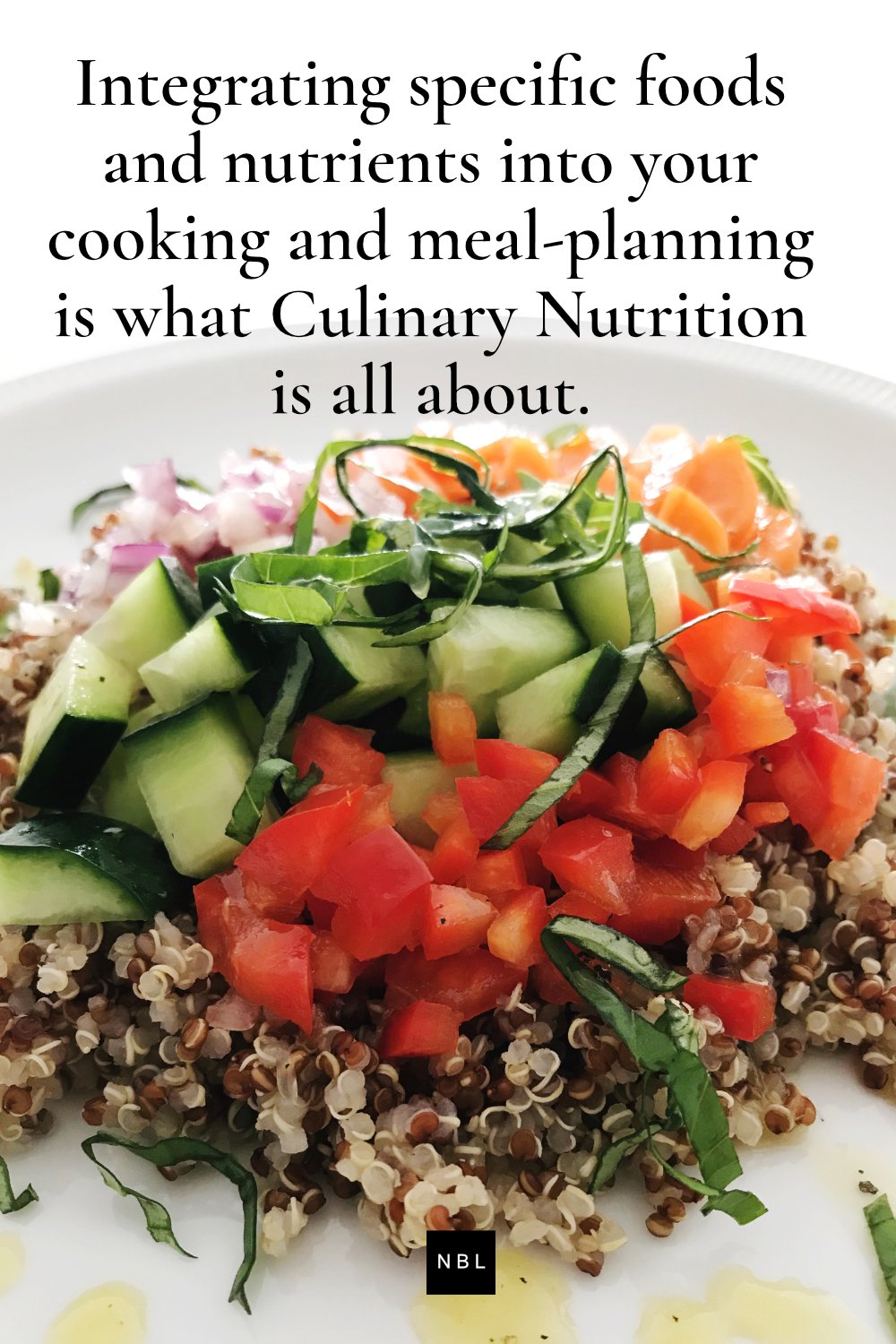
Integrating specific foods and nutrients into your cooking and meal-planning practice is what culinary nutrition is all about.
What culinary nutrition is not about
It is not just about healthy eating.
It’s nutritional therapy grounded in the practice of cooking and meal planning.
Healthy eating isn’t just what you read about in fitness blogs and social media.
It’s actually about the actual practice of good eating habits and especially, getting consciously involved in prepping, acquiring and harvesting of those ingredients.
Nutritional therapy may be academic discourse in one context but in general, all you need to know is that it’s about how your body functions and what it needs for optimal health.
Is it a diet or a practice?
Culinary nutrition is the actual practice of integrating nutritional elements into your eating rituals. And this the rewarding bit – building the knowledge of what you’re consuming and how you’re consuming it.
I know the hardest part of adopting healthy and nutritious habits is having to give up the comfort foods we love because they are not nutritionally beneficial or don’t contribute to building good health — mental or physical.
So, most of us forego the opportunity to at least try a healthy food diet.
Or some of us try it and incorporate too many cheat days, or they binge on the “bad” foods.
Conversely, some take “eating plans” too seriously, with an overzealous approach, and ultimately deprive themselves of certain foods that may be beneficial.
Culinary nutrition is the perfect alternative approach, as it encourages knowledge-building and experimentation through cooking and food preparation.
It is not about a rigid, limiting or eliminating eating regime.
Rather, it is about inclusivity — of all nutritious, whole and fresh foods — and only a small amount of exclusion where the state of health, dependent on the individual or family, demands it.
Furthermore, it does not exclude any particular eating style. Which is a relief – meaning, it’s a cooking and meal-prep style that’s completely versatile and compassionate (actually). How many of you have felt judged or ‘failed’ when unable to keep up with strict diets that promise everything?
Do you have to give up comfort food?
Culinary nutrition works with the way you already like to eat.
It’s a philosophy which subscribes to a mindful, informed and thoughtful — conscious — way of acquiring, preparing and consuming your food.
So, where’s the fun in it?
When it comes to playing around in the kitchen – even if you don’t like to cook – this is an opportunity to learn to cook with raw, whole, fresh and, more importantly, unprocessed food.
The recipes are actually full of surprises and easy to assemble if hard-core ingredient alchemy is not your bag.
It’s really game-changing if you want to create healthy eating habits with staying power.
I don’t believe in giving up comfort food completely. Life is about living fully.
That means indulging in diverse flavours and ingredients and giving in to cravings on occasion.
But, as you know, thoughtfulness — moderation and consideration for our emotions and current state of health — makes all the difference between overindulgence and deprivation.
I advocate for neither of these.
Educating yourself on how to make healthy food swaps for your favourite “comfort” foods means that you can indulge in your favourite meals while not sacrificing optimal health.
It’s about knowledge, not trending appliances.
Knowledge is still power, and if you already love to cook, culinary nutrition will be life-changing in the kitchen.
It will no doubt positively affect other aspects of your life too.
Yes, soon you’ll be slowing down and spending more time outdoors — even if it’s just on your apartment balcony — as you’ll instinctively want to be closer to all things natural.
Disclosure: While this publication uses AI tools for data collection and analysis support, the research questions, hypotheses, and core insights are the human author’s original work. NBL may receive a commission from some referral links mentioned in this article.


